OpenStreetMap logo OpenStreetMap

Users' Diaries

Recent diary entries

Posted by villasv on 8 July 2022 in English.

I was finally able to start reconciling the Vancouver Storefronts Inventory (VSI from now on) and the OSM nodes. VSI has 578 coffe/café matches, OSM has 574. These numbers are so close, it gives me hope.

When searching from nodes in OSM that have a nearby (<10 m) node in VSI, 54 results come out. Of those, 51 are perfect matches (business name in OSM is the same as in VSI, except for things like “Starbucks” in OSM vs “Starbucks Coffee” in VSI). This isn’t too thrilling, but honestly a near 10% perfect match from the get go is pretty sweet.

Using 10 meters is pretty bold, so I’ll experiment a bit on a healthy threshold that gives me more matches but doesn’t yield too many false matches. A 25 m radius already jumps to 391 matches and a 50 m radius gives 705 which is obviously too much.

If I have the time, I should also probably start getting fancy with fuzzy matching business names to get the obvious non-identical matches out of the way so I can investigate proper mismatches.

Posted by ivanbranco on 8 July 2022 in Italian (Italiano). Last updated on 28 April 2023.

Condivido alcuni dei miei tool/siti/app preferiti relativi ad OSM con una brevissima descrizione, compresi quelli più conosciuti (non si sa mai). Sicuramente ne ho dimenticati molti e non ne conosco altrettanti.

Siti

  • overpass turbo: Sito essenziale per fare query sul database. Utile anche per fare filtri QA personalizzati.
  • taginfo: Per controllare quali tag sono più utilizzati, il loro uso nel tempo, i valori più utilizzati per ogni tag ecc. Per la history di un tag esiste anche questo sito.
  • RapiD: iD sotto steroidi. Segnala possibili edifici e strade mancanti.
  • osm-revert: Per revertare interi changeset. (ho sostituito Revert UI, non più supportato).
  • Level0: Per revertare singoli nodi. È un editor testuale utile anche per cambiare svariati tag contemporaneamente. Leggete però questo prima.
  • NotesReview: Per filtrare le note di OSM per utente, data, testo ecc. C’è anche un sito di Pascal Neis.
  • Strade senza nome
  • Disaster Ninja: Non è il suo scopo principale, ma c’è un layer interessante chiamato “Building Quantity” nel caso vogliate trovare zone con edifici da mappare.
  • YoHours: Un sito per semplificare la compilazione del tag opening_hours=*
  • How Did You Contribute: Statistiche riguardanti gli utenti. C’è anche la heat map delle vostre modifiche.
  • Is OSM up-to-date?: Interessante sito creato da un italiano che vi segnala i nodi meno aggiornati. Se non c’è nulla da aggiornare potete comunque lasciare un tag check_date.
  • Field Papers: Modificate OSM prendendo appunti su carta.

Renderer

Wiki

See full entry

本文章同時嘛有提供 English version華語版本

開放街圖臺灣社群(OpenStreetMap 臺灣社群)誠歡喜爭取到維基媒體基金會的聯盟補助,主要欲買兩台 Insta360 One X2 翕相機(佮相關的配件),猶閣有規劃對2022年3月開始,一直到2023年2月的街景踏查團佮對應的編輯工作坊活動。咱欲辦理六擺實地踏查佮至少六擺的編輯工作坊。社群成員欲共360翕相機囥佇汽車車頂,若開車若翕360相片,翕猶未翕著街景的所在。翕了後佇咧電腦前,閣來若看翕的相片,若編輯 OpenStreetMap 共編地圖添加資料,猶有共路途中間經過的景緻佮在庄聚落,共相關相片上傳到 Wiki Commons 多媒體站。

Khai-hóng Kue-tôo Tâi-uân Siā-kûn(OpenStreetMap Tâi-uân Siā-kûn)tsiânn huann-hí tsing-tshú kàu Uî-ki Muî-thé Ki-kim-huē ê Liân-bîng Póo-tsōo, tsú-iàu bueh bué nn̄g-tâi Insta360 One X2 hip-siòng-ki (Kah siong-kuan ê phuè-kiānn), iáu-koh-ū kui-uē tuì 2022-nî 3–ge̍h khai-sí, it-ti̍t kàu 2023-nî 2–ge̍h ê kue-kíng tah-tshâ-thuân kah tuì-ìng ê pian-tsi̍p kang-tsok-hong ua̍h-tōng. Lán-bueh pān-lí la̍k-pái si̍t-tuē tah-tsâ kah tsì-tsió la̍k-pái ê pian-tsi̍p kang-tsok-hong. Siā-kûn sîng-uân bueh kā 360 hip-siòng-ki khǹg tī khì-tshia tshia-tíng, nā khui-tshia nā hip 360 siòng-phìnn, hip iah-bē hip-tio̍h kue-kíng ê sóo-tsāi. hip liáu-āu tī tiān-náu tsîng, koh-lâi nā khuànn hip–ê siòng-phìnn, nā pian-tsi̍p OpenStreetMa kiōng pian tuē-tôo thiam-ka tsu-liāu, iáu-ū kā lōo-tôo tiong-kan king-kè ê kíng-tì kap tsāi-tsng tsu-lo̍h, kā siong-kuan siòng-phìnn siōng-thuân kàu Wiki Commons to-muî-thé-tsām.

這擺踏查團和頂擺行無仝的方向,頂擺是對北海岸(主要是基隆、金山、萬里)的方向行,毋過這擺是對鶯歌、三峽、大溪的方向翕相,和頂擺無仝,這擺是三台車的出發地點攏無仝(筆者駕駛的車是對和運租車新店站出發的,佇出發進前嘛發見路對面的新店區公所站二號出口猶未翕過,所以就順手翕一張囥佇 Wikimedia Commons頂懸)。

Tsit-pái tah-tsha-thuân hām tíng-pái kiânn bô-kâng ê hong-hiòng, tíng-pái sī tuì Pak-hái-huānn (tsú-iàu sī Ke-lâng, Kim-san, Bān-lí) ê hong-hiòng kiânn, m̄-koh tsit-pái sī tuì Ing-ko,Sam-kiap, Tāi-khe ê hong-hiòng hip-siòng, hām tíng-pái bô-kâng, tsit-pái sī sann-tâi-tshia ê tshut-huat tuē-tiám lóng bô-kâng (pit-tsiá ká-sú ê tshia sī tuì Hô-ūn Tsoo-tshia Sin-tiàm-tsām tshut-huat ê, tī tshut-huat tsìn-tsîng mā huat-kìnn lōo tuì-bīn ê Sin-tiàm Khu-kong-sóo tsām 2-hō tshut-kháu iah-bē hi̍p–kè, sóo-í tō sūn-tshiú hip tsi̍t-tiunn khǹg tī Wikimedia Commons 頂懸).

See full entry

Location: 竹崙, 三峽區, 新北市, 23743, 臺灣

This article is also available in Taiwanese Mandarin (台灣華語) and Taiwanese Hokkien / Taigi (台文)


The OpenStreetMap (OSMTW) is pleased to receive the Wikimedia Alliance Fund for procuring two Insta360 One X2 (and accessories), as well as holding at least six Expeditions and Post-expedition Mapping Workshops from March 2022 to February 2023. OSMTW members will initiate surveys to the street-view terra incognita with a 360-degree-camera-mounted vehicle, then edit on OpenStreetMap and upload media taken throughout the exploration to Wikimedia Commons.

The path of this expedition differs from last time and headed south for Yingge, Sanxia, and Daxi rather than the Northern Coast (Keelung, Jingshan and Wanli). The “Street view car” dispatched this time also departs differently. (The vehicle author droves kick off at Hotai Easyrent Xindian, so he took a photo of the unphotographed Exit 2 of MRT Xindian District Office Station and uploaded to Wikimedia Commons before departure.)

Exit 2, MRT Xindian DIstrict Office Station

See full entry

Location: Xinde Village, Xindian District, New Taipei, Taiwan

本文章同時也提供 English version台文版本


開放街圖臺灣社群(OpenStreetMap 臺灣社群)很榮幸爭取到維基媒體基金會的聯盟補助,主要用在購置了兩台 Insta360 One X2 相機(與相對應的配件),並規劃自2022年3月開始,一直到2023年2月的街景踏查團與對應的編輯工作坊活動。將辦理六次實地踏查與至少六次的編輯工作坊。社群成員架設360相機在汽車上面,邊開車邊拍攝360相片,拍攝還沒有人拍攝街景的地方。之後回到電腦前,再來用拍攝到的相片為依據,編輯 OpenStreetMap 共編地圖添加資料,以及將沿途經過的景點與在地聚落,上傳相關照片到 Wikimedia Commons 多媒體站。

這次踏查團跟上次走了不同的方向,上次是往北海岸(主要是基隆、金山、萬里)的方向走,而這次是往鶯歌、三峽、大溪的方向拍攝,與上次不同的是,這次三台車的出發地點都不同(筆者駕駛的車是從和運租車新店站出發的,在出發之前也發現其對面的新店區公所站二號出口尚未拍攝,所以就順手拍了一張放到 Wikimedia Commons上)。

新店區公所站二號出口
新店區公所站二號出口

走的路線也幾乎都不一樣(但中間還是設了會合點,是在三峽白雞山的行脩宮)。

See full entry

Posted by villasv on 7 July 2022 in English.

Getting familiar with the Vancouver Storefront Inventory dataset. Apparently there are around 578 businesses with names that include Coffee or Cafe/Café, which looks pretty good. Judging by name only is pretty unreliable, but at least the vast majority of the matches are in the Food & Beverages category which is reassuring.

By chance, one of these businesses is already permanently closed (according to other sources): Café Logos. It was literally the first one I randomly selected to investigate, and it’s already data that should not be imported to OSM. Oh well. This is going to be tough.

On the OSM front, today I learned how to use the BigQuery dataset that has a handy table containing the OSM areas/ways as GDAL objects, which I can use to further sub select the nodes that are inside the region of interest (Vancouver) using ST_DWithin.

Posted by alexkemp on 7 July 2022 in English. Last updated on 20 July 2022.

My last fortnight has been spent updating the photo-URLs within these diaries of pictures that I’ve taken whilst mapping. By default the Mapillary page will normally show a small version of any photo in it’s GIS-database, whilst behind it is a map using OSM-mapping; here is an example of that, showing the front of a business called AST, as it was displayed in a 12 July 2019 diary.

In the past the owner of the photo — the person that uploaded it to Mapillary — was given a button that would give them a URL that allowed them to download the raw file of the original photograph. That was useful for webpages such as these diaries, since it allowed the photograph to be displayed. However, Mapillary has changed it’s policy on the usage of those download URLs.

At some time in the past Mapillary changed the URL format for both map-display pages & download-file pages. The original map-display URLs had the following format (1st line below) whilst the download-files were 2nd-line below (the IDs in each URL were identical for a specific photo):

  • https://www.mapillary.com/map/iM/<12-digit-alpha-ID>
  • https://d1cuyjsrcm0gby.cloudfront.net/<12-digit-ID>/thumb-2048.jpg

Mapillary changed the format to the following (sorry about this):

  • https://www.mapillary.com/app/?pKey=<16-digit-numeric-ID
  • https://scontent-man2-1.xx.fbcdn.net/m1/v/t6/<150-digit-alpha-ID>?stp=s2048x1152&ccb=10-5&oh=<61-digit-alpha-ID>&_nc_sid=122ab1

Mapillary also made 3 crucial extra decisions:

  1. The map URL would auto-rewrite via a 302 between the old & new format
  2. The old Download URL would NOT rewrite to the new
  3. The new Download URL would timeout after 14 days (or maybe less) (appears to be just 2 days)

Thus, after 14 days of trawling through every relevant page & changing all relevant URLs the photos are still not showing. I’m not happy.

And here the relevant photo to see what happens:

See full entry

Posted by alexkemp on 7 July 2022 in English. Last updated on 8 July 2022.

I tried to launch JOSM for the first time in a little while & got the error:

failed to execute josm-latest no such file or directory

It had worked fine the last time I used it & had been continuously updated every since.

Searching for the Fix

An internet search did not reveal anyone reporting the same error, but did point me towards the GitHub site (more on that later, with the eventual fix at bottom of this diary post). Searching the computer did not help much, but it did reveal the .desktop menu file:

$ locate josm-latest
/etc/default/josm-latest
/usr/bin/josm-latest
/usr/share/applications/org.openstreetmap.josm-latest.desktop
/usr/share/josm-latest/josm-latest.jar

My local .desktop menu file is identical to the GitHub-code latest .desktop file. I tried running the exec-line in that file from a console (I work under Devuan, which is a Linux distribution):

$ josm-latest %U
bash: /usr/bin/josm-latest: /usr/bin/bash: bad interpreter: No such file or directory

Here is the reason why:

$ file /etc/default/josm-latest
/etc/default/josm-latest: ASCII text
$ cat /etc/default/josm-latest
# Options to pass to java when starting JOSM.
# Uncomment the JAVA_OPTS lines to enable their use by /usr/bin/josm-latest

# Increase usable memory
#JAVA_OPTS="${JAVA_OPTS} -Xmx2048m"

# Enable OpenGL pipeline (2D graphic accelerators)
#JAVA_OPTS="${JAVA_OPTS} -Dsun.java2d.opengl=True"
$ file /usr/bin/josm-latest
/usr/bin/josm-latest: Bourne-Again shell script, ASCII text executable
$ head -1 /usr/bin/josm-latest
#!/usr/bin/bash
$ la /usr/bin/bash
ls: cannot access '/usr/bin/bash': No such file or directory
$ which bash
/bin/bash

(translation): Neither josm-latest provided within the latest JOSM is fit for purpose:

See full entry

Wikidata is a free knowledge base for linked open data designed to support Wikipedia and its sister projects, such as Wikivoyage. It contains over 97 million entries structured as a “Labeled Property Graph,” which is more powerful than RDF-based graphs. Like OpenStreetMap (OSM), Wikidata (WD) is an open crowdsourcing project with a large and active community.

Since 2014, OSM can be linked to WD through its tags. Currently, there are about 5.5 million such Wikidata tags with steadily growing popularity. These links can be used to create interesting products, for example a map with castles enriched with factual data from WD. However, the quality of these manually captured links in OSM is as yet unknown and untested. One must also note that the preferred way from WD to OSM - the other way around - is to use only coordinates (WD property P625) - i.e., no WD properties such as P402 are to be used because this covers only OSM relationships.

Now, two computer science students, Jari Elmer and Timon Erhart, from the University of Applied Sciences of Eastern Switzerland (OST), with the help of Sascha Brawer - a young software engineer in “un-retirement” and Wikipedian - have developed an application called “osm wikidata quality checker”. The goal was to check the existing links from OSM to WD. The errors found - for example invalid WD entries in OSM - are also sent to osmose with a suggested correction. Osmose is a quality assurance tool for detecting problems in OSM data. The goal of the application was to become an integral part of OSM’s quality assurance ecosystem. It handles the large amounts of data in the two databases (about 1.5 TB each).

See full entry

Location: Rapperswil, Rapperswil-Jona, Wahlkreis See-Gaster, St. Gallen, 8640, Switzerland

Date - 07/06/22
Time Spent - 0.75 hrs Activity:
1. Trying to decide focus of next steps. Pedestrian footpaths or Lane mapping accuracy?
2. Tried to evaluate if small improvements to pedestrian footpaths can make it easier for kids/parents to walk to school?
Notes:
Used geojson.io to create a map_potentialwalkway.geojson trace to see where a footpath trace can be drawn. More to come about this exercise.

Location: Northwest Columbus, Columbus, Sharon, Franklin County, Ohio, 43235, United States
Posted by Harry Wood on 6 July 2022 in English. Last updated on 7 July 2022.

Next week we’re having an OSMLondon pub meet-up for the first time in a while. Or at least I am. People don’t seem to like setting themselves as “attending” on osmcal.org, but I don’t think I’ll be alone in the pub. Looking forward to it anyway!

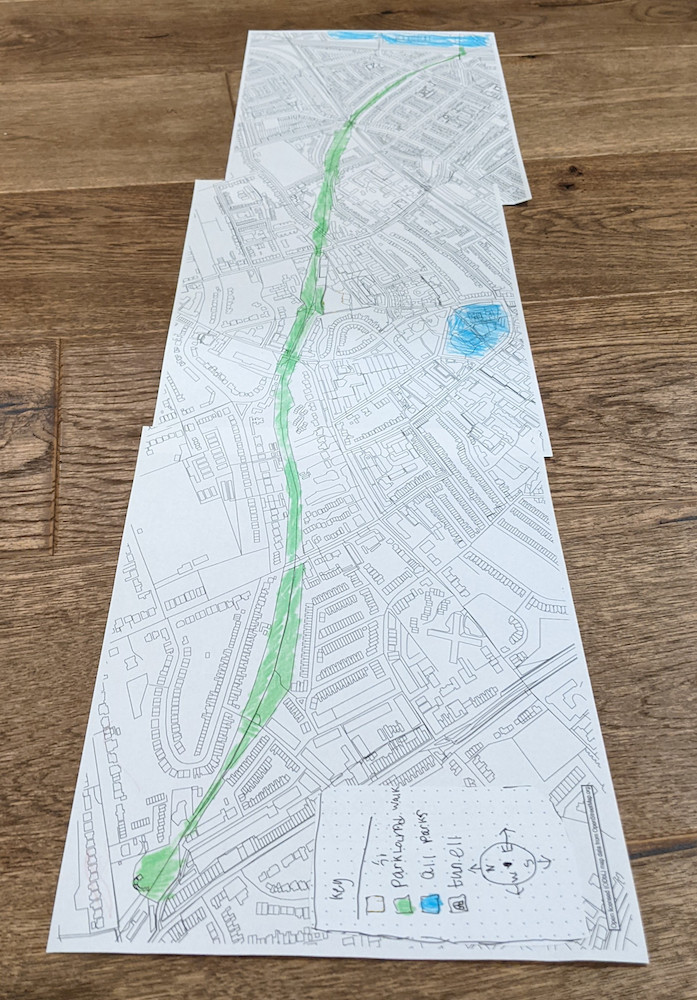
Today I wanted to print out a map of “Parkland Walk”, a local nature trail (and former railway). This was a project for/with my 6 year old son, which I spent a bit longer on than I should have today. In his class they’re doing various activities related to Parkland Walk. I thought it would be fun to give him a big map in style which he could colour in.

parkland walk map printout

See full entry

Location: Crouch End, London Borough of Haringey, Greater London, England, N8 9SU, United Kingdom
Posted by b-unicycling on 6 July 2022 in English. Last updated on 12 July 2022.

I’m preparing a video tutorial on thatched buildings - it’s dead simple, but it’s an interesting topic, I thought. So I was doing a bit of research trying to learn something about local thatching traditions and came across a 1994 survey by - it turns out - a thatcher. I only came across one volume which is basically a photo album of 106 thatched buildings in Co. Kilkenny with handwritten captions given the location. Location being in most cases the townland. But because it is handwritten and because this is Ireland, I have not been able to identify all the townlands.

What I’m doing now is trying to find the townland and trying to identify the building. Most times, if there are other buildings in the picture, it is possible to spot them in the townland by comparing the arrangement of buildings. Luckily, most buildings in Co. Kilkenny are mapped thanks to our #osmIRL_buildings project. And luckily, those are mostly old buildings, so I don’t have to worry about them being built since 2019. The National Index of Architectural Heritage is somewhat helpful in that they have indexed some of those buildings, but not all. They have a map where you can find a blue dot for those marking the spot. However, they are not always correct. They also have pictures of those buildings (sometimes also the wrong ones) which I can compare to that survey/ photo album. Sometimes, rarely, because those are very rural areas, I have mapillary to work with.

If they are not too far away and accessible for a non-driver like me, I’ll go and check them out in situ, take mapillary and a photo or two for Wikimedia. #OpenData, baby!

You can kind of see on Esri World Imagery (Clarity) Beta, whether it is thatched or a slate roof, because the thatched roofs have smoother corners and the colour is a bit different.

See full entry

Location: Knocktopher Manor, Knocktopher, The Municipal District of Callan — Thomastown, County Kilkenny, Leinster, Ireland
Posted by villasv on 6 July 2022 in English.

I have an endgame in mind, which is having a complete walkability study on a bunch of major cities in the world, which competes in quality with walkscore.com but it’s fully open data.

That’s too grand for me to accomplish in a year of less-than-part-time effort. So I’ve decided to scope it down to a single city I care about, which is Vancouver. How hard can it be to analyze walkability in a single city? Well, pretty damn hard actually.

The very first thing I’d like to consider analyzing walkability is proximity to amenities like cafés, markets and pharmacies. Turns out OSM seems to have pretty good coverage on shops in Vancouver already, but for me to be very confident on my analysis the study stars with an evaluation of data coverage.

If I’m going to compare OSM with an official source, say Vancouver’s Storefront Inventory, whatever the coverage might be… I might as well import what’s missing? I think I owe OSM this much, and it will be nice to say that the whole data used in the walkability study is from OSM instead of from multiple sources.

The thing is, my past experience with data imports is limited to a single one I made for Wikidata of Higher Education Institutions in Brazil, and it took a whole month to finish it. I had more tooling available (OpenRefine is very integrated with Wikidata), more time available (5 years ago I had more energy) and the data was much more straightforward (no mapping involved, just categorization)…

Considering all that, I’d estimate it would take me about 3 months to import the whole thing following proper procedures. So I’ve decided to scope it down once again, to a subset of the data that I can reasonably scan through manually. I’ll start with coffee shops / cafés only. That I think should bring the estimate back down to a single month or so. Hopefully.

Date - 07/05/2022
Time Spent - 1.5hrs
Changeset - #123254900
Activities:
1. Focused on improving junction and road definition at Bethel Road & Pickforde Dr.
2. Split Bethel Road and Pickforde Dr. by adding nodes.
3. Added lane information for Bethel Road and Pickforde Dr. going into and out of intersection.
4. Reviewed turn assignments at junction. They look okay.
Notes:
It was difficult to understand the correct approach to mapping a junction. The OSM Wiki documentation can benefit from additional examples and best practices.

Location: Columbus, Franklin County, Ohio, United States

In my last diary entry I wrote about putting the requested note ids into url. I said that it’s likely not going to be a problem because ids are stored in the url part that’s not sent over HTTP therefore it doesn’t matter how long is this part, how many ids it contains. That was said about a typical output of neis-one.org note feeds for countries that contain updates dating back up to a week. For a busy country that’s usually a few hundred notes. Concatenated with single-character separators they result in a few thousand character string appended to a url.

Feeds are not the only way to get note ids from neis-one.org. In fact you may no even want to get notes from the feeds because of their one week age limit. There are regular html pages for each country too, one for all notes, another for open notes. They likely contain more notes than the feeds do. The open notes pages, which are of interest to someone who wants to resolve notes in a given country, can have up to ten thousand notes. I added options to open those with note-viewer, along with arbitrary html files. The last two options in the neis-one.org Get … notes for this country dropdown of the XML tab set up the selector (cells in second columns of tables from neis-one.org webpages) and open the webpage that you have to save to a file and then open that file with note-viewer. Unlike the xml feeds, even Firefox won’t start the download automatically.

See full entry