OpenStreetMap logo OpenStreetMap

Users' Diaries

Recent diary entries

Posted by Komadinovic Vanja on 4 November 2021 in English.

create new app ( osm.org/oauth2/applications/new )
set callback url ( must be https if not 127.0.0.1 )
client id and secret will be presented ( secret only once )

to obtain authorization code from browser go to
https://www.openstreetmap.org/oauth2/authorize?client_id=<Client ID>&response_type=code&redirect_uri=<Callback url encoded>&scope=write_api%20read_prefs%20write_notes

when user authorize access callback will be called like
https://localhost:7077/oauth2/callback?code=<Authorization Code>

exchange Authorization Code for access token, POST
curl -d "" 'https://www.openstreetmap.org/oauth2/token?grant_type=authorization_code&code=<Authorization Code>&client_id=<Client ID>&redirect_uri=<Callback url encoded>&client_secret=<Client Secret>'

access token will be returned as json, use it for API calls
curl -H "Authorization: Bearer <Access token>" 'https://api.openstreetmap.org/api/0.6/user/details'

resources to read:
https://aaronparecki.com/oauth-2-simplified/
osm.wiki/OAuth

Uzoefu wangu katika teknologia ya jeografia umeniwezeha kuchangia majengo mengi katika mji wa ifakara ulipo Morogoro, Tanzania.

watu wengi hawafahamu njia hii rahisi kusaidia jamii zao hususani kwenye jamii maskini ambazo mara nyingi hu athiriwa na majanga kama mafuriko.

openstreetmap ni moja wapo wa jukwaa ambazo humpa mtu uwezo wa kuchangia kwa kuchora ramani za maeneo tofauti kama nyumba na barabara. Kupitia jukwaa hili watu tofauti katika kila fani hutumia taarifa hizi kusaidia jamii hizi.

nitaendelea kutumia OSM kuwezesha faida hizi kwa jamii zetu, wewe je?

Location: Lipangalala, Ifakara Town, Mkoa wa Morogoro, Coastal Zone, Tanzania

Pesos Pesados

Caminho dos Grandes

Devido a relatos frequentes que ouço de motoristas de veículos pesados, tais como caminhões, ônibus (Double Decker / Low Driver), entre outros, sobre a incidência de acidentes ao passarem por pontes baixas, ou por ter um caminho inadequado apontado seja pelo OSRM ou outro qualquer, que desconsideram a altura do veículo. Decidi realizar algumas ajustes em um ponto específico “setando” as alturas das pontes, para tentar evitar tais incidentes.

No exemplo do link acima, caso um Ônibus Double Decker que possui 4,1m altura passar pela via de acesso à Ponte da Casa Verde que possui 4,3m, sobra apenas 20cm (pouco mais que a altura de um celular), medida esta, que se houver alguma ondulação de pista, infelizmente o teto do carro será danificado.

PS: Caso alguém se interessar pela ideia, e quiser ou puder testar, tamo junto!

Location: Imirim, Santana, São Paulo, Região Imediata de São Paulo, Região Metropolitana de São Paulo, Região Geográfica Intermediária de São Paulo, São Paulo, Região Sudeste, 02467-120, Brasil
Posted by grin on 3 November 2021 in English.

Real Time Kinetics (RTK)

For half a year now I’m walking, biking and generally moving accompanied by an uBlock F9P unit, which is a precision multichannel GPS receiver board with an external antenna and bluetooth connection to my mobile phone. The phone receives correction stream (NTRIP) by mobile net and uploads it to the unit, which in turn uses the correctional data to fix up atmospheric noise in the GPS signal.

The result is a GPS position way more precise than a phone.

There are 3 usual states:

  • RTK - or “Real Time Kinetics”, when there is both satellite and internet data is available, and the base station of the stream is near. It means precision between 50 centimeters up to 5 centimeters! Imagine it like not only it’s visible when I go to the other side of the path but the track even show when I turn around, since my backpack makes a 30 cm circle around. :-)
  • FloatRTK - is when the precision “floats” from a known-good position, which in practice mean 1.5 meters up to about 90 cm (on average 1 m). When I am within 100-300 km of a base station and I’m moving in a forest this is the most usual state.
  • DGPS - when there is no RTK fix (usually due to no mobile network or blocked satellite receiving) the “normal” differential receiving mode is active, which means 3m - 1m precision, closer to 1.5 m on average, thanks to the external antenna and multichannel receiver.

When I am on FloatRTK or RTK it’s amazing: it can get back to the same position everytime, later on the day, or on a different day, which basically mean that the position is exact. I can draw a track with 50 cm precision and try not to draw that much detail on OSM (not to make anyone mad seeing fixes of centimeters along :-)).

See full entry

I’m editing OSM with JOSM for many years now. After so many years, the UI of it is still something that kinda throws me off, it feels quite clunky at times, not all icons do make as much sense, and it’s not consistent with other editor tools.

But what kinda grinds my gears, is that after so many years, it still can’t do hardware acceleration.

Yes, I’m an nVidia pleb, but it’s something I feel like I must roll my eyes round every time I use this. Given a fast enough CPU it at least still works, but having more complex graphical things work better in a browser, is kinda saddening.

On one hand I feel kinda entitled to tell people to “fix it”, but then again, I should probably look into it myself, I don’t know. I think it’ll be next to impossible to fix anything in JOSM. Last time I’ve checked, the codebase is a little all over the place. That, and it’s also just too big. But there are a bunch of things that I’d like to have changed, I guess. On the other hand, iD is also quite annoying at times, but fixing tags presets with it, is whole lot more convenient than in JOSM.

Perhaps one day, the Java gods will have mercy and fix JOSM for us…

今天上午,CCTV13新闻频道新闻直播间播出了航空国家安全反间谍内容,主要讲有人使用设备监测中国飞机信息数据,危害了中国国家安全。其中播出了使用OSM作为底图的某航空信息网站,还把视角停留在东南某海峡(并没有打码,这居然公然播出在国内属于问题地图的地图了,应该是没有发现)。 提醒各位身处中国大陆的地图绘制者,特别是个别爱到处画军事区的人,以后不要再标、画军营了(有的居然把兵种和番号都标出来了,你给谁看呢?),反正平民对于这些信息是不需要的,如果哪天被政府发现了,把OSM墙了,这些人都要负责嗷。

In San Francisco, several roads are marked as having sidewalks, which is normal and good. But I notice some (like Van Ness Avenue here) are marked with foot=yes as well. Even though you clearly shouldn’t be walking around in the actual busy street.

This seems pretty wrong? Being marked as having a sidewalk should be enough for routers. As a bonus, the sidewalk is double-mapped, and Van Ness should be marked sidewalk=separate, I think.

I see a lot of this in SF, which is why I’ve been hesitant to fix it. But I can fix this, right?

Location: Russian Hill, San Francisco, California, 90214, United States
Posted by DUGA on 29 October 2021 in English. Last updated on 10 July 2022.

Maybe someone is trying to steal the name here by deleting and readding things at the same time. They have similar profile descriptions almost can be identified as fake/illogical. They share similar behaviors and may even be able to write a diary.

However, they have received blocks in the history:

@NorthwestPAmapper (we caught this account churning in Maryland by deleting a whole shopping mall with surrounding area and failed to readd back after 3 days).

@theurbanexploringman

@buildingroadfixer12

@ZenithTheFox

@Jakethedog2004

I assume that some laymen residing in that area are willing to join and improve the project, but the repeated similar behaviors prompt me to believe that it is abnormal.

If anyone above thinks that you are being offended, please reply and tell us why you keep churning. Seriously speaking, I wish to know the benefits as well!

Location: Waterford Township, Erie County, Pennsylvania, 16441, United States
Posted by Kento Kei on 29 October 2021 in English.

For months now I’ve been wanting to properly do the Zoning and Land use of Madison county, but I’ve finally got around to doing it. I plan on beginning with farmlands around the northern half of the county in order to fill up a lot of the empty space. I do hope that once I begin to add in residential, commercial, industrial, and retail areas into the metro east, More people would begin to add things in the region, seeing I want to get the region to be more active by adding things that people would not really know how to do first thing.

For folks who would want to add some road names in Klang Valley, we have an interesting maproulette challenge for you! These are for mappers who are a little experienced. Here’s where you can get started: https://maproulette.org/browse/challenges/23131

image

Put your mapping hats on and let’s do some mapping!

We would love to hear your suggestions and feedback on these tasks so that we could better next time.

PS: Can’t wait to see who is going to be on top in this challenge (psst.. We have some goodies for you) 😉

Happy Mapping!

Posted by SK53 on 26 October 2021 in English. Last updated on 7 November 2021.

A few weeks ago TrekClimbing asked on talk-gb about tagging various types of vegetation. He has documented some of the more problematic ones on the wiki.

The usage of natural=heath in the UK has not been particularly consistent, and his examples confirmed this. The situation is not helped because large swathes of natural=heath were added by a single mapper. Although doubts were expressed at the time, no-one was confident enough to say that such mapping was wrong.

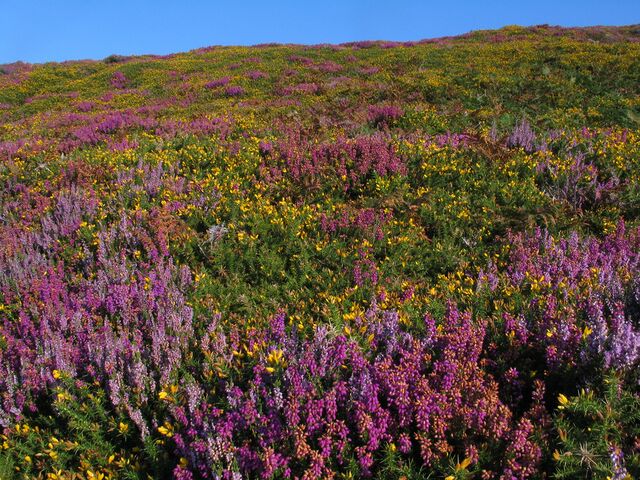
Classic dry heath at South Stack, Anglesey Colourful late summer heath at South Stack

I have been aware that in upland areas of Great Britain natural=heath includes things I would describe differently. Notably these include : upland acid grassland used for rough grazing (mainly of sheep) and blanket bog.

It occurred to me that by comparing OSM data with another source would quantify this impression. Fortunately, a suitable source exists for Wales: Phase 1 habitat data.

See full entry

Location: Betws Garmon, Gwynedd, Wales, United Kingdom
Posted by Mordechai23 on 26 October 2021 in English. Last updated on 4 July 2022.

This is a collection of gifs illustrating the process of me and other mappers redrawing landuse, buildings, paths and other objects in my home city - Wrocław

Most gifs represent the state of OSMcarto immidiatelly before and after the main bulk of my edits in the area and thus may not include later changes made by me or other contributors

Current goal is to revise the core city centre of Wrocław and then possibly other densely populated areas. I focus on realigning and correcting the geometry of existing buildings and adding missing footways, driveways, green areas and landuse, while ignoring the City’s street grid and POIs

Those edits are mainly based on areal photos from 2018 and 2021, complimented by photos from fotopolska.eu and of course my own observations made while strolling around ;)

Why?
  • First of all, before my edits there was next to none landuse in the city centre and not much more in the suburbs.
  • Secondly, most of buildings here are remnants of an old, poorly executed import and are often misaligned, crossing each other or were simply demolished since 2011. Some buildings were broken down into small parts without using building:part tagging
  • But most importantly, we’re observing a big influx of new users contributing via StreetComplete and other similar tools. Those users often edit the old, problematic buildings, with huge issues with geometry, potentially causing problems later. By replacing those, I try to provide more meaningful challanges for those users to complete ;)
Progress (finished 04.07.2022): 149/149 areas, 100% done 🎆

See full entry

Location: Four Denominations District, Stare Miasto, Wrocław, Lower Silesian Voivodeship, 50-073, Poland
Posted by bdon on 26 October 2021 in English.

When working with OSM it’s generally fair to assume that textual data, like tag values, are encoded in UTF-8. Without this assumption, multilingual mapmaking would be almost impossible - custom fonts or browser settings would need to be specified for every language when displaying geocoding results, routing directions or map labels.

As part of the newly resurrected Engineering Working Group, I’m investigating ways to improve OSM’s software ecosystem. One of the top tasks for the EWG is localization, and standardized text encoding is a prerequisite for this, but OSM does not enforce any particular encoding as policy.

Where is the non-Unicode data?

The most obvious instance of non-Unicode in OSM is the Zawgyi encoding for Burmese text. For background on Zawgyi, see this post on the civil war between fonts in Myanmar.

The default Mapnik-based rendering on OpenStreetMap.org, openstreetmap-carto, uses Unicode fonts. Zawgyi-encoded tags appear obviously garbled on the map, with the combining mark ◌ visible:

See full entry

Location: 觀音山, Zhongzheng District, Gongguan, Taipei, 10091, Taiwan