OpenStreetMap logo OpenStreetMap

Users' Diaries

Recent diary entries

Posted by wielandb on 12 May 2022 in English. Last updated on 16 May 2022.

I did some statistical evaluation around StreetComplete, and in this post I describe what I evaluated and what the results are.

(This post is more or less the english text version of this YouTube video, which is in german. There is also a german version of this post here.)

First of all, how did I evaluate this data, or rather, where did I get all the info I’m talking about here? The basis was the StreetCompleteNumbers script that I wrote some time ago. It’s a Python script that can be used to find out the number of solved quests for a user. The script is also available on GitHub. One can use this script very easily:

from StreetCompleteNumbers import StreetCompleteNumbers

StreetCompleteNumbers("wielandb")

Then we just had to find out who are the users whose StreetComplete numbers we want to download. I tried to develop a method that makes as small a number of requests to the OpenStreetMap servers as possible. So simply downloading the entire changeset history for every user I come across should be avoided. I was using the daily replication diffs since October 2021 (so since half a year ago). I downloaded every diff file, and looked at every changeset that occurred in it. If a changeset contains the changeset tag StreetComplete:QuestType, I trigger a download and save of its numbers for that user. Also, the program remembers for which users it has already saved StreetComplete numbers, so that they are not downloaded twice for the same user.

So I ended up with StreetComplete numbers for 5284 users, which was my database. And so we came directly to the first limitation of this evaluation. Only users who solved at least one StreetComplete quest between October 2021 and March 2022 appear in this statistic.

Before we get to the statistics, it should be said that I do not want to name any users in this evaluation, so we will only see the countries of the top users. So, let’s get to the statistics now:


How many ★ do the top users have?

See full entry

Ich habe ein paar statistische Auswertungen rund um StreetComplete gemacht, und in diesem Post beschreibe ich was ich Ausgewertet habe und was die Ergebnisse sind.

(Dieser Post ist mehr oder weniger die Text-Version von diesem YouTube-Video.)

Zunächst einmal: Wie habe ich diese Daten ausgewertet, bzw. woher habe ich all die Infos, über die ich hier rede? Grundlage war das Skript StreetCompleteNumbers, dass ich vor einiger Zeit geschrieben habe. Es ist ein Python-Skript, mit dem man die Anzahl der gelösten Quests für einen Nutzer herausfinden kann. Das Skript gibt es auch auf GitHub. Dieses Skript kann man sehr einfach verwenden:

from StreetCompleteNumbers import StreetCompleteNumbers

StreetCompleteNumbers("wielandb")

Dann galt es nur noch herauszufinden, wer denn die Nutzer sind, deren StreetComplete-Zahlen wir herunterladen wollen. Dabei habe ich versucht eine Methode zu entwickeln, die eine möglichst kleine Anzahl an Anfragen an die OpenStreetMap-Server stellt. Also einfach für jeden Nutzer der mir unterkommt die gesamte Changeset-History runterladen sollte vermieden werden. Ich nutzte die täglichen replication-Diffs seit Oktober 2021 (also seit vor einem halben Jahr). Ich lud jede diff-Datei herunter, und sah mir jedes Changeset, dass in ihm vorkommt, an. Sollte ein Changeset den Changeset-Tag StreetComplete:QuestType enthalten, löse ich für diesen Nutzer ein herunterladen und abspeichern seiner Zahlen aus. Außerdem merkt sich das Programm, für welche Nutzer es schon StreetComplete-Zahlen abgespeichert hat, damit sie nicht zweimal für den selben Nutzer heruntergeladen werden.

Dadurch hatte ich am Ende die StreetComplete-Zahlen für 5284 Nutzer, was meine Datenbasis darstellte. Und so sind wir auch direkt bei der ersten Limitierung dieser Auswertung angelangt. In dieser Statistik tauchen nur Nutzer auf, die zwischen Oktober 2021 und März 2022 mindestens eine StreetComplete-Quest gelöst haben.

See full entry

Just a question, when searching for any substation. As an example, here is Pembroke Substation:

relation/13110367

However searching using the words “Pembroke Substation” returns significantly wrong results ie: in Bristol, Dublin, and even Florida!

The Name field is spelled correctly as “Pembroke Substation”, copy/pasting these exact words from the Name field into the search bar still can’t find it.

I have only been researching substations in South Wales so far, and they all have had good accurate naming, and are wither a Way if a single entity, or a Relation if more than one Way is used.

Is there a setting somewhere to enable this search? Maybe someone could drop me a message.

Many thanks, Scott

Posted by SLMapper on 12 May 2022 in English.

Introduction

Hi, this is my first osm blog post :-)

Recently I stumbled upon some large areas that where mapped as forest, but Bing aerial imagery showed just a bleak, empty space. I was irritated first, shocked right after - having some thoughts about the earth climate in mind. Only some time later recognized: “Ok, wait. What do you think where your furniture comes from? This kind of thing has to happen. These are actually reneable resources.”

bing

Album, comparing Bing, Esri and Esri Clarity imagery

Checking sources

See full entry

Location: Dumfries and Galloway, Scotland, United Kingdom
Posted by Zverik on 11 May 2022 in English.

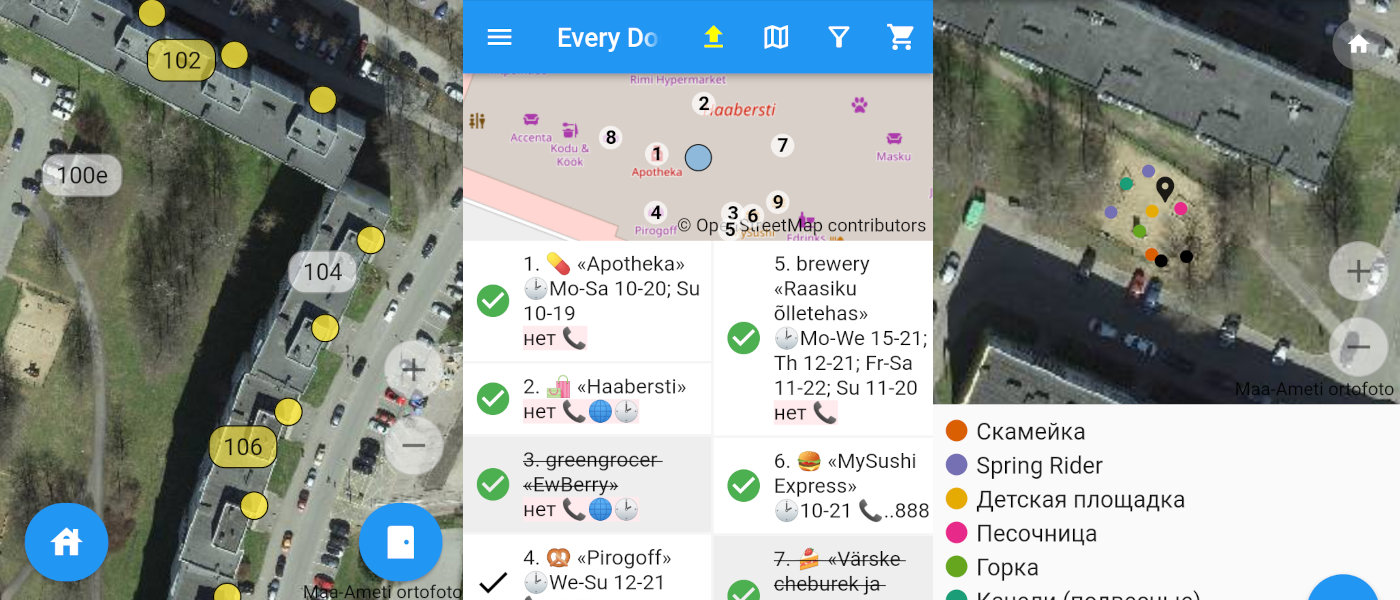
Three screenshots of the editor

Today I’m proud to present my new OpenStreetMap editor. It’s called Every Door and works on both iPhones and Androids. I shared the idea last Summer at a State of the Map, but started writing just late October. In the last month and a half thirty people made ten thousand edits with the editor and helped make it much better. Now I’m launching the open testing.

The official website has links to TestFlight and Google Play, a short video, and a FAQ.

I’ve got just one feeling: at long last. One way or another I was suggesting something like that for OSM since 2013. Made a failed attempt with OpenSurveyor. Watched with hope for big company projects with paid developers — but all these have disappeared. In this time we’ve got one amazing StreetComplete, which I like a lot, although it’s not for me.

See full entry

Вчера проехался на запад от дома. Заехал на пруд Кунцевщина, заехал на островок. Хорошее место для шашлыка, правда людное. Заехал на заправку взял выпить и решил проехать по путепроводу через МКАД на водоотстойник (Очистное сооружение дождевой канализации районов Красный бор и Сухарево). До путепровода было далеко. Проехал под мостом, пересек поле и выехал к пруду №3 Дививелко. Объехав вокруг водоотстойника решил отдохнуть на пригорке, понаблюдать за закатом.

Location: Сухарево, Фрунзенский район, Минск, 220059, Беларусь

Now that the weather is more welcoming, i.e. dry, I’ve gone back to mapping walking and hiking trails in my area. I had done that before, either added the trail completely new as a relation with all that’s included, sometimes just added the trail markers, where the trail was already mapped. Most times, I try to do mapillary as well, sometimes just with the phone, sometimes with a 360° camera.

Today, I went to map the O’Gorman’s Lane Loop which is only a 4km walk (that is if you don’t get lost…), but it meets another, longer trail which was already mapped. But anyway, I ran into an American couple, Don and Kim who are exploring Ireland on rented motorbikes, but are also avid hikers and have hiked across the Czech Republic, Germany, Switzerland etc. Don was telling me that he has this app maps.me which shows all the trails and it’s free! And I said, well, it’s people like me who add those trails to OpenStreetMap which in turn adds it to your app. We parted ways, but I had a suspicion that I would run into them again after in the only café in the village. And I did. I walked up to them and gave him an openstreetmap.ie sticker (always handy in any bag I carry around). Once I had taken off my backpack, he could see the “OpenStreetMap surveyor” on my high viz vest, and the penny dropped. He had loads of questions and all the right ones, so I joined their table and chatted away with him.

He said that he wanted to map all the benches along the Camino. :D (We had noticed earlier that there are never enough benches along hiking trails in Ireland.) He also wants his name on one of those benches, and I explained that those little plaques can be added to OSM as well. He was very impressed, I think. They wanted to pay for my scone, but I had already paid. But we decided to share a taxi back, even though I would have been fine on the bus, and had told them about the bus as well.

See full entry

Posted by Lawi_Gn on 10 May 2022 in French (Français). Last updated on 10 October 2022.

Que fait habituellement Moussa DIALLO avec OpenStreetMap?

Moussa Diallo aime les cartes et Internet. Il estime que les données géographiques sont une plate-forme essentielle en tant que telle, devraient être gratuites, il fait donc sa part. Moussa Diallo cartographie principalement la Guinée, le Mali et le reste du monde. Vous pouvez consulter sa page utilisateur OpenStreetMap , ses traces GPS et bien sûr ses modifications OpenStreetMap sur lesquelles il y a un résumé statistique pratique et une belle carte.

Quelles régions du monde cartographie-t-il?

Moussa Diallo vit à Nzérékoré. Il cartographie son environnement, les lieux qu’il connaît bien et tout ce qui se trouve sur son chemin et de ses courses quotidiennes. Moussa Diallo cartographie parfois aussi d’autres régions où il voyage, notamment les sous régions qu’il connaît le mieux. Il adore l’Afrique et la Guinée en particulier pour les occasions d’améliorer les cartes des lieux qu’il affectionne, notamment Conakry, Kankan et Nzérékoré.

Quels outils utilise-t-il?

Moussa Diallo recueille des traces GPS à l’aide d’un OsmAnd. Les outils de post-production incluent Go Map et StreetComplete.

Moussa Diallo joue avec des application de production des données sur Android mais fait presque tout son Mapping en utilisant JOSM. Anciens projets Moussa Diallo a commencé à travailler OpenStreetMap depuis avril 2017.

Je veux en savoir plus sur Moussa Diallo

Moussa Diallo se cache sur Twitter, LinkedIn, Facebook. Vous trouverez également la page de l’ONG FreeLocalMappers.

See full entry

Iniciamos no setor de Geoprocessamento da Prefeitura Municipal de Jaraguá do Sul a 12 meses atrás a migração e sobreposição no OSM das edificações através do JOSM - Editor Java do Openstreetmap de 72.678 edificações que recebemos a partir da restituição aerofotogramétrica contratada pelo município de Jaraguá do Sul em março de 2020. Iniciamos esse trabalho de atualização na área central da cidade e avançamos para atingir todos os 38 bairros e as 15 localidades rurais que compõe o Município. Para esse trabalho contamos também com a participação de vários Bolsistas e estagiários de Engenharia Civil e Arquitetura que desenvolveram também essa atividade durante o tempo que estiveram no setor de Geoprocessamento. Outro editor que também foi usado com bastante frequência foi o Editor iD - Editor no navegador web do OSM utilizado para demais atualizações como número de edificações e seus vários tipos de usos, etc. Queria deixar registrado que as ferramentas mais usadas no JOS após a importação das edificações em blocos foi o plug coloured streets para colorir as edificações com números já existentes no OSM, facilitando o uso da ferramenta Substituir Geometrias, e da configuração de seleção de nós e tags. Também utilizamos no JOS a URL de configuração de serviço TMS/XYZ:https://www.jaraguadosul.sc.gov.br/geo/ortomosaico2020/{z}/{x}/{y}.png mosaico de ortofotos da mesma contratação citada acima. É Importante salientar que essa base atualizada tem grande importância para o Município de Jaraguá do Sul por fazer parte da página inicial do Geoportal do Município que pode ser visualizado no seguinte endereço https://sistemas.jaraguadosul.sc.gov.br/index.php?class=GeoMapView. Agradecemos também o apoio e as dicas do Engenheiro Helio C. Tomio do setor de parcelamento de solos na concretização desse trabalho.

Posted by Allison P on 8 May 2022 in English. Last updated on 22 May 2022.

Cartography is an artform. Besides being used for art, it is a practice rooted in subjectivity. For most people, it may be only a means of navigation, but any cartographer acknowledges that they make decisions based on their own opinions when making maps. OpenStreetMap is one of the more objective maps out there, but it’s still not always clear how to map things. As a community, we’ve had to make numerous decisions on the “best” way to map something. Sometimes, we don’t have a singular answer. Users of OpenStreetMap data must interpret these decisions as best they can. Tagging is usually what comes to mind when considering what comes into dispute here, but scope is important as well. And this is where privacy comes in.

Privacy status quo

We have some privacy standards. Besides GDPR compliance, the Data Working Group redacts edits that introduce personal information, such as annotations intended for an individual that may link their account to a real person. It generally isn’t acceptable to map features inside private residences either, like rooms or toilets. These may come as common sense to most, but others still could have counterpoints. The level of detail most are comfortable with is what is visible from street level or the sky. I think this is a good standard, but some are still left uncomfortable. There’s the occasional new mapper who deletes driveways leading to single-family homes. It may not even be their own driveway, but some may be unfamiliar with OpenStreetMap’s tagging system that makes it clear when a driveway is private and that it is, indeed, a driveway. One cannot fault a person for wanting privacy; the concern then is about damaging data (digital vandalism). At least where OpenStreetMap is based, there is no law against making a map of someone else’s property. Legal concerns about cartography are a separate matter not related to individual privacy, which is my focus here.

See full entry

Location: Anchorage, Alaska, United States

Ruta circular que parte de Aso de Sobremonte , para pasar por Betès antes de comenzar la subida. Subida que primero nos llevará a Punta Cerruza , luego ya vamos recorriendo las numerosas Puntas que rodean este Valle, Punta Faceras , Burrumbalo , Sarrataclau , Peñas de Aso, Balposata, Canales….y acabamos en el Monte Lucas donde iniciamos el descenso. Desde las distintas puntas y picos hay magnificas vistas al Vignemale, la sierra de Tendereña, Macizo de Argualas etc. La ruta no tiene complicación. La pongo moderada por la distancia y el desnivel. @fsopena/traces/4324177