OpenStreetMap logo OpenStreetMap

Users' Diaries

Recent diary entries

Posted by tebby7 on 17 July 2025 in English.

In 2020, I was presented with an opportunity to participate in the Humanitarian OpenStreetMap Team’s Data Quality Internship, https://www.hotosm.org/jobs/data-quality-internship/,a twelve-week program designed to facilitate deep engagement within the Humanitarian OpenStreetMap Team and its community while acquiring transferable geospatial skills.

Commencing on August 3rd, I undertook a three-month internship that concentrated on Geospatial Data Quality within the Humanitarian OpenStreetMap Team. The primary objective of this internship was to prepare interns to evaluate data quality, execute mapping and validation tasks, and provide constructive feedback to mappers engaged in HOT’s remote mapping initiatives, which included various activations. This experience necessitated the acquisition and application of both novel and established OpenStreetMap Quality Assurance tools to enhance the quality of data within the OpenStreetMap framework.

-Data Quality Assurance with QGIS

  1. Downloading OpenStreetMap data into QGIS

https://youtu.be/Mvh5l0PiOiE

  1. Editing OpenStreetMap data in QGIS

  2. Using Map Composer

-Mapping and validation on Tasks e.g #8294 and #9194

-Introduction to Overpass Turbo and Umap: filter OSM data, extract/export data

-Improving data quality with Overpass and creating simple webmaps using Umap

  • The graphic interface and tools for creating a basic map layout through the manipulation of vector data

-Quality Assurance Tools such as OSMCha, OSM Inspector, Keep Right and Osmose

-The use of Map Roulette and Map Paint Styles

  • JOSM training i.e mapping and validation using JOSM, task #9055

우선, 저는 한국어를 못해서 자동 번역입니다. 저는 러시아 출신이지만 지난 3년 동안 서울에 살고 있어서 한국어로 글을 쓰고 싶습니다. 저는 1년 동안 OSM을 사용해 왔지만, 일주일 전에 지도 제작에 손을 대기로 했습니다. 제 첫 프로젝트는 «석정리». 세계문화유산화순고인돌군에서 멀지 않은 외딴 마을이에요. 어디서부터 시작해야 할지 몰라서 그냥 무작위로 이 마을을 선택했습니다.

제가 알기로는 한국의 OSM 커뮤니티는 그다지 활발하지 않은 것 같습니다. 하지만 한국에서 3년을 보냈지만 여전히 같은 관심사를 가진 친구를 찾을 수 없었기에, 이번 시도가 시간이 지나면서 결실을 맺기를 바랍니다. 어떤 식으로든 제 작업이 유용하기를 바랍니다.

제가 뭔가 잘못한 게 있다면 알려주세요. 번역가가 좋은 일을 해서 여러분을 울게 하지 않았기를 바랍니다 :) 화이팅!

Location: 석정리, 화순군, 전라남도, 58157, 대한민국

OSMHungary Matrix szobában merült fel a kérdés, hogy melyik a legkényelmesebb házszámfelvivő app. Every Door (ED) és StreetComplete (SC) rajongók is jelezték, hogy az általuk használt app szerintük a nyerő, de konkrét összehasonlítást nem írt senki. Mindenkinek az a kényelmes amit ismer és használ természetesen, szóval úgydöntöttem, én majd összehasonlítom a kettőt, minél objekívebben.

ED-t már nagyon régen használtam, így letöltöttem újra, és végignyomogattam benne a funkciókat, hogy részletesen teszteljem ott milyen házszámokat felvinni mostanában. SC-ből én az Expert Editiont használom, de ez a funkció ugyanaz mindkettőben, SCEE nem ad hozzá ehhez a nézethez semmi pluszt, a képernyőképek a hagyományos SC-ben készültek.

Térkép nézet

Házszámozás workflow eléggé hasonló, mindkét programban egy külön nézetre kell váltani, bekapcsolni.

SC-ben a térképen a felvitt házszámokat kétféleképpen jeleníti meg: ha pontokon szerepelnek akkor egy kék pötty, ha épületen akkor az egész épület kék kitöltést kap. Házszám hiányát úgy lehet észrevenni, hogy az épület nincs így kiemelve, és nincs benne kék házszám pont sem.

ED-ban a felvitt és hiányzó házszámok is egy szövegdobozként jelennek meg, ahol van házszám ott a számot írja ki, ahol hiányzik, ott egy kérdőjel jelenik meg a.

Nagy különbség, hogy ED-ban csak a házszámok látszanak ilyenkor az alaptérkép felett, míg SC-ben az általános küldetések is.

See full entry

人間によって整備された公園を指します。自然のままに維持されている公園は対象外です。

公園の敷地全体

= このコードブロックをコピーして、JOSMでCtrl+Shift+Vで貼り付けることができます。
= 先頭がイコールの行はJOSMで無視されます。

= 人工的な公園であることを表す。
https://wiki.openstreetmap.org/wiki/Tag:leisure=park 
= 公園の名前
name=
= 管理者
operator=
= 所有者
owner=
= 一般公衆が利用可能; 特定の人のみが利用可能な場合はprivate
https://wiki.openstreetmap.org/wiki/Tag:access=yes
= 24時間開放; 曜日や時間帯によって閉鎖される場合は変更
https://wiki.openstreetmap.org/wiki/Tag:opening_hours=24/7
= 犬
dog=
= フェンスや壁などで公園の敷地が囲まれている場合
barrier=

電力線以外 (電話回線やインターネット回線) は対象外。

電力線とともに電話線がある場合でも、communication=lineは使用しない (このタグは海上ケーブルなどを対象としている)。

配電線 (送電線ではない)

https://wiki.openstreetmap.org/wiki/Tag:power=minor_line
https://wiki.openstreetmap.org/wiki/Tag:frequency=60 ← 関西は60、関東は50

三相6600V (高圧)

https://wiki.openstreetmap.org/wiki/Tag:voltage=6600
https://wiki.openstreetmap.org/wiki/Tag:cables=3
https://wiki.openstreetmap.org/wiki/Tag:circuits=1

単相±100V

https://wiki.openstreetmap.org/wiki/Tag:voltage=100; 200
https://wiki.openstreetmap.org/wiki/Tag:cables=3
https://wiki.openstreetmap.org/wiki/Tag:circuits=1

三相200V & 単相±100V (工場用)

https://wiki.openstreetmap.org/wiki/Tag:voltage=100; 200
https://wiki.openstreetmap.org/wiki/Tag:cables=4
https://wiki.openstreetmap.org/wiki/Tag:circuits=2

電線の終端 (住宅などへの引き込み部分)

https://wiki.openstreetmap.org/wiki/Tag:power=terminal
https://wiki.openstreetmap.org/wiki/Tag:line_attachment=anchor

電線の分岐点 (電柱無し)

https://wiki.openstreetmap.org/wiki/Tag:power=connection
https://wiki.openstreetmap.org/wiki/Tag:cables=電線の本数

電柱

https://wiki.openstreetmap.org/wiki/Tag:power=pole
https://wiki.openstreetmap.org/wiki/Tag:line_attachment=anchor
https://wiki.openstreetmap.org/wiki/Tag:material=concrete
https://wiki.openstreetmap.org/wiki/Key:operator
https://wiki.openstreetmap.org/wiki/Key:ref

変圧器付きの電柱 (単相) 6600V→±100V

変圧器は1個

https://wiki.openstreetmap.org/wiki/Tag:transformer=yes
https://wiki.openstreetmap.org/wiki/Tag:location=outdoor
https://wiki.openstreetmap.org/wiki/Tag:voltage:primary=6600
https://wiki.openstreetmap.org/wiki/Tag:voltage:secondary=200;100
https://wiki.openstreetmap.org/wiki/Tag:phases:primary=1
https://wiki.openstreetmap.org/wiki/Tag:phases:secondary=1

変圧器付きの電柱 (三相) 6600V→三相200V & 単相±100V

変圧器は2個

See full entry

Posted by Sayaka7 on 15 July 2025 in Japanese (日本語).
https://wiki.openstreetmap.org/wiki/Tag:building=residential
https://wiki.openstreetmap.org/wiki/Tag:building:level=地上の階数 ← (2階建ての場合は2)
https://wiki.openstreetmap.org/wiki/Tag:addr:*=住所

一世帯住宅

https://wiki.openstreetmap.org/wiki/Tag:building=house

★他の世帯と壁を共有しない一世帯住宅 (最も一般的な一軒家)

https://wiki.openstreetmap.org/wiki/Tag:building=detached

他の世帯と壁のみを共有する一世帯住宅 (壁越しに住んでいる)

https://wiki.openstreetmap.org/wiki/Tag:building=semidetached_house

★集合住宅 (アパート/マンション)

https://wiki.openstreetmap.org/wiki/Tag:building=apartments
https://wiki.openstreetmap.org/wiki/Tag:building:flats=部屋数
https://wiki.openstreetmap.org/wiki/Tag:name=アパート名

https://wiki.openstreetmap.org/wiki/Tag:operator=管理会社の名前
https://wiki.openstreetmap.org/wiki/Tag:operator:wikidata=Q00000 ← 管理会社のウィキデータ項目
https://wiki.openstreetmap.org/wiki/Tag:operator:phone=電話番号 ← 管理会社の電話番号
https://wiki.openstreetmap.org/wiki/Tag:operator:website=URL ← 管理会社の公式サイト
https://wiki.openstreetmap.org/wiki/Tag:operator:addr:*=住所 ← 管理会社の住所

https://wiki.openstreetmap.org/wiki/Tag:owner=大家さんの名前
https://wiki.openstreetmap.org/wiki/Tag:smoking=yes/no ← 喫煙可能かどうか
https://wiki.openstreetmap.org/wiki/Tag:wheelchair=yes/no/limited ← 車椅子で利用できるかどうか

タグ付けに関する個人的なメモを書いています。

間違っている所があるかもしれません。間違いを見つけたらコメントしていただければ幸いです。

下に追記していきます。ある程度まとまったら別のエントリに移す予定です。

住所

地番と住居表示

地番

住居表示

  • 字 (あざ)
  • 大字 (おおあざ)
  • 小字 (こあざ)

郵便番号

原則、町域 (町の名称から丁目を除く部分および大字の区域) までが表される。

電話番号

OSMではDIN 5008の書式で記述。

  • 電話番号はスペースで区切る。
  • 加入者番号と内線番号の間はハイフンで区切る。

国際電話から掛けられない電話番号 (フリーダイヤル、ナビダイヤル)

  • contact:phoneではなくcontact:phone:JPを使用する。他のタグも同じく:JPを付ける。
  • 国内電話の形式で記述する。
  • 例: contact:phone:JP=0120 XXX YYY
  • 0120, 0800, 0570

携帯電話

  • 法律的には0X0-YYYY-ZZZZではなく0X0-YYY-ZZZZZとなる。
  • DINにすると+81 X0 YYY ZZZZZとなる。
Posted by KhubsuratInsaan on 14 July 2025 in English. Last updated on 24 July 2025.

Most of our mapping parties, if not all, start with a brief introduction. The newbies are informed about the various benefits of using and contributing to OpenStreetMap, such as massive improvements to the individual’s privacy and an easy mechanism to correct data.

However, I have been wondering if this approach is the optimal path. This doubt started nagging me after I picked up The Theory of the Leisure Class by Thorstein Veblen. If class distinctions are really so pervasive as theorized in the book, shouldn’t we try to incorporate these findings in our promotion of OSM in mapping parties and everywhere else?

A clear description of the context would be in order. Though our existing method of extolling the benefits of OSM is good, I don’t think it is the best one for India. India has, unfortunately, one of the lowest proportion of people contributing to social activities. In conversation with my friends, I often find them considering the idea of “doing something for free” repugnant. Maybe its due to the oppressive nature of the Indian classes, where people’s aspirations are mostly reduced to the singular objective of rising above their current class. Whatever is the reason, we can at least conclude that the current system of promoting OSM is unsatisfactory in the context of India.

We can, for instance, try to frame OSM as a hobby and actively compare the intensity of mapping activity with other mappers (say, by focusing on the heat map that is displayed on the OSM profile page). Setting aside the moral considerations this entails, I believe this approach is likely to bring some interesting results. People may or may not be excited by the idea of increasing their reputation by performing conspicuous leisure in the form of contributions. However, it must be tested on field before we derive any conclusions.

This diary entry was first posted on my website under CC BY-NC-SA 4.0.

Location: Sara Mohanpur, Darbhanga, Bihar, 846007, India

Journal de contributeur – Relevés lampadaires à Jassans-Riottier (Avril – Septembre 2025)

Depuis avril 2025, j’ai entrepris un travail de terrain minutieux pour cartographier les lampadaires dans la commune de Jassans-Riottier (01). Mon objectif principal : relever les numéros de référence (ref) visibles sur place et les intégrer dans OpenStreetMap.

Chiffres clés

1 281 lampadaires présents dans OSM sur la zone

915 lampadaires référencés avec un ref visible

366 lampadaires sans ref dans OSM (lampadaires non numérotés ou refs absentes)

Numérotation maximale terrain connue : 1 357 lampadaires

Environ 75 lampadaires à cartographier encore pour atteindre la numérotation maximale

Méthode

Relevés terrain par secteur, avec photos et vérification

Comparaison des données OSM, Overpass, et numérisations communales

Gestion des cas particuliers (lampadaires remplacés, refs effacées, numérotation partielle)

Mises à jour régulières sur OSM

Résultats

Ce travail améliore significativement la qualité des données d’éclairage public sur OSM dans la région, facilitant la maintenance et le suivi des infrastructures. Cela contribue aussi à la précision des cartes et des services dépendants de ces données.

À venir

En pause depuis début novembre à cause de raisons perso

Who am I ?

I have been retired since 2020 after a long career in networking and IT security.

Since then, I’ve spent my time walking (nothing too ambitious: no mountains, but still around 2,000 km per year) and doing math (a lifelong hobby, mainly algebra focused on functional equations).

I discovered OSM very recently (spring 2025) when switching from Windows to Linux MINT and trying out my first smartphone with LineageOS (a de-Googled Android).

what follows is of course only my personal opinion

At first, I thought it was just a freely editable map application, before realizing that it is in fact:

  • a global geospatial database with open contributions, listing and exposing only data that is free of rights, under the most permissive licenses possible.
  • a vast open-source application ecosystem leveraging this geospatial database for a wide variety of uses:

    • to contribute or make smart, efficient, even fun use of it.

      • Tools I’ve looked at and used: Id, JOSM, OsmTracker, Osmose, StreetComplete, taginfo, overpass, panoramax, NSI
      • Tools I’ve only skimmed so far: MapRoulette, Mon Commerce OSM, Libre Charge Map, H.O.T.
    • to use the database for various purposes aimed at diverse audiences:

      • The one that led me to OSM: OsmAnd, then leaflet and uMap
      • Also cartes.app, and a bunch of hiking and cycling apps that I’ve only briefly glimpsed.
  • and of course, a set of proprietary applications built on the OSM database (not always with proper attribution, by the way)

So I created an account, joined OpenStreetMapFrance (not mandatory), and tried to understand enough of the principles, limitations, and recommendations to contribute effectively.

I’m now a regular reader of the WIKI and the forum (even though I sometimes struggle to follow whole conversations – such as those about hiking route relations, linear or networked…).

See full entry

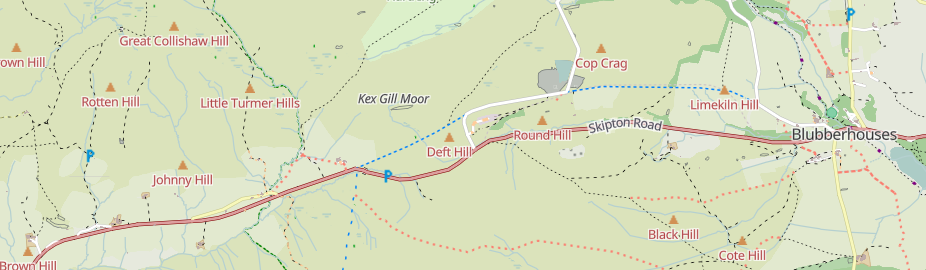
Kex Gill, west of Harrogate

Kex Gill (humorously named the “Côte de Blubberhouses” for a stage of the 2014 Tour de France) is a road in Yorkshire between Harrogate and Skipton. Part of it is gradually sliding down the valley that it is built half-way up the side of and is being rebuilt; it was the access tags on bridleways there that caught my eye in the first place.

See full entry

Location: Blubberhouses, North Yorkshire, York and North Yorkshire, England, United Kingdom