 OpenStreetMap

Reconocimiento del lugar, recorriendo bellos paisajes y descubriendo la naturaleza.
Users' Diaries
Recent diary entries

When I started getting involved in mapping on OSM around July 2021, I asked myself: “But why hasn’t anyone made a guide to help me map this country?” and indeed, there was no specific guide to contribute on North Korea!

Beginning
After learning and integrating all the basic OSM tags (including https://wiki.openstreetmap.org/wiki/Key:highway, https://wiki.openstreetmap.org/wiki/Key:building, https://wiki.openstreetmap.org/wiki/Key:natural, https://wiki.openstreetmap.org/wiki/Key:landuse etc.) and mapping some small towns of the country, I thought about creating a personal page of recurring tags for easy retrieval.
Then the idea came to me to make a thematic page on the contribution specific to this country.
Access to the terrain in North Korea is complicated, and a good understanding of satellite imagery is essential, so a guide to the subject becomes all the more relevant. So I decided to create one!
Posted by Terry Senior on 4 September 2023 in English.

Being now 67 years of age I have started to think that I should get out and explore my local area. Partly to get fitter but also I have now got my free bus pass and I intend to exploit it. I have lived in Doncaster since 2016 (7 yrs). I have some knowledge of the local area obtained by driving around, but I feel its time I got out on my bicycle and explore.

Revised Script for usage in macOS 12+ with zsh:

Tree mapping is a task that is better done in person than using aerial imagery, unless it is a tree row. The reasoning being that node placement of https://wiki.openstreetmap.org/wiki/Tag:natural=tree is more precise than looking from above, since more often than not the imagery is not that clear.
Trees tell a story
When looking at this area it is fascinating how one can make out man made structures relative to the placement of trees.

Further once adding the leaf_cycle and leaf_type one can create shade maps that could be practical during heat waves like at mapasdesombra.org or if jveuxdusoleil.fr extended its algorithm to include tree details as well.
One can add the tree’s height and diameter with a check date to create a timeline of the tree’s lifespan, though also add more potential data points in ecological terms.
Or one can add the genus and/or species to ease the search for foragers like mundraub does with their overlay map.
Tree specification

The damn deploy repository of the Divide and map. Now. has been refactored. And that’s a great opportunity for another round of load testing.
This is the third round of load testing, see the first and the second one if you are interested.
The load testing is a bit different from the last time. I performed load testing of new, freshly deployed damn project instance on $6/month VPS with 1 GB RAM, single 2.5 GHz vCPU, and 25 GB SSD. (The changes from the last time are that there is no more load testing of the “production” server, the price increased by $1/month, and shared_buffers is now 256 MB instead of 409 MB.)
The preparation for load testing on the server’s side, when the damn project is deployed, is just to run
docker-compose -f damn-deploy/gen.yml run --rm prepareloadtest
to create 1000 test users and 10 (load) testing areas in the database. For each run of load testing, the database has been deleted and created again with
systemctl stop damn-http.service
reboot
docker volume rm damn-deploy_damndb-volume
systemctl start damn.target
docker-compose -f damn-deploy/gen.yml run --rm prepareloadtest
commands. For each run of load testing, log the server’s utilization with
sar -o load-test-100 -A 15 $((4 * 61)) 1>/dev/null 2>&1
Then, from that file, you can generate data series and plot the graphs with
./get-info.sh 100
gnuplot plot1.pl
gnuplot plot2.pl
where the content of the corresponding files is
get-info.sh:
Posted by Raquel Dezidério Souto on 3 September 2023 in Brazilian Portuguese (Português do Brasil).
Last updated on 10 February 2024.

Como presidenta do Instituto Virtual para o Desenvolvimento Sustentável - IVIDES.org, idealizei, organizei e ministrei o curso de “Capacitação em mapeamento com OpenStreetMap”, para dar início às atividades do Capítulo YouthMappers UFRJ, Rio de Janeiro, Brasil, do qual, sou também presidenta e conto com a colaboração do Dr. Manoel Fernandes, professor mentor; do Dr. Paulo Menezes, professor mentor colaborador, todos nós do Lab. GeoCart-UFRJ; e ainda, com a fundamental colaboração de alunos e alunas do nosso laboratório e de unidades vizinhas do Centro de Ciências Matemáticas e da Natureza, especificamente, da Geologia; da Meteorologia e da Ciência da Computação e Núcleo de Computação Eletrônica - NCE. Poderia desfiar um rosário de instituições nacionais, principalmente do Rio de Janeiro, que fazem parte do nosso grupo de pesquisa, mas estou aqui para falar do nosso curso!
Apresentação do curso
O curso foi ministrado entre os dias 20 de julho e 24 de agosto de 2023 e transformou-se em um curso de fluxo contínuo, uma vez que houve interesse de demais pessoas, que conheceram a iniciativa após o início de sua realização. Assim, aos participantes que concluirem com sucesso - vide as condições presentes no portal https://ivides.org/curso-osm-2023, serão emitidos certificados ao final das fases de seis meses. Os envios de resultados são realizados por esta mesma plataforma e os certificados serão enviados por e-mail cadastrado no curso (vide no mesmo local, o portal web, as informações sobre a Secretaria).

… unless you want a greatbighuge label inexplicably hovering over the map at z=16.
Looking over this fine city of Toronto, I saw a couple of brown labels for places that are sort-of not real. Exporting and grepping local exports showed me they were landuse ways with a name value set.
I’m sure there are plenty of good examples where a landuse area would have a name. In these cases, though:
-
one was the name of a city/developer study from roughly five years ago that has disappeared from the record since then. Will it become a neighbourhood name? Who knows, but that’s for the future and not for us to force. (fun fact: it’s apparently the densest concentration of office workers in the city. Less fun but very Toronto fact: there is no dedicated transit there. I had a job there ~2006–2008 and new transit was planned, but then the trainwreck formerly known as Mayor Rob Ford happened so it didn’t.)
-
one was a drive-by tagging error by an out-of-band specialist. I really think they meant it for a bus stop.
Aligned with my personal policy of “Only kvetch after fixing”, they’re gone and our z=16 will be so much less jarring. Thank me later.


Posted by umbraosmbr on 2 September 2023 in English.
Location:
Centro, Curitiba, Região Geográfica Imediata de Curitiba, Região Metropolitana de Curitiba, Região Geográfica Intermediária de Curitiba, Paraná, South Region, Brazil

Posted by GPSPERU on 1 September 2023 in Spanish (Español).
Last updated on 20 March 2025.

Señores de openstreetmap, se podría más adelante agregar la opción en edición de mapas, poder girar de orientación el mapa 360 grados casi similar a Google maps hace falta esta opción.. Es una sugerencia que muchos piden para una mejor edición y también poder ver el mapa en un perfil 3D.

The Standard Tile Layer has a lot of traffic. On August 1st, a typical day, it had 2.8 billion requests served by Fastly, about 32 thousand a second. The challenges of scaling to this size are documented elsewhere, and we handle the traffic reliably, but something we don’t often talk about is the logging. In some cases, you could log a random sample of requests but that comes with downsides like obscuring low frequency events, and preventing some kinds of log analysis. Critically, we publish data that depends on logging all requests.
We query our logs with Athena, a hosted version of Presto, a SQL engine that, among features, can query files on an object store like S3. Automated queries are run with tilelog, which publishes files daily to generate published files on usage of the standard tile layer.
As you might imagine, 2.8 billion requests is a lot of log data. Fastly offers a number of logging options, and we publish compressed CSV logs to Amazon S3. These logs are large, and suffer a few problems for long-term use because they:
- contain personal information like request details and IPs, that, although essential for running the service, cannot be retained forever;
- contain invalid requests, making analysis more difficult;
- are large, being 136 GB/day; and
- become slow to query, being compressed gzip files with the only indexing being the date and hour of the request, which is part of the file path.
To solve these problems we reformat, filter, and aggregate logs which lets us delete old logs. We’ve done the first two for some time, and are now doing the third.

How do we better organize to support the Humanitarian OpenStreetMap Team organization, staff, membership, and community? We have been on a journey to open up and consider what is the best way forward for HOT’s Governance. Now that we have the HOT Living Strategy, we have more incentive to imagine how we might evolve. We are taking stock of our governance and investigating how we might be able to encourage more people to engage in the governance of HOT.
The HOT Governance Working Group (GWG) started the process of research and engagement with the HOT membership in January 2023. We’ve documented this process in the GWG meeting minutes. Together we designed a terms of reference to hire support to help us research some initial bylaw adjustments and wider organizational needs and structures.
Our first big research is exploring how we govern with the board and to better support the membership chair. There will be future steps and research to consider the role of the membership and how we collaborate with the Open Mapping Hubs.
The board and membership asked us to consider the following topics: the possibility of appointed board members, board member stipends, and membership chair term. See the current HOT bylaws
Why the proposed changes
The HOT voting members have a wide range of skills, and have brought much insight and change to the organization. Currently, HOT’s board is elected from and by the voting membership. Over the past years, HOT board and organization have identified gaps in key expertise for the board, including legal, finance and large-scale fundraising. This has been documented in various OSM diary posts, the HOT board election discussions, and the Board and GWG meeting minutes.

今天把好多原来是一整块的小区乡村分割然后补名字。晚上又试着给了几个小区画建筑…… 要开学了,以后可能就没有这样的机会画这么多了……唉 啊对 还有街道分界线问题……有空亲自去东边看看吧

googlemaps
#applemaps #here #mapbox
Posted by HAOHT on 30 August 2023 in Vietnamese (Tiếng Việt).
Last updated on 31 August 2023.

Lắp đặt, kiểm tra và tư vấn hệ thống điện (0981206886)
… wenn das Gute liegt so nah …
Ich hab mal für Leute mit etwas schmalerem Geldbeutel ‘ne Sammlung an deutschen Reisezielen zusammengestellt, die man zum Einen unbedingt gesehen haben muss und zum anderen man nach der Reise viel zu erzählen (oder besser zu erklären?) hat…
Das isse, viel Spass: osm.wiki/User:Dex2000#%22sch%C3%B6ne%22_Reiseziele_in_Deutschland
P.s. Wenn ich mich recht entsinne, war ich nur an einem dieser Orte. Welcher, wird nicht verraten, sonst klickt ja niemand…
Posted by 神楽坂 千鶴🏳️⚧️ on 29 August 2023 in Chinese (China) (中文(中国大陆)).
Last updated on 30 August 2023.
从徐州到济南的公交路线我会尽量完成 现在已经差不多完成济宁段了. 第二天补:嗯 提前开学 没时间了
Posted by lhirlimann on 29 August 2023 in English.

Last week I had a week of vacation in beautiful Greece. As I needed to do some kind of daily exercise, I decided to walk and played with streetcomplete. I’ve been off the app for a few months due to lack of motivation.
After one hour of going around and adding things I looked at my profile and was #1 on Greece what a shock.
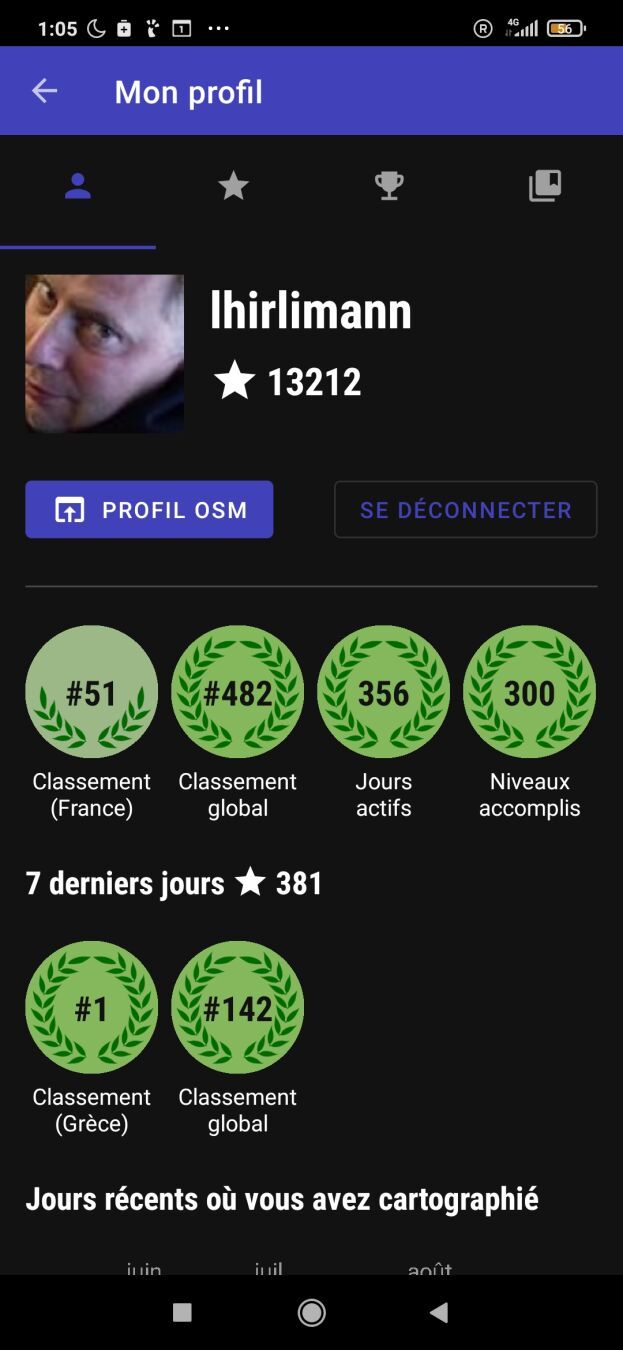
Wondering how that could be?
- Are all greeks using iphone? (I doubt)
- Is no one using OSM in Greece? (I doubt)
- Is Streetcomplete missing some greek translation (probably, I didn’t check).
- Am I the only one doing streetcomplete while on vacation?

OSM에는 왜 이렇게 흐릿한 갈래가 많을까……
외국 사람들에게 한국의 ‘곰’, ‘탕’, ‘국’을 갈래지으려면 갈래지을 수 있을까?
도대체가 말이 안 되는 짓거리를 언제까지 하고 있을 건가…… ㅡ.ㅡ
Why does OSM have so many fuzzy branches……
Is it really possible to make Korean ‘gom’, ‘tang’, and ‘guk’ forked for foreigners?
How long are we going to keep doing this nonsense…… ㅡ.ㅡ