OpenStreetMap logo OpenStreetMap

Users' Diaries

Recent diary entries

Today, at 43 years old, I decided to start a blog to note down memorable experiences while mapping.

So this is about a spring day two months ago when I mapped this set of bicycle lockers: way/82447313

They are located right next to the station in the Czech town of Melnik. They caught my attention when we were waiting for the train that was to take us into Prague. They work like this: You push your bicycle in, drop a small returnable deposit into the slot and that’s your bicycle safely stored for the day.

I could not help comparing them to the bicycle lockers next to the station of Wolfsburg, Germany, where I live. These work like this: You walk up to the operator’s office during their opening hours, sign a contract, pay a fee of 60€ (that’s for a year, but there are no shorter periods available).

I didn’t map anything else that day but there was also a nice public transport experience. At the end of our day trip to Prague we took the bus back from Ladvi to Melnik. It was during afternoon rush hour, so traffic moved slowly between the tower blocks. The bus was quite full, and after a day of sightseeing it already felt a little strange to sit as a tourist between locals going home from work. But when the long-haired bus driver turned up his radio as Queen played “Bohemian Rhapsody”, it felt as if we had been caught in an indie road movie by accident.

Another thing I like about Ladvi is that the green areas between the tower blocks are mapped as appropriate (garden/park/grass).


Location: Mělník, okres Mělník, Central Bohemia, 276 01, Czechia
Posted by Neelima Mohanty on 18 June 2023 in English. Last updated on 6 July 2023.

While everyone struggles , I chose to embrace the struggle.

Hello everyone, I am here again with the 2nd Blog of my journey as an Outreachy intern. For those who don’t know me , I am Neelima Mohanty , selected as an Outreachy intern at Humanitarian OpenStreetMap Team (HOTOSM) for the May to August Cohort. If you are new to my blog then make sure you read my Blog 1 before going through this blog post.

How many of you have come across new terms while contributing to open source communities? I guess everyone has . And do you remember how did you cope with it? As you think of all this , I will narrate you one such experience of mine during the contribution phase of Outreachy during March 2023 .

While raising a PR to add comments to the code of the osm-fieldwork repo as part of technical documentation , my mentor Rob Savoye reviewed it and said me that he liked the thought of adding comments to the code but it was not the right way. I would like to quote his words “Thanks for adding comments. We usually don’t need to comment write() and open(), as it’s obvious. If you want to get really deep into commenting source code, we want to add support for sphinx.This adds a comment block for each class and method. This would require you read and gain some understanding of the code itself, which is not a bad thing. We use sphinx for other python projects.”

See full entry

Posted by b-unicycling on 18 June 2023 in English.

This weekend, I attended the 2023 OHNI Conference, OHNI standing for Oral History Network Ireland. The overall topic was “Power & Resistance”. I had heard about them at a training seminar for Heritage Week where I went in preparation for my events about milk churn stands. I had 4 days before the deadline to hand in an abstract, but I went for it! I was granted a slot in the “moments” section where people get 10 mins to present their project.

My reasoning for participating was to spread the word about OpenStreetMap which seems to be very little known in academia and maybe especially the humanities, as well as local authorities. I did not know how well attended this conference would be, but every little helps.

I decided to talk about the possibility of mapping place names like field names, because that could be considered oral history and because I expected most attendees to be Irish and to know about field names. I was trying to make OSM as relatable as possible.

See full entry

Posted by NorthCrab on 18 June 2023 in Polish (Polski). Last updated on 11 August 2023.

Witaj społeczności OpenStreetMap,

Po publikacji osm-revert, pragnę podzielić się szczegółami na temat mojego nowego projektu, OSM Relatify. Narzędzie to ma na celu uproszczenie procesu edycji relacji transportu publicznego w OpenStreetMap (OSM).

Podgląd aplikacji

OSM Relatify został zaprojektowany tak, aby mapowanie transportu publicznego było bardziej dostępne i wydajne. Chociaż obecnie skupia się na relacjach autobusowych, wizja OSM Relatify obejmuje szerszy zakres zadań mapowania transportu publicznego.

Jedną z kluczowych cech OSM Relatify jest inteligentna logika wyznaczania tras. Automatycznie tworzy poprawne relacje autobusowe z podanych przystanków i dróg, biorąc pod uwagę takie czynniki jak ulice jednokierunkowe i ronda. To znacznie skraca czas i obniża trudność związaną z zarządzaniem relacjami autobusowymi, czyniąc to narzędzie cennym zasobem zarówno dla nowych, jak i doświadczonych maperów.

See full entry

Posted by NorthCrab on 18 June 2023 in English. Last updated on 11 August 2023.

Greetings OpenStreetMap community,

Following the release of osm-revert, I’m here to share details about my new project, OSM Relatify. This tool is designed to simplify the process of editing public transport relations within OpenStreetMap (OSM).

Application preview

OSM Relatify is built with the goal of making public transport mapping more accessible and efficient. While it currently focuses on bus relations, the vision for OSM Relatify is to encompass a broader range of public transport mapping tasks.

One of the key features of OSM Relatify is its smart routing logic. It automatically constructs bus routes from given bus stops and ways, taking into account factors like one-way streets and roundabouts. This significantly reduces the time and complexity involved in managing bus relations, making the tool a valuable asset for both new mappers and seasoned contributors.

See full entry

Posted by seeergiofdez on 15 June 2023 in Spanish (Español). Last updated on 30 June 2023.

En este post adjunto todos los recursos que me han sido útiles para la creación de rutas de autobuses del CRTM. Muchos de ellos han sido creados por otros usuarios, limitandome a crear una “norma general” para hacer todas las rutas más regulares, y con las mismas etiquetas que otras del mismo estilo.

Conocimiento general

Una ruta de autobus en OpenStreetMap se compondrá de tres cosas:

  1. El recorrido,
  2. La ubicación de parada dentro del recorrido
  3. La plataforma de parada (marquesinas)

Nodos

Ubicación de parada

Se colocará en aquellos puntos del recorrido (calles, avenidas…) donde el autobús hace parada o tiene establecida parada en su itinerario.

bus=yes public_transport=stop_position

Plataforma de parada

See full entry

Location: Sol, Centro, Madrid, Comunidad de Madrid, 28013, España
Posted by Longhorn256 on 15 June 2023 in English.

Along Pennsylvania’s freeways, there are emergency detour routes that allows travelers to bypass traffic accidents, inclement weather, and other road closures. Colors commonly used are black, blue, green, orange, and red. The detours are perhaps one of the least mapped features across Pennsylvania.

The best sources to consult are street-level photos from Mapillary and Bing Maps to establish which highways the particular route follows. I also recommend having a map nearby and to use colored pencils to mark the detour on the map.

Tagging the colored detours is quite easy using iD. Simply create a new Relation -> Route Features -> Detour Route.

Under Name, type in the name to be used, for example Orange Detour (I 79 Exits 121-130). Colors are used multiple times, so it is necessary to differentiate between them by including the ref for the highway being detoured and also the exit numbers that are being bypassed.

The Route Number in this case is Orange.

Because these detours are bidirectional, the from and to tags aren’t necessary.

The Colour tag would be orange.

Since I-79 is being detoured in this example, the Detour tag would be I 79.

Don’t forget to tag the directional role of the relation if the road being tagged is one way.

To make tagging easier, consult the OSM Wiki under the Detour page.

I have also published a YouTube video showing the best way of how to tag the relation.

I hope y’all find the resources helpful for adding the emergency detour routes across Pennsylvania.

Cross-posting from HOTOSM blog.

As we dive into the second half of 2023, we are thrilled to share the progress made by HOT and the Community Team in leveraging OSM data for informed decision making.

Hello! I’m Rubén Martín, HOT’s Community Strategist and Research Lead, and in this post, I aim to highlight our recent achievements and extend an invitation to OSM communities, contributors, organizations, and individuals interested in OSM data to collaborate with us on analysis and research endeavors.

Focusing on Actionable Insights: A Data-Driven Approach

At HOT, our data approach goes beyond satisfying curiosity; we strive to generate actionable insights that enable us to better support the communities utilizing Open Mapping to address local needs. Over the past months we have, together with our dedicated Data and Analysis Intern, Caleb Fagunloye (along with support from Benni Herfort at HeiGIT) made significant progress in two key areas outlined below:

  • Better understand OSM Contributor Data and validate assumptions around contributors decline.

  • Explore and experiment how to make OSM Data more accessible to non-technical people.

OSM Contributions Decline

See full entry

Posted by Zando on 14 June 2023 in Italian (Italiano).

Sto cercando una soluzione

a questo problema

Come vedete, i vai sono taggati waterway:steam o waterway:ditch anche se lì dentro acqua non ne scorre mai. Il loro inserimento e denominazione deriva dalla copiatura da un noto libro di itinerari alpinistici. Ma non si tagga per il rendering.

Sto pensando di ritaggare tutto con valley, che al momento è quello che si avvicina di più alla morfologia. Il problema non è di facile soluzione perchè si tratta di vallette molto strette e ripide. Che fare?

Ogni suggerimento sull’argomento è benvenuto

Location: Vallarsa, Comunità della Vallagarina, Trento, Trentino-Alto Adige, 38060, Italia

Making plans, so checking on the many sources for good hikes in an area. First, because it’s Six Rivers National Forest (mainly), I glance over the Forest Service topographic maps. There’s not a lot of trails showing on there in the area, but there’s three heading up to a selection of lookouts. There’s also a bunch of quarter mile spurs. Why? What sense do these make?

I check the USGS, but these are generally older and the information was supplied by the Forest Service anyway.

For the basic well known things, check AllTrails. It says you can cross country up Black Lassic. (I knew that already.) A community content tab appeared a few years back and you can find some good things here sometimes, but it’s always buried in a load of strange. There’s a bunch of strange in this area. Strange strange. Usually there’s a lot of long bike rides, but not here. Someone has apparently hiked the river underneath the reservoir. That’s fancy.

Hiking Project will often have a different set of trails. Actually, I find this a much more useable app for finding trails. Some of that is because even the free version will let you easily have the whole state downloaded. (It’s funding by outdoor venders and if they encourage you to wear out your gear, you’ll buy more gear.) Unfortunately it only has the nearby National Recreation Trail I already know about.

See full entry

Location: Trinity County, California, United States
Posted by AngocA on 13 June 2023 in Spanish (Español). Last updated on 14 June 2023.

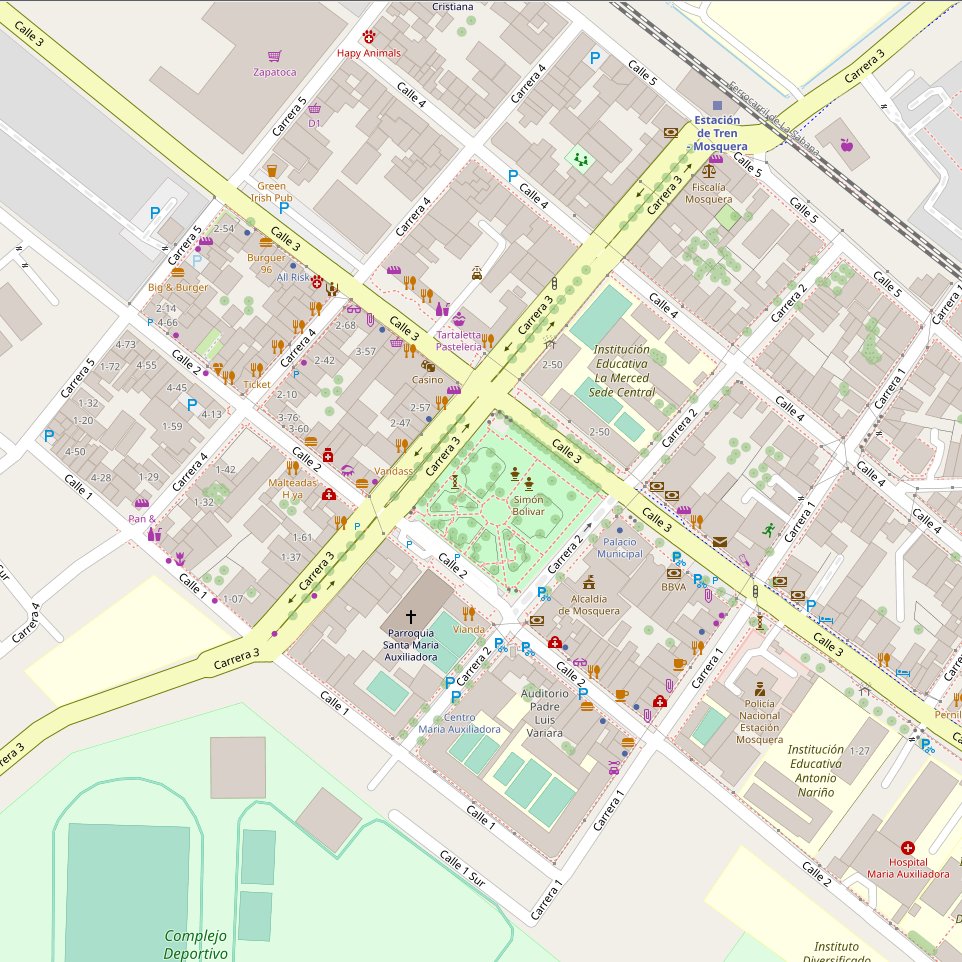
Este es un artículo que describe la actividad que se realizó entre mayo y junio de 2023, llamada Mapea por Mosquera, donde se mapeó en detalle el centro del municipio de Mosquera, Cundinamarca, Colombia.

Despues

Involucrar a la comunidad

Este evento buscó integrar a la comunidad, enviando invitaciones a varios grupos locales, publicando invitaciones tanto físicas como por redes sociales, y haciendo referencia a la alcaldía del municipio (este último usa OpenStreetMap en su página web.)

Por otro lado, se imprimió un sticker para pegarse en los establecimientos detallaban en el mapa. La pegatina tenía un código QR a un enlace acortado (dub.sh) que apuntaba a una subpágina del wiki de la actividad: osm.wiki/ES:Edici%C3%B3n_organizada/Actividades/Mapea_por_Mosquera/Bienvenido

Esto permitía que las calcomanías hicieran publicidad sobre el evento días después de terminado, y que las personas supieran qué se había hecho.

See full entry

Location: Mosquera, Sabana Occidente, Cundinamarca, RAP (Especial) Central, Colombia
Posted by adreamy on 13 June 2023 in Korean (한국어). Last updated on 15 June 2023.

먼저, 흔히 광장과 같은 ‘보행자 지역’을 제대로 태그하는 것이 왜 중요한가 하면,…
그런 곳을 ‘영역’(area=yes)로만 태그하면 그 곳을 길찾기(routing), 길 안내(navigating)에서 길을 이어주지를 못 합니다.
따라서, ‘보행자 지역’을 ‘영역’으로 지정함과 동시에 ‘highway=pedestrian’으로 태그하면 영역의 바깥선을 따라 길을 이어주게 됩니다.
가장 좋은 것은 영역으로 지정하되 ‘area=yes’가 아니라 ‘area:highway=pedestrian’으로 하고 동시에 ‘highway=pedestrian’ 하는 것입니다.

참고로 OSM 위키에서는 ‘highway=pedestrian’ + ‘area=yes’ 사용을 추천하고 있습니다.

길찾기가 제대로 되는 것을 확인했습니다.

A virtual discussion on the subject “Structure and Governance of a Local OSM Community” held on March 23, 2023 was the third of the Humanitarian OpenStreetMap Team (HOT) Community Working Group Peer-to-Peer Learning Series aimed at supporting the new OSM chapters in Saint Lucia and Dominica. This session was attended by 18 members of the OSM Community from across the globe. The session was guided by some key questions on the subject; below are the major take-aways from this discussion.

What are the different roles that people can play in a local OpenStreetMap community?

The roles and responsibilities were discussed as a precursor to the discussion on the structure. It is important to identify what the community should consist of ahead of assessing how it is organized. The most common roles highlighted were mapper and trainer. However, roles such as sponsor, social media marketer, community coordinator, communications and project manager. Communications include posting on social media, blogs and even responding to questions on the forum.

See full entry

Posted by Barro on 12 June 2023 in Finnish (Suomi). Last updated on 25 June 2023.

Loin joskus yli 10 vuotta sitten OpenStreetMap-tunnuksen ja tein silloin yhden päivityksen. Silloin ei oma halvalla hankittu ainoa älypuhelimeni oikein soveltunut käytettävyytensä puolesta OpenStreetMapin datan keräämiseen ja muutenkin työkalut tällöin oli käytettävyysmielessä vähän mitä sattuu.

Sitten pari vuotta sitten tuli vastaan tilanne, jossa yritin keksiä, että mihin pysäköidä pyörä Helsingin keskusta-alueella lähelle määränpäätä siten, että sen saisi järkevästi rungosta lukittua. Kun tajusin, että tämän datan voisi olla hyvä löytyä OpenStreetMapista, niin aloitin sitten oman projektin pyöräparkkien kartoittamiseksi alueilta, joilla liikun.

Valitaan mitä kartoitetaan

OpenStreetMap on loputon suo sen suhteen, että mitä kaikkea siinä voi kartoittaa. Päätin itse rajata oman panokseni koskemaan noin suunnilleen seuraavia tilanteita:

  • Lisätään kartalle pääasiassa runkolukittavia pyörätelineitä. Perinteiset kiekonväännintyyppiset helposti siirrettävät telineet, joita löytyy ripoteltuna sieltä täältä saa jäädä lisäämättä.
  • Poikkeuksena tilanteet, jossa kyseinen teline on jo kartalla ja se tarvitsee tietojen päivitystä. Tai jos näitä kiekonväännintyyppisiä telineitä on paljon yhdessä paikkaa.

Nämä rajaukset siksi, että se vähentää työmäärääni ja ylläpitää paremmin mielenkiintoa OpenStreetMapin päivittämiseen. Osaksi tämä on myös arvovalintakysymys, sillä jos siinä on edes teoreettinen mahdollisuus, että tuomalla OpenStreetMapiin esiin hyviä ratkaisuja yli huonojen, joku voi hyödyntää tätä tietoa omassa päätöksenteossaan. Käytän myös itse aina välillä kartalle lisäämääni tietoa hyväkseni. Omassa käytössä luonnollisesti suosin sitä, etten joutuisi kärsimään huonolaatuisista ratkaisuista.

See full entry

Last week, the climate officer from my local county council reached out to me to see whether “we” (i.e. OSM) had locations for drinking_water:refill mapped. (She used to be the heritage officer, so she knows well what I do).

After some confusion about what she meant (I thought holy wells…), I found that there was one mapped as amenity=drinking_water, but without the drinking_water:refill tag.

I presume the reason she is asking is that the council wants to install more, but doesn’t know where there are already some.

Some more research revealed that there are at least two providers in Ireland, both use GoogleMaps, one not very successfully: EcoFil. In agreement with the OpenStreetMap Ireland board, I sent emails to both companies to ask whether they could make their datasets open giving the county council analysis as one example for the usefulness of #OpenData in this case, pointing out that they could also benefit from a complete dataset.

(overpass-turbo for Republic of Ireland)

Refill Ireland sticker

See full entry