 OpenStreetMap

.
Users' Diaries
Recent diary entries

Representing the federal government of traffic I would like to upload the 12 Routes of national cycling routes, representing the Cycle Network Germany. All data ist quality checked and free to use (Data licence Germany – attribution – version 2.0)
Looking for a contact to provide a boost for OpenCycleMap and OSM in general
Geodata is already published: https://www.radroutenplaner-deutschland.de/veraDaten_EN.asp

opened my map account on August 10, 2022.

40度

Wstęp
Podczas wizyty w Krynicy-Zdroju udałem się za drogowskazem znajdującym się na reklamie Ogrodów Żywiołów ponieważ zaciekawiła mnie ona wodnymi eksperymentami. Oczywiście strzałka na plakacie była mało precyzyjna a miejsce zupełnie nieoznaczone. Google mapsy nie potrafiły doprowadzić bezpośrednio do ogrodów. Na osm nawet nie było ich zaznaczonych. Pomocna okazała się opinia na google maps która sprecyzowała chociaż z której strony szukać wejścia. W lesie od strony ulicy Doktora Henryka Ebersa zauważyłem małe tabliczki z logiem parku które doprowadziły już na alejki ogrodów.
Jednym słowem o parku
Cóż. Pomysł na park fajny. Jednak z tego co przeczytałem w internecie został on otwarty wiosną 2022 roku a już niektóre eksperymenty są uszkodzone. Ludzi nie ma (pewnie poddają się szukając wejścia do parku).
Mapowanie
Zbieranie danych
Hello please help me i make three places and i need to delete them please help me please

Toronto Police Service has major, systemic problems. But they also have this one:
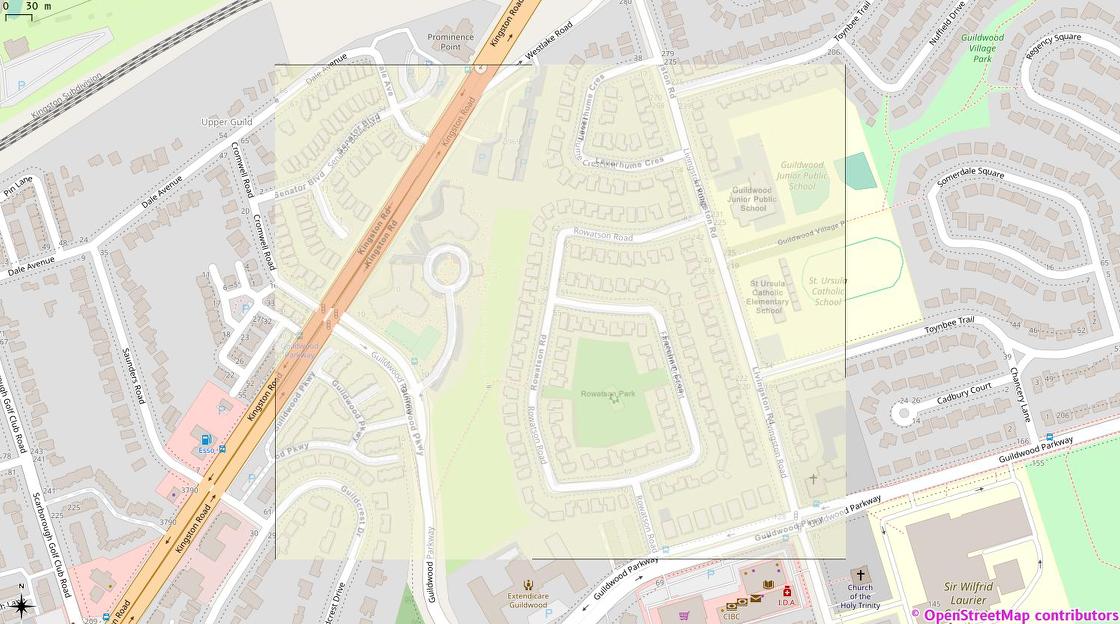
This is my hastily-georeferenced version of the image from this Toronto Police Operations tweet over OSM tiles in QGis. Note the extreme similarity between the streets and building detail. But also note the complete lack of OSM attribution on TPS’s map …

_
Posted by Troy Hartwig on 8 August 2022 in English.

When preparing to embark on a hike, I want to know if a trail suitable for me (my skill level and the time/energy I have for the hike). I would like to review a map and have trails clearly identified based on their level of difficulty and level of required exertion. There are numerous classification systems which grade trails for hiking and mountain biking including the Swiss Alpine Club Rating scale, German Single-track Scale, International Mountain Mike Association scale, Yosemite Decimal System, Australian Walking Track Grading System, the Sierra Club scale, the Appalachian Mountain Club, and Shenandoah National Park and Pigeon Forge National Park, and the US Forest Service and others. These rating systems variously take into account surface condition and obstacles, steepness, trail visibility, required gear, required wayfarer skills, risk/exposure, length, and elevation change.
Several of the established scales focus on exertion level based on length/elevation with different formulas but don’t take into account technical difficulty (National Park Service and Appalachian Mountain Club, Sierra Club). Several focus terrain and skill required with criteria for peak and/or average incline, surface material, smoothness, visibility, required gear, and risk/exposure (SAC, MTB, YDS, and USFS). While others combine these factors (Australian System, and Adventure Nerds). Others have proposed modifications/alternative scales that have not been widely adopted, but attempt to merge and isolate key factors.

A note to myself
This is a note I’m writing to myself, but sharing it to the wider OSM community. I’m a great fan of OSM as a close-to-perfect means for producing this beautiful free geographic database we have, and I like Telegram as an informal platform. I’ve been using Telegram while discussing OSM changesets with fellow mappers, switching from changeset comments that were slowing down the communication, being less interactive and not letting us share images.
me on Telegram
On Telegram I founded the Comunidad OSM Panamá (let’s call it COP here), to which I’ve been inviting mappers who start contributing OSM data in Panama. I have also been made owner of the OpenStreetMap Off Topic (OOT) group, a quite diversified community of mappers who sometimes want to talk about anything else but mapping. In both groups I implement a very simple set of rules: 1) introduce yourself when you enter; 2) assume and practice good faith; 3) try to be nice to each other.
the CoC
In particular in the OOT group we have discussed some meta-issues, like when the OSMF was discussing the need for a formal Code of Conduct. From those discussions, I distilled my personal reasons for decidedly contrasting the formalization of “norms”, on top of what should be shared “values”: if we don’t agree on values, there’s no set of norms that will keep us together. Also, should we once agreed on a set of norms, we would need a group of enforcers, and while on the OSM platforms we have the OSM Foundation to perform that role, on Telegram we are outside the Foundation’s jurisdiction. Cutting it short, in my opinion, if we need the protection offered by the OSM Code of Conduct, we must stay on OSM services.
an event on official channels

OSM’de mevcut olan hatlar
Ctrl+F yapıp hat numarasını yazarak bulabilirsiniz. Listeyi mümkün olduğunca güncellemeye çalışacağım.

(notatki by nie zapomnieć)
Sprzątam bo mylnym moim otagowaniu Kamer jako “outdoor”, bo gdzieśtam było opisane tylko rozróżnienie indoor/outdoor, dopiero teraz widzę, że wszelkie uliczne kamery to jednak “public”. A “outdoor” to raczej zewnętrzna kamera na zamkniętej posesji.
Ani na osm.org ani na osmandzie nie umiem sensownie wyszukać dla danego rewiru “man_made : Surveillance” z “surveillance : outdoor”.
Próbuję więc sobie pomóc overpass-turbo i query, która mi działa, to:
node
["man_made"="surveillance"]({{bbox}})
["surveillance"="outdoor"]({{bbox}});
out body;
I jak zamiast “out body” dam “out ids” to mam listę interesujących mnie nodów.
Pytanie jak znaleźć te wszystkie świeżo dorzucone i jeszcze nie otagowane kamery.
Niestety, ["surveillance"~"^$"] nie daje rezultatów, bo byłyby to nody z pustym “surveillance”, a tu w ogóle tego tagu brak. Trzeba podmienić na [!"surveillance"] które robi robote!
Jeszcze tylko nie wiem jak znalezione nody masowo modyfikować. No i było by super móc zawęzić wyniki tylko do nodów stworzonych przeze mnie. Ale to zostawiam na kiedy indziej.
Microsoft have recently released their “Worldwide building footprints derived from satellite imagery”. This is a dataset containing the shape and positions of houses. It covers many parts of the world and is derived from Bing aerial imagery with the use of deep learning.
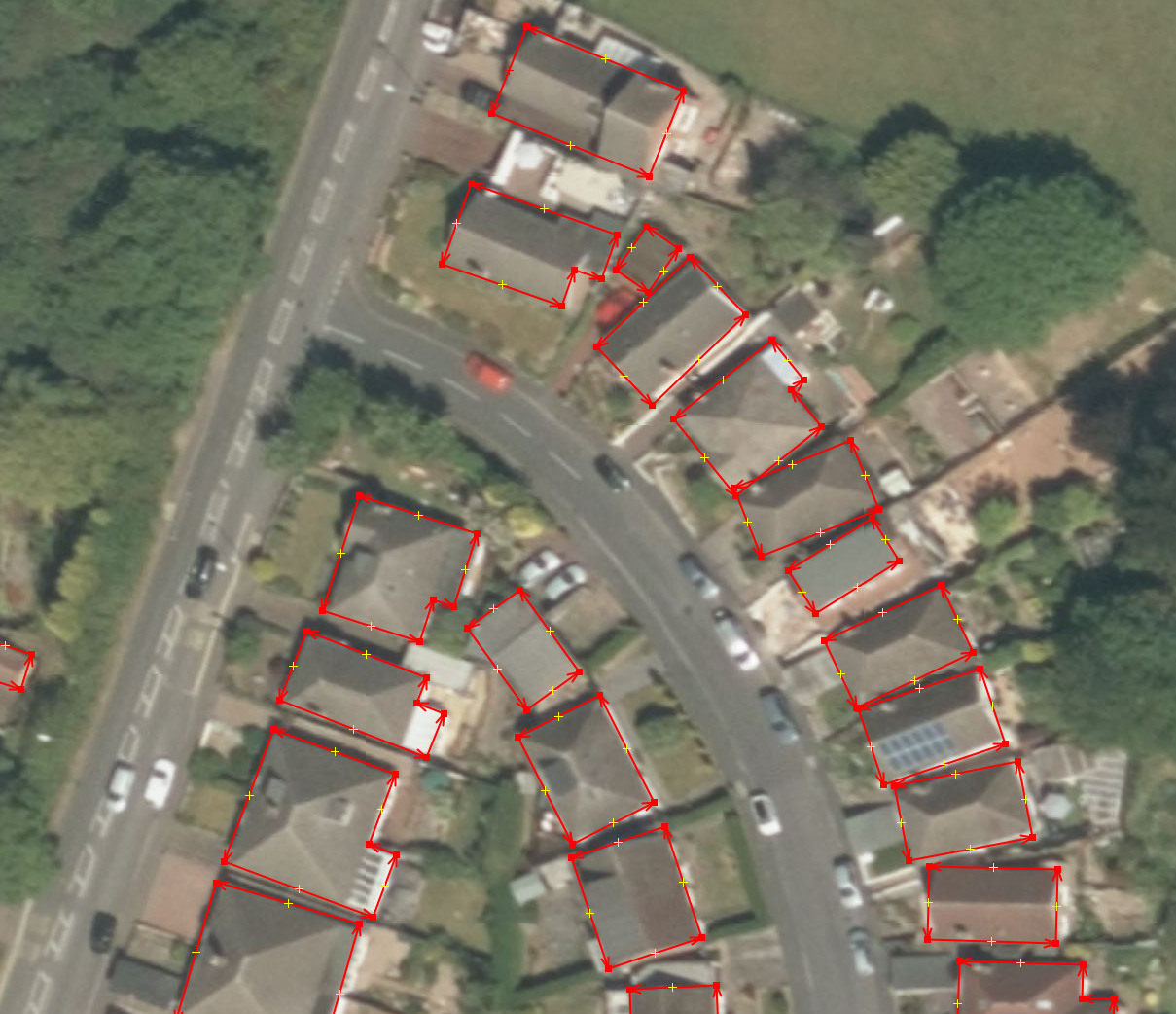
I find these footprints interesting for numerous reasons. The focus here will be to use the data to aid in mapping. There is further information on the OSM wiki.
In this diary entry I want to explain how I got the data into JOSM. In a following entry I will explain how I use this data to speed up building mapping.
Obtaining the data
The data is freely available on Github. It is licensed under ODbL and is compatible with OpenStreetMap. Each available country has its own zip file. Some of the files are of the order of gigabytes - far larger than can be opened in regular software. Pick a country and download the zip file.
Issues with the data
Posted by b-unicycling on 3 August 2022 in English.
Last updated on 5 August 2022.
Disclaimer: yes, I know, it’s absolutely micro mapping, but see “Side effects”.
It’s now been about 4 weeks since I started mapping thatched buildings in Ireland more systematically than just ad hoc adding roof:material=thatch whenever I saw one. I had focussed on Co. Kilkenny, because of a 1994 survey carried out by thatcher and archaeologist Jimmy Lenehan in that county, so all I had to do was revisit the sites and check whether the roof:material was still the same. I ended up visiting about 58 of of the 106 sites in his survey. (I tried to remember to add survey_date to those, so I could run an overpass query.)
He also told me about some newly thatched buildings, where I could add the tag, too.
I also had a long talk with him in his own thatched house which was a very interesting experience, because it was a very warm day (for Ireland), and the thatch really did insulate the house really well. He is not very good with technology, but I think he understood the potential of mapping the thatched buildings on an OpenData platform. I’ve added ref:IE:lenehan to the buildings from his survey and documented the tag in the wiki.
I also had a chat with our Heritage Officer who thought it was a good idea to undertake a new survey, but doesn’t seem to grasp the advantages of crowd sourcing and OpenData quite as much as I would hope. She is under the impression that I’m only doing a photographic survey, because I told her that I was uploading the photographs to WikiCommons (about 82 uploads for Co. Kilkenny so far). She asked if I would provide these images to their county archive as well, because “not everybody knows how to use that OpenData thing”. Well, everybody knows how to use Google, that should bring them to WikiCommons straight away. So I politely explained that and declined providing duplicate content. Needless to say, there is also no public funding for a survey this year, so I’ll just soldier on in my own time and out of my own pocket.

no this is not about Minecraft, its about my non existent journey to map out Mainaschaff (my hometown) by the end of summer break (2nd week of September)
I already did 6-7 blocks today in around 2h which leaves me with more time than I have left to do the rest of the city.
So I’m stopping here…. for now.
If anyone wants to help me, feel free to just like…. make the map better.
Bye, nonexistent reader :)

Dear all,
Today, v5.6.0 of the OpenStreetMap Carto stylesheet (the default stylesheet on the OSM website) has been released. Once changes are deployed on the openstreetmap.org it will take couple of days before all tiles show the new rendering.
Changes include
- using locally installed fonts instead of system fonts, for more up to date fonts;
- changing tree and tree row colours to the same colour as areas with trees;
- rendering parcel lockers; and
- rendering name labels of bays and straights from z14 only, and lakes from z5
Thanks to all the contributors for this release including GoutamVerma, yvecai, ttomasz, and Indieberrie, new contributors.
For a full list of commits, see https://github.com/gravitystorm/openstreetmap-carto/compare/v5.5.1…v5.6.0
As always, we welcome any bug reports at https://github.com/gravitystorm/openstreetmap-carto/issues
OpenStreetMap Carto could use more help reviewing pull requests, so if you’re able to, please head over to Github and review some of the open PRs.
Posted by risturiz on 1 August 2022 in Spanish (Español).

Memoria
Hace unos meses alguien preguntó ( disculpen que no recuerdo quien ) sobre opciones para recibir notificaciones de cambios en el mapa que sirvieran para hacerle seguimiento a ediciones en zonas especificas.
Investigando un poco, solamente encontré un excelente articulo de Willie donde se habla de los filtros de Osmcha, el uso de RSS/Telegram/IFTTT/Zapier/Huginn para recibir este tipo de notificaciones.
Me pareció interesante, “pero” habían 2 cosas que no terminaron de convencerme:
- El flujo de trabajo quizás es complejo para usuarios novatos
- No todo es 100% software libre
Y en ese momento gracias a información adicional que me facilitó Matheus sobre los canales Telegram que usan en Brasil con filtros de Osmcha, pude obtener una idea más general para buscar alguna alternativa que fuese mas sencilla.
Nota: Openstreetmap tiene una gran cantidad de servicios que usan RSS, con lo cual se hace mucho más sencillo usar este método.
Deltachat
Como mencionan en su página web, Deltachat es simplemente un app de mensajería que trabaja mediante el correo ( se pudiese ver como un cliente de correo ). Es fácil de usar, multiplataforma y es software libre.
Posted by Pieter Vander Vennet on 31 July 2022 in English.

Hey all,
In the past month, MapComplete was part of Open Summer of Code where 4 students and myself did make a lot of improvements and a new theme.
With this diary entry, I’d like to give you some insights in what we’ve done the past 4 weeks.
What is Open Summer of Code
Open Summer of Code (or OSOC) is a programme organized by Open Knowledge Belgium, which is a small belgian NGO that promotes Open Source and Open Data.
For OSOC, they search clients (organizations or governmental institutions) which have an interesting problem that they want solved and with budget to pay a team of about 4 students.
These 4 students will be guided by a coach (such as me) to make sure something useful comes out of it.
The actual problems are varied. We’ve had a planning tool for building new homes, a calendar application based on SOLID, a tool to discover research papers, …
The bottom line is that data must be open and that all produced software and tools will be open sourced. If possible, the programs should reuse existing tools and datasets, such as OpenStreetMap or wikidata.
OnWheels: the wheelchair accessibility map
One of the projects this year was paid for by BOSA (a belgian gov organization) requested by OnWheels - a belgian application which helps wheelchair users to navigate the world. They have a database of shops, restaurants and other amenties together with some info about them, such as name, contact details and opening hours, but also information about the width of the door, the height of the kurb at the entrance, …
During the past years, the idea of opening this data has grown within OnWheels, for various reasons. By opening the data, more people can reuse it. Furthermore, by switching to OSM, the cost of maintaining this data is shared amongst more people.
However, making the switch is not easy. With the OSOC-project, we wanted to create a first version of how an OnWheels 2.0 might work.
Whom is this app for?

I have just returned from a no-toll way trip through France. What struck me was the widespread errors in speed limit tags, or the complete absence thereof, especially on a 90 kph or 80 kph stretch. Is somebody actually taking care of this in the France OSM editor group?