 OpenStreetMap

The Compound
Users' Diaries
Recent diary entries

Mentre mi muovo per la città approfitto per migliorare la mappa aggiungendo note qui e là. Mi viene in aiuto StreetComplete.


Go Map!! is now a desktop app for Mac, in the App Store: https://apps.apple.com/us/app/go-map/id592990211
Did anybody ask for a desktop version? In fact a few people did, but the primary reason to release it is “because we can.” Many people edit using iPad, and many of those people use mouse/keyboard, so adding support for those input methods got the app 80% of the way to full desktop support. Enjoy!

Posted by Valerio_Bozzolan on 16 October 2021 in English.

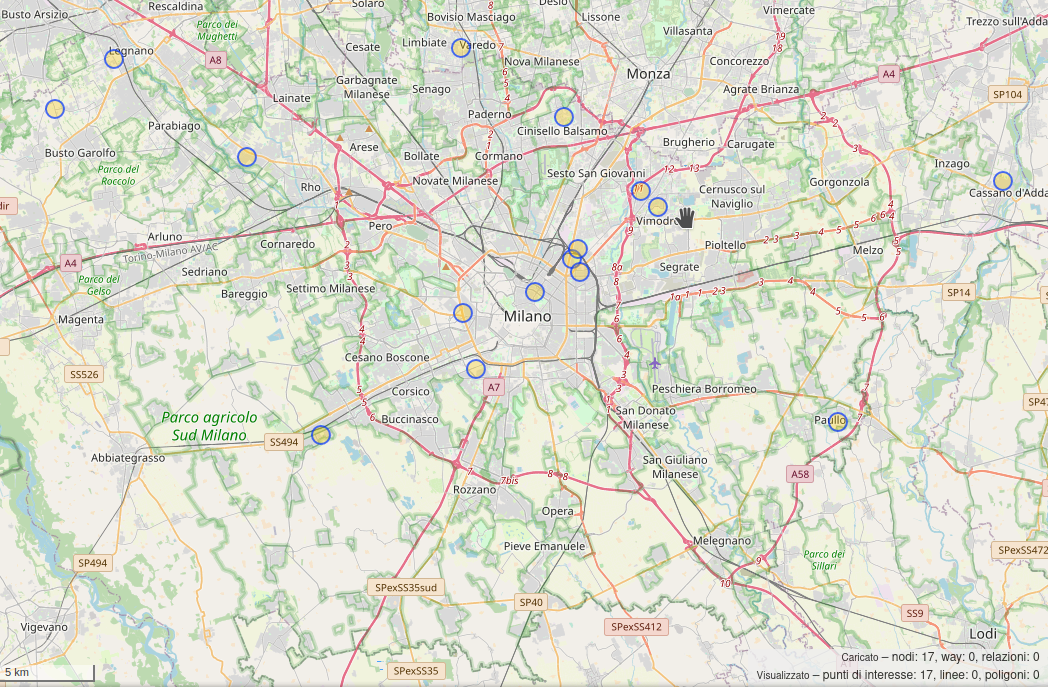
If you have a beautiful bunny sadly you can’t take them to a regular vet. You need “exotic experts”. This is true at least in Italy.
That’s why I tried to expand an OpenStreetMap RFC about veterinarians, to cover this case.
The result? See with your eyes:
https://overpass-turbo.eu/s/1c7F
It’s absolutely amazing how somebody can expand OpenStreetMap so quickly to add useful metadata and being able to query them in realtime.
https://overpass-turbo.eu/s/1c7F
Happy bunny!🐇

قرى وادي مقسى قرى سعودية، تتبع محافظة ميسان بمنطقة مكة المكرمة. تقع في جنوب غرب مدينة الطائف بمسافة (90 ) كم.[1]
بنيوس الغورية ويقصد بهم ( المجافية ـ آل شداد ـ المفارجة ـ العبدة ـ السواهر ـ العبد الله ـ العلثى ـ الضبعة )

S
Village comes under Pusad Tahasil of Yavatmal District, Maharashtra, India,

This entry will be constantly updated based on my findings in USA.
Please be advised that a correct solution depicted below is not the only one. You are welcome to brainstorm in the comment section!
Hint: Right click on the picture to view in a new tab so you will see it in a better size.
1:
Wrong:

The reason why the intersection originally looks like this is to prevent reckless driving in rural area.
Posted by arnalielsewhere on 13 October 2021 in Portuguese (Português).
Last updated on 18 October 2021.

| Versões: English / | French / | HOT website (English) |
Juntamente com as comunidades/contribuintes locais do Vietname, Madagáscar e Moçambique, e os Centros Mapas Abertos (Ásia-Pacífico, e África Oriental e Austral), tenho muito prazer em partilhar convosco a colaboração Projecto: Localização como um facilitador de inclusão e participação (também disponível em Francês, Português e Espanhol).
Resumo dos detalhes do projecto:
Contexto
A barreira linguística e a omissão do inglês coloca os não falantes de inglês em desvantagem sistémica nas comunidades de mapeamento aberto e nas actividades humanitárias de mapeamento aberto que o HOT tenta apoiar, resultando numa falta significativa de participação e impacto (Gayton, 2021) .
Motivação
Acreditamos que a localização linguística permitirá a inclusão e participação de grupos subrepresentados no mapeamento, diálogos e outras actividades humanitárias de mapeamento aberto.
Objectivo
O nosso objectivo é desenvolver dados de base para informar uma estratégia de localização*** auto-sustentável para colmatar a lacuna entre linguagem e acessibilidade dos recursos de cartografia aberta que servem as comunidades envolvidas no trabalho humanitário / de desenvolvimento (ver Países Prioritários do HOT).
Metodologia
Iremos realizar pequenas experiências (isto é, fluxos de trabalho de tradução, e compromissos) com comunidades locais para testar como a localização de recursos poderia funcionar nas principais línguas de 3 países prioritários: Vietname (Tieng Viet), Madagascar (francês) e Moçambique (português).
Linha do tempo (sujeito a alterações)
- June-Julho: brainstorming inicial, preparação e análise dos requisitos (completo)
- *Agosto - Setembro:** Compromissos com as comunidades como colaboradores nas experiências (completo)
- Outubro - Novembro:** Experiências/Translações em curso
Posted by arnalielsewhere on 13 October 2021 in French (Français).
Last updated on 18 October 2021.
| Versions: English / | Portuguese / | HOT website (English) |
Avec les communautés locales/contributeurs du Vietnam, de Madagascar et du Mozambique, et les centres Open Mapping (Asie-Pacifique, et Afrique de l’Est et Afrique australe), je suis très heureux de partager avec vous la collaboration Projet : La localisation comme outil d’inclusion et de participation (également disponible en français, portugais et espagnol).
Résumé des détails du projet :
Contexte
La barrière de la langue et le choix par défaut de l’anglais désavantagent systématiquement les non-anglophones dans les communautés de cartographie ouverte et les activités de cartographie ouverte humanitaire que HOT tente de soutenir, ce qui entraîne une participation et un impact manqués (Gayton, 2021).
Motivation
Nous pensons que la localisation de la langue permettra l’inclusion et la participation des groupes sous-représentés dans la cartographie, les dialogues et autres activités de cartographie ouverte humanitaire.
Objectif
Nous visons à développer des données de base pour informer une stratégie de localisation autonome afin de combler le fossé entre la langue et l’accessibilité des ressources de cartographie ouverte qui servent les communautés impliquées dans le travail humanitaire / de développement (voir [Pays prioritaires de HOT] (osm.wiki/Humanitarian_OSM_Team/Working_groups/Community/Terms_of_Reference#How_we_define_our_community_focus)).
Méthodologie
Nous allons mener de petites expériences (c’est-à-dire des flux de travail de traduction et des engagements) avec les communautés locales pour tester comment la localisation des ressources pourrait fonctionner dans les principales langues de trois pays prioritaires : Vietnam (Tieng Viet), Madagascar (français) et Mozambique (portugais).
Calendrier (sous réserve de modifications)
Juin-Juillet: Brainstorming initial, mise en place et analyse des besoins (terminé)
Posted by arnalielsewhere on 13 October 2021 in English.
Last updated on 18 October 2021.
| Versions: French / | Portuguese / | HOT website (English) |
Together with the local communities/contributors from Vietnam, Madagascar and Mozambique, and Open Mapping Hubs (Asia-Pacific, and East & Southern Africa), I am very happy to share with you the collaboration Project: Localization as an Inclusion and Participatory Enabler (also available in French, Portuguese and Spanish).
Summary of the project details:
Context
Language barrier and the default to English puts non-English speakers at a systemic disadvantage throughout open mapping communities and humanitarian open mapping activities that HOT tries to support, resulting in significant missed participation and impact (Gayton, 2021) .
Motivation
We believe that language localization will enable inclusion and participation of underrepresented groups in mapping, dialogues and other humanitarian open mapping activities.
Goal
We aim to develop baseline data to inform a self-sustainable localization strategy to bridge the gap between language and accessibility of Open Mapping resources that serve communities involved in humanitarian / development work (see HOT’s Priority Countries).
Methodology
We will be running small experiments (i.e. translation workflows, and engagements) with local communities to test how localisation of resources could work in the main languages of 3 priority countries: Vietnam (Tieng Viet), Madagascar (French) and Mozambique (Portuguese).
Timeline (subject to change)
- June-July: Initial brainstorming, set-up and analysis on requirements (complete)
- August- September: Engagements with communities as collaborators in the experiments (complete)
- October - November: Experiments/Translations running
I can’t find my neighbors house or my front yard. Yep! This seems perfect for me
Data
## G. Montesanto leg.
Posted by jinalfoflia on 13 October 2021 in English.

It was great going through the challenges in part 1. We have a few more interesting tasks as the next maproulette challenges for you all. They are for mappers who are just starting or are experienced. Here are the tasks for you all:

- Connectivity checks: https://maproulette.org/browse/challenges/21203
- Building-Road intersection checks: https://maproulette.org/browse/challenges/21201
- Inconsistent Road Classification checks: https://maproulette.org/browse/challenges/21207
- Intersecting Buildings checks: https://maproulette.org/browse/challenges/21208
- Correcting mixed name case: https://maproulette.org/browse/challenges/21215
- Connectivity checks: https://maproulette.org/browse/challenges/19892
- Invalid Turn restrictions checks: https://maproulette.org/browse/challenges/19890
Put your mapping hats on and let’s do some mapping!
We would love to hear suggestions and feedback from you on these tasks so that we could better ones next time.
Posted by Mordechai23 on 13 October 2021 in Polish (Polski).

W tym poradniku dowiesz się, jak przy pomocy programu QGIS i wtyczki mbtiles w JOSM zmienić wybrany rysunek projektowy…

…w podkład do JOSMa.
Posted by bkil on 12 October 2021 in Hungarian (Magyar).

- szavazás: https://cloud.systest.eu/apps/polls/s/eU7bkvkXWp7t348K
- 11:45-12:15 szendvics OE NIK aula;
- 12:15-16h terepezés;
- 16-18h evés-ivás-tudáscsere;
- 18-20h terepezés

HOT Tasking Manager (TM), SimpleTaskManager (STM), and Divide and map. Now. (damn) are tools for collaborative mapping, with different philosophies and different approaches. In this diary, I discuss some issues of the first two from the perspective of the third one.
DISCLAIMER: I’m the damn project developer.
Which issues to consider: I filter out bug reports and issues that oppose the damn project philosophy. Then, I pick up issues I think are interesting and categorize them, describe the category, and provide some comments how the particular issues are or would be solved.
About naming: TM’s and STM’s project corresponds to damn’s area. TM’s and STM’s task corresponds to damn’s square. Where TM uses validation, damn uses review.
Solved by design
There are many issues of both managers that wouldn’t be an issues for the damn project because of it’s design. Let’s quickly recap that design.
There are areas divided to squares. Any change to an area is stored as commit. So, creating new area leads to creating new squares as well as new commit with to map type for each square. During collaborative mapping, new commits of different types like locked or done are added with area and square identifiers, always updating particular square of the area. It’s not possible to delete something.
One of OpenStreetMap’s greatest strengths is our worldwide platform backed by a worldwide community. As such we need to give our full support to our mappers around the world, including the ones in countries whose cultural and legal norms you may dislike and wish to work against. Supporting these mappers isn’t an endorsement of those norms; rather it is a commitment to worldwide mapping.
Any suggestion of ostracising countries would be a stand against inclusion of mappers, depriving them of the opportunity to talk about their specific issues both with each other and with the rest of the world.
Posted by Mateusz Konieczny on 10 October 2021 in English.

StreetComplete is an application allowing to contribute to OSM by answering simple question. It makes possible to contribute without learning about tagging schemes and without learning how to handle interface of more general editor like JOSM, iD or Vespucci.
I contributed to StreetComplete in past. Recently I received a grant that will allow me to spend more time on improving it.
Grant is funded by a NLnet as part of NGI Zero grants. StretComplete grant is mentioned by NLnet at https://nlnet.nl/thema/NGIZeroDiscovery.html and https://nlnet.nl/project/StreetComplete/ pages. It will allow me to spend far more time on improving StreetComplete.
I will participate in project as usual, sending pull requests that will be reviewed and accepted (or rejected) by StreetComplete author, Tobias Zwick and minor changes commited directly (and still subject as review).
Note that I selected topics of work to be done (based mostly on open issues on the bug tracker) on my own, and it was accepted without any requested changes. I am sole beneficiary of the grant.
Total grant will depend on how much I will manage to do before deadline.
See @Mateusz%20Konieczny/diary/368849 for earlier, very similar entry.
I created osm.wiki/NLnet and submitted it OSM weekly as it seems to me that other OSM projects also may be funded.