OpenStreetMap logo OpenStreetMap

Users' Diaries

Recent diary entries

Posted by MKnight on 25 October 2021 in German (Deutsch). Last updated on 30 October 2021.

… da fallen einem paar Sachen unangenehm, nervig oder interessant auf, die will ich mal hier festhalten.

Vorweg. Ich hab die letzten Wochen meine Zeit vertrödelt um Thüringer Autobahnen mit Leitplanken zu beglücken. Mehrwert nahe -Null, aber da in der letzten Zeit die Relevanzdiskussionen in OSM immer ekliger werden, dachte ich mir: mach mal was hart OTG, wo Dir keiner vorn Karren scheisst. (Siehe auch) Bis auf die A 71 ist das nun flächendeckend, bei der geh ich’s nun aber bisschen langsamer an.

Ärmel hochgekrempelt und die A 4(overpass) als Beispiel gehts los.

Gibt 2 Arten von Leitplanken, barrier=guard_rail und barrier=jersey_barrier. Ersteres sind die Blechdinger, letzteres die Betonklumpen. (Gibt noch ne dritte Art, das wäre barrier=kerb in Tunneln, aber das mach ich ma irnkwann, wenn mir nix anderes doofes einfällt. Vielleicht gibt’s dann hier im Kino was neues dazu.) Die Betondinger sind gern in der Nähe von Brücken anzutreffen, die Aludinger haben auf Brücken gern die Eigenschaft two_sided=yes.

Hach Brücken, hat man mal paar 100km Leitplanken gemappt fällt auf oder ein: Brücken und layer. Also den ganzen Kladderadatsch noch mal “abgelaufen” und layer zugefügt. Im selben Atemzug ca. 50% fehlende man_made=bridge ergänzt incl. Schere im Kopf, was jetzt bridge und/oder tunnel ist. Die ganzen Relevanz- oder echten Diskussionen zum Thema ignoriert und nach gusto “korrigiert”. Meine Interpretation: wenn am Luftbild erkennbar ist, dass die Strasse “überirdisch” verläuft, dann ist es eine Brücke. Ich möchte da hier nicht drüber diskutieren, das Thema ist ein anderes. Und semi-unlösbare Spezielfälle gibts auch.

Wo war ich?

Jedes Mal, wenn ich die Autobahnen ablaufe, finde ich neue Sachen die fehlen.

Was jetzt noch fehlt sind:

See full entry

Posted by Lejun on 24 October 2021 in English. Last updated on 25 October 2021.

Objective

For a while now I’ve been contributing in smallish countryside cities. While not small through their surface area nor their population count, they have a low proportion of active OpenStreetMap contributors and their urban development share a common pattern that is “downtown commercial arteries” leading me to classify them as “countryside cities” rather than “modern evolved and distributed cities”. Those commercial arteries are defined by a street network of mixed uses buildings with shops at ground level and housing at higher levels ; Walking down one of these street, one could model the facade as a succession of doors allowing access to either a shop or housings and that’s exactly what I am looking a software for.

Criterias

I have searched and tested multiple solutions in my journey but haven’t quite found the ideal one so far. The criterias I am looking for are as follows:

  • Lightweight: I’m one of those still using old hardware limited both in memory and performance ;
  • Offline map: I’m a cheap guy, allow me to cache the mapping area through WiFi before leaving home ;
  • “Notes” creation rather than Waypoints: Most of the apps allows you to create “waypoints” on a GPS trace, while those have their use I definitely can’t use those as GPS function is rather battery intensive and high-rise buildings, or simply clouds, highly affects signal quality. Given a map (see aforementioned point) I would rather be allowed to pinpoint a location and add my own tags to it. Those data could then be exported to a computer to be processed through comparison with OpenStreetMap data.

While not dealbreaking, the app use could be extended through an uncluttered UI and workflow, a customizable presets to one-tap buttons function could make themed mapping parties a breeze, and pictures/voice records.

Tested solutions

Below are some solutions I tested with no success so far.

“Utility” solutions

See full entry

Location: Rue Battant, Besançon, Doubs, Bourgogne – Franche-Comté, Metropolitan France, 25000, France
Posted by TravelingEditor on 24 October 2021 in English.

I’m having a ton of fun trying to fix up my local community and close surrounding areas and other little interesting things. Here’s hoping that what I am doing will have an impact on someone’s journey thru town or even one of my fellow locals! I’m having a blast as a beginner, why didn’t I do this sooner?!

Location: Wawa, Algoma District, Northeastern Ontario, Ontario, P0S 1K0, Canada

Hoje venho compartilhar com vocês as novas pastas criada pelo IBGE ( Instituto Brasileiro de Geografia e estatisticas ) orgão que disponibiliza os dados para que possamos mapear e atualizar os dados existente no Openstreetmap para o Brasil.

Só tinhamos dados de 2010 da area Urbana e 2017 da area Rural, hoje temos dados de 2019 e 2020.

Esse link tem os endereços para baixar os arquivos zipados de 2010, 2019 e 2020. https://geoftp.ibge.gov.br/recortes_para_fins_estatisticos/malha_de_setores_censitarios/censo_2010/

No Gith temos esse repositorio com os endereços para baixar os arquivos e ainda disponibilizados os arquivos para baixar no modo torrent, facilitando ainda mais o donwload dos arquivos. https://github.com/vgeorge/cnefe

Baixar torrent dos arquivos do IBGE.

ARQUIVO PDF CNEFE 2010 https://raw.githubusercontent.com/vgeorge/cnefe/master/torrent/cnefe-2010.torrent

Faces de Logradouros (2010) https://raw.githubusercontent.com/vgeorge/cnefe/master/torrent/cnefe-2010-logradouros-2010.torrent

Faces de Logradouros (2019) https://raw.githubusercontent.com/vgeorge/cnefe/master/torrent/cnefe-2010-logradouros-2019.torrent

Faces de Logradouros (2020) https://raw.githubusercontent.com/vgeorge/cnefe/master/torrent/cnefe-2010-logradouros-2020.torrent

FTP IBGE - 2010. https://geoftp.ibge.gov.br/recortes_para_fins_estatisticos/malha_de_setores_censitarios/censo_2010/base_de_faces_de_logradouros_versao_2010/

FTP IBGE - 2019. https://geoftp.ibge.gov.br/recortes_para_fins_estatisticos/malha_de_setores_censitarios/censo_2010/base_de_faces_de_logradouros_versao_2019/

FTP IBGE 2020. https://geoftp.ibge.gov.br/recortes_para_fins_estatisticos/malha_de_setores_censitarios/censo_2010/base_de_faces_de_logradouros_versao_2020/

Today I come to share with you the new folders created by the IBGE (Brazilian Institute of Geography and Statistics) which makes the data available so that we can map and update the existing data on Openstreetmap for Brazil.

See full entry

Location: Cohab, Recife, Região Geográfica Imediata do Recife, Região Metropolitana do Recife, Região Geográfica Intermediária do Recife, Pernambuco, Região Nordeste, Brasil
Posted by GOwin on 23 October 2021 in English. Last updated on 25 October 2021.

It took us 2 years, and 22 days but it’s now “complete.” 😉

Well, at least, all the published tasks has been completely reviewed, resulting in 39,129 mapped schools out of the 39,966 tasks. An additional 837 tasks has also been reviewed but was deemed unverifiable, or needed further information.

The school dataset was informally released to the OSM-PH community in 2013 but languished in the pipeline because of a murky data license until official permission to use it with OpenStreetMap was obtained in 2016. Even with that out of the way, it still needed tons of work before it was ready for use.

In October 2019, the cleaned-up dataset was made into a MapRoulette challenge, as a practical mapping exercise for MapAmore’s mentoring program for NSTP volunteer students from the Polytechnic University of the Philippines’ campus in San Juan City.

See full entry

Location: Combado, Bacong, Negros Oriental, Negros Island Region, Philippines
Posted by Gustavo22Soares on 22 October 2021 in English.

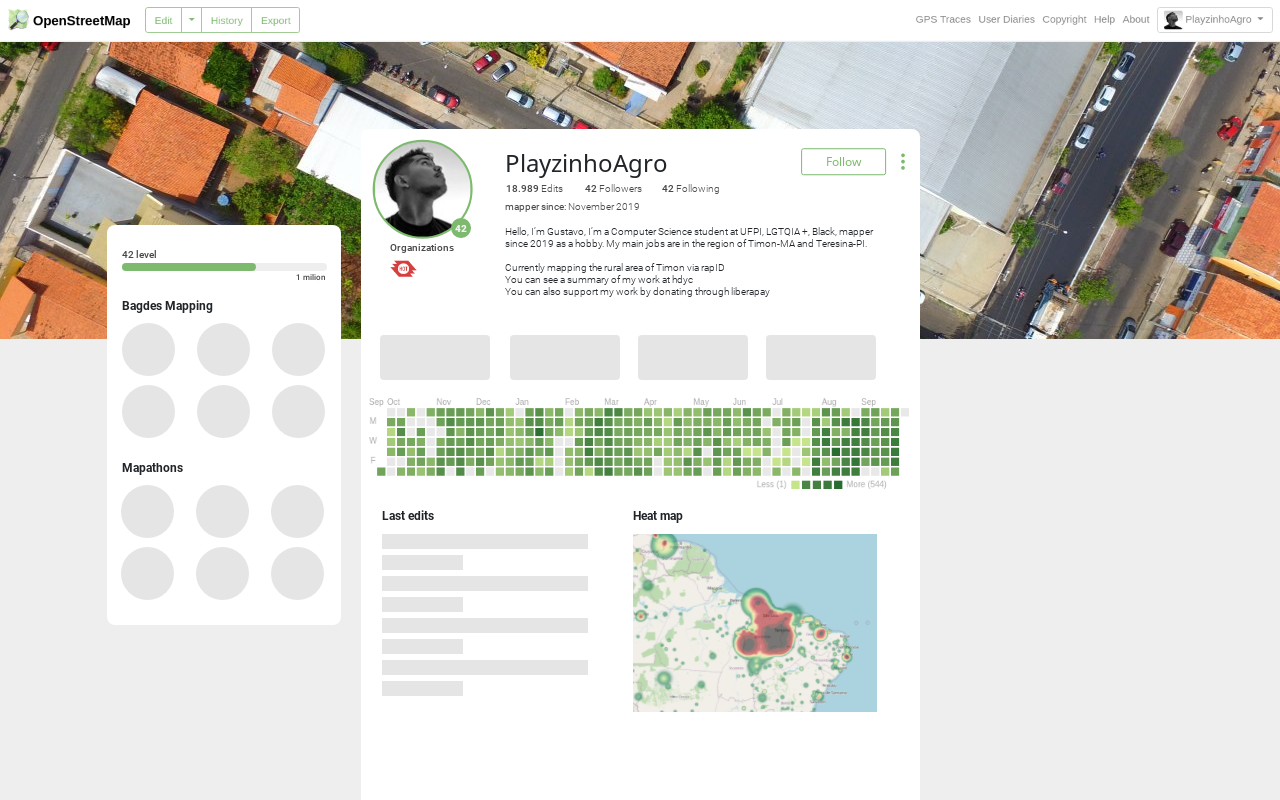
I would like to start by explaining that this is an exercise in imagination on how we could improve the UX/UI in the OSM profile, this means that some changes were based on my experience and there are still some things missing that I have not explored, like the Diaries, settings and Messages, I would love to get feedbacks from you!!!

User.png

More social and personal

See full entry

Location: Parque Aliança, Timon, Região Geográfica Imediata de Timon, Região Integrada de Desenvolvimento da Grande Teresina, Região Geográfica Intermediária de Caxias, Maranhão, Northeast Region, 65634-238, Brazil

Eu gostaria de inicio explicar que se trata de um exercício de imaginação de como poderíamos melhorar a UX/UI no perfil do OSM, isso quer dizer que algumas mudanças foram com base na minha experiencia e ainda faltam algumas coisas que não explorei, como os Diários, configurações e Mensagens, adoraria receber o feedbacks de vocês!!

User Profile

Mais social e pessoal

See full entry

Location: Parque Aliança, Timon, Região Geográfica Imediata de Timon, Região Integrada de Desenvolvimento da Grande Teresina, Região Geográfica Intermediária de Caxias, Maranhão, Região Nordeste, 65634-238, Brasil
Posted by imagico on 22 October 2021 in English.

When the current OSMF board some time ago spoke (during a board meeting) of the upcoming OSMF board election season as silly season i interpreted that as a indication of highly problematic collective and undifferentiated disrespect and loathing for the constituency (what we in German call Wählerbeschimpfung). I failed to consider that this would be prophetic regarding board members’ own actions during this time.

Compare:

osm.wiki/Foundation/AGM21/Election_to_Board#List

and last paragraph of:

@mikelmaron/diary/391498

(in the not unlikely case of retroactive censorship here is the permanent record).

OTOH of course the saying is: In a democracy people (collectively) always get the government they deserve

Logo banner

The FOSS4G SotM Oceania Perth Hub conference program has just been announced, with a few things about OSM (including a small talk by me, but I’m not promising anything amazing!). The bit I’m most excited about is an OSM workshop all day on Saturday the 13th: everyone should come along, with laptops, cameras, and GPSs (or just a phone), and learn to edit the map!

Location: Perth, City of Perth, Western Australia, 6000, Australia
Posted by martien-176 on 20 October 2021 in English.

As a validator and #Slack validation channel visitor I am regularly confronted with complaints from fellow validators about the sometimes bad quality of the mappings of beginner mappers. This refers especially to buildings and to a lesser extent highways. Adding to the frustration is that instructive comments after invalidation of tasks hardly seem to be read by these same beginner mappers. The result is often that a task is invalidated several times for much the same reason(s).

Therefore validators can get the feeling that they are “fighting against all odds”. This can work as a demotivating factor. Possibly that even some validators quit validating.

Several solutions have been tried and applied. Ranging from getting the notifications more in sight within the Tasking Manager, limiting iD Editor in which features can be mapped to making Project authors creating their project more beginner friendly.

And of course there are the training webinars organized by the Training Working Group. These are good introductions for new mappers to get themselves onboard. However, they are imo mainly visited by the more motivated mappers. While the bulk of the problem is with the large group of casual mappers, of whom some only map incidentally (e.g. during a one-time mapathon event).

But why not attack the issue right from the start? Why not educate new mappers before they make their first edit?

There are several possibilities.

Sandpit

A virtual space where new mappers can exercise their skills and get some form of basic automatic feedback. Mimicking how mapping a real world task would look like. The mappings will not be saved in the OSM database, so mappers can make mistakes without consequences. Feedback is given automatically, through popups or messages in the margins. The ID Editor WalkThrough could serve as an example.

Quiz

See full entry

Posted by BryDee on 20 October 2021 in English. Last updated on 22 October 2021.

Early in 2021, we at the Open Mapping Hub - Asia Pacific (OMH-AP) first began discussions to collaborate with the World Organization of the Scout Movement (WOSM), through the World Scout Bureau/Asia Pacific Region (WSB/APR). Both organizations understood the atypical environment and the challenges we are all working around with amidst the pandemic. On the other hand, we also saw exciting and innovative opportunities to bring together technology and open-source mapping through OpenStreetMap (OSM), and the energy of the young people that WOSM is working with in the region.

We are delighted to share that the OMH-AP and WOSM, through WSB/APR have signed a Letter of Intent on October 17, 2021, signifying a three-year agreement between the two organizations. It captures our mutual commitment of creating and using up-to-date, high quality map data in OSM for humanitarian response and decision-making in the region. Through this partnership, we aim to mobilize the network of Scouts from their 30 national Scout organizations within the Asia-Pacific Region to map from the grassroots level. Both OMH-AP and WOSM recognize that to achieve this impact, it is vital to work together as part of a larger movement.

See full entry

Location: La Paz, District I, Makati, Southern Manila District, Metro Manila, 1204, Philippines
Posted by DENelson83 on 19 October 2021 in English.

In case you are wondering what I am scheming with my recent changesets, I have started converting individually-named bodies of water on the Atlantic coast of Canada to relations. I started with Cobequid Bay, progressed out the Bay of Fundy to Passamaquoddy Bay and St. Marys Bay, and I have subsequently rounded Cape Sable Island and gotten as far northeast as Liverpool Harbour, progressing towards Halifax. What I am intending to do with this series of edits is to make relations for bodies of water throughout the entire coast of Canada, from the Bay of Fundy all the way to the Beaufort Sea. I have already done this for the Pacific coast, and I figured I might continue this through the rest of the coastal areas of the country. And this little pet project is going to take quite a bit of time to complete, given just how vast Canada is and how much coastline she has, the most out of any country in the world.

The Grind

After 13 days I today finished my review of all streets in Mülheim an der Ruhr, added the street name origin and roadkey ger: “Straßenschlüssel” where possible.

I have been casually adding street name origins for some time, an interesting topic if you are into history I think. At some point I set out to review all streets from A-Z, and while doing that add the roadkey too, as described in osm.wiki/DE:Key:de:strassenschluessel

Orientation and inspiration came from osm.wiki/Düsseldorf/Projekte/Straßennamen

Gladly Mülheim provides a list that had both, a name origin hint and a reference from that I could get the roadkey, on their website: https://geo.muelheim-ruhr.de/node/14033

Along the way I made some minor additions, on about 4 occasions OSM didn’t have the street name or was missing renames for instance.

After having worked through the list I verified the presence of “Straßenschlüssel” by Overpass:

[out:csv("name",
         "de:strassenschluessel_exists",
         "de:strassenschluessel",
         "local:strassenschluessel",
         "wikidata",
         "wikipedia",
         "wikimedia_commons",
         "name:etymology:start_date",
         "name:etymology:wikidata",
         "name:etymology:wikidata:missing",
         "name:etymology:wikidata:note",
         "name:etymology:wikipedia",
         "name:etymology:description",
         "name:etymology:note";
         yes;
         "|"
        )]
[timeout:250];

{{geocodeArea:Mülheim an der Ruhr}}->.searchArea;

(  
  wr[highway]
    [highway != platform] 
    [name]
    [!"de:strassenschluessel"]
    ["de:strassenschluessel_exists" != "no"]
    (area.searchArea);
); 

out geom;

See full entry

Location: Altstadt I, Rechtsruhr-Süd, Mülheim an der Ruhr, North Rhine-Westphalia, 45468, Germany