OpenStreetMap logo OpenStreetMap

Users' Diaries

Recent diary entries

Posted by KAWAMALA on 19 October 2022 in English.

This is a plan for the addition of building footprint data for Tanga City, Tanzania. The import is currently going through the Import Guidelines steps, and it should be soon an ongoing crowdsourced task

The goal is to import building footprint data developed by Ardhi University (ARU) in Collaboration with Tanzania Communication Regulatory Authority (TCRA) in 2021, using 2019 satellite images.

Read more at : osm.wiki/Tanga_Building_Footprints_Import

Promoting a data-driven decision making culture in Tanga under living lab initiative, we are complementing the global objective of OSM i.e. to create a free editable geographic database of the world by various mapping activities around the region. The initiative uses local member by building capacity on how to use OSM and contributing to it as well as University Students. These mappings have been putting the missing pieces of the community on the map and addressing challenges they face so far. The usage of GIS data as a tool for community as a decision-making data tool can help in timely action and on-time problem-solving.

This is an Initiative for scaling up the OpenStreetMap Project by addition of buildings footprint data for entire region of Tanga,Datasets was developed by Ardhi University Students (ARU) in Collaboration with Tanzania Communication Regulatory Authority (TCRA) in 2021. Furthermore, There are different community mapping activities as micro-works going on in the region, as the mission of enriching and making freely global spatial data as well as capacity building to the local community on how to use free and open source tools in contributing data to OSM.

En estos días he estado mapeando las ciclovías de C uenca, tomando fotografías y decidiendo la mejor manera en cada caso.

Una de las principales decisiones ha sido si incluir una geometría separada para las ciclovías que son paralelas a las calles o si, por el contrario, mapearlas como tags de la geometría de la calle.

Siguiendo los esquemas recomendados en la wiki de OSM, principalmente la sección de cycle tracks, he decidido no dibujar separada la mayoría de ciclovías, por las siguientes razones:

  • Es difícil alinear la línea de la ciclovía con la línea de la calle
  • Al dibujar la ciclovía separada, hay que tener mucho cuidado con las conexiones a las demás calles y esto no siempre es intuitivo para otros mapeadores
  • Al dibujar la geometría separada, hay problemas con los algoritmos de ruteo (ej: las calles transversales, si son de una vía, no permiten un acceso correcto a las ciclovías)
  • usar una sola geometría facilita el mantenimiento.

Un ejemplo de esto es la ciclovía de la Av. 1 de Mayo que estaba originalmente mapeada con una línea separada y que no conectaba con muchas de las calles transversales

Location: La Merced, El Sagrario, Cuenca, Azuay, Ecuador

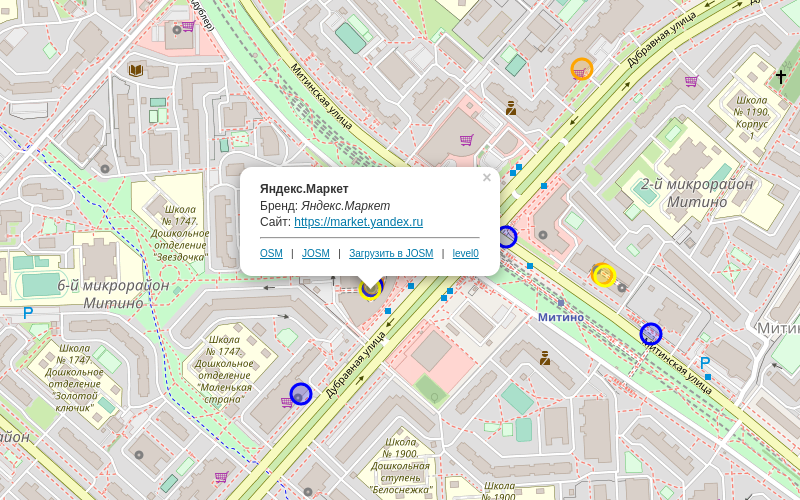
Продолжаю экспериментировать с картами - добавил слой с постаматами.

Разметить можно тегами:

name=Постамат [Бренд]
amenity=parcel_locker
brand=PickPoint
parcel locker:type=cabinet

Из брендов навскидку основные: PickPoint, Ozon, Яндекс, 5post, Почта России. Какие ещё забыл?

скриншот

https://osm.cupivan.ru/postamats/

The current usage of tags in OSM for junctions between motorways is really dangerous in high density areas.

  • There is currently a tag for the junction that is put at the point where the driver can’t change anymore way but at great risk.
  • Author of the current situation say that it’s fine as there is some tags on main lane say there is a junction and mode lane during the split of main road and junction.

I tried it around Paris with Organic Maps in navigation mode. An oral announce is made few hundred meters that driver should at left or right in few hundred meters, then when the change is no more possible, that the change should be made.

In high density areas, junctions can be on the left or on the right, two or three exits can follow from few tens of meters, making it more confusing, especially if there in not any announce of the name or number of the exit (as in case of Organics Maps), and on often overloaded traffic in these areas.

A good solution could be the announce of the exit direction, number or road name/number to follow, that could be verified on traffic signs, this imply that traffic signs nodes contains these informations. In France, on A6, exit numbers are given (ref field), but not the exit direction/name (name field).

Around Ris-Orangis in about 1000m (~40s at 90km/h) there are lot of changes at left/right between A6a, a6b and A10 The current representation doesn’t display at all the parallel lanes, but only start at the last moment the change can be done, from few tens of meters to several km after the start.

The driving rules, say to go as soon as possible on the exit and THEN to slow down quickly, not to slow down on the main lane, nor to wait for last time to change to exit lane.

Posted by Cristoffs on 17 October 2022 in English.

Warning: you read this at your own risk and you may collide with a wall of text. I’m sorry, but it didn’t fit in a few words.

I listened with interest to Florian’s speech at SotM 2022 (https://youtu.be/BRv-IFp_zZs), unlike him I do not feel I am a long-time contributor, although I consider myself active, both in terms of OSM editing and my activities in the Polish OpenStreetMap community. I would like to add my voice to the discussion and support Florian’s position a bit.

Let me start with why, in my opinion, the replacement of the current OpenStreetMap operating model, both in terms of the organisation and the database, is necessary. The reasons are the threats and challenges that are becoming more and more apparent and, paradoxically, stem from the growing interest in OpenStreetMap and its development.

By way of introduction, I refer you to Jennings Anderson’s speech at SotM from 2020: https://youtu.be/BI0VrPyAtcQ

and the update he made a year later and published in his diary: @Jennings%20Anderson/diary/396271

I’ll start with the scaremongering - here’s a list of the threats I think we will face in the near future:

Threat One - loss of community control over the project.

See full entry

Posted by b-unicycling on 17 October 2022 in English.

Still influenced by my proposal for settlement_type=crannog, I’ve looked at how historic settlements are mapped on OSM. There are three more or less “right” ways to do it (and so many wrong ones…). The three options are * map as historic= [whatever type of settlement] * map as historic=archaeological_site + site_type= [whatever type of settlement] * map as historic=archaeological_site + site_type=settlement + settlement_type= [whatever type of settlement]

The distribution today1 was (in reversed order from above, sorry):

settlement type/ form settlement_type=* site_type=* historic=*
ringfort 131 2 0
crannog 82 0 2
hut_circle 24 348 1
oppidum 8 15 3
city 6 612 16+(messy mapping) 2
village 3 11 58+ (messy mapping3)
town 2 0 12 (+ 3 “ghost_town”)
longphort 1 0 0
rundling 1 0 0
hut_site 1 0 0
hut 0 0 12
vicus 0 24 0
shieling 0 0 20 371
settlement n/a 3 788 ~25

In my opinion, historic= [whatever type of settlement] should only be used when the remains are still recognizable as buildings, like a ghost town or some sort of preserved settlement used as a museum (or “visitor experience”, as they’re now known), like some of the Pioneer towns in America.

Everything else I would classify as an historic=archaeological_site, and I personally would like to be able to classify settlements as such and then use sub-classification, if they are known. The high number of site_type=settlement supports that in my opinion.5

See full entry

Posted by Drallibor on 17 October 2022 in French (Français). Last updated on 7 November 2022.

Comment la caractériser objectivement ? Telle était la question que je me posais avant d’interroger les sources spécialisées (voir ci-dessous les principales) Il s’avère que la question porte très vite à débat, et cela a une certaine logique : la perception du caractère cyclable d’une route dépend du cycliste qu’il soit adulte sportif au quotidien ou enfant.

Moi je veux obtenir une carte pour un(e) enfant de douze ans. Pas de réponse claire : alors il faut militer pour obtenir des aménagements cyclables, ou la réduction de la circulation automobile.

Sources

Posted by tomtom1234 on 16 October 2022 in Japanese (日本語).

長らく止まっているEXレイドの代わりなのか、本日エピックレイドが開催された。
レイド開催ジムは、スポンサー以外のEXレイドジムをそのまま利用しているようだ。
近所でもかなり人が集まって、みんなコロナ禍でもこのゲームをやめなかったんだなとしみじみと思った。
反映まで長い時間はかかってしまったが、マップ更新を頑張って本当に良かったと思う。
今後このシステムのままエピックレイドが継続的に行われていくのか、注視していきたい。

ポケストは最近は飲食店をちまちま申請している。これもコツコツと続けていきたい。

10 жовтня територія України зазнала наймасованішої ракетної атаки після 24 лютого 2022 року.

Повітряна тривога тривала 6 годин.

Величезну кількість ракет було випущено з самого ранку по містам України. На додачу до ракет також було випущено дрони-камікадзе. Постраждало багато об’єктів інфраструктури.

Наш ранок також розпочався з жахливого вибуху, від якого здригнулась багатоповерхівка. Одна з перших ракет впала недалеко.

В ЗМІ є багато інтерпретацій і візуалізацій знищення нашої країни - тексти, відео, зображення.

Не залишився осторонь і підготував своє бачення у вигляді невеличкої візуалізації з використанням узагальнених хронологічних даних, отриманих з відкритих джерел. Для відтворення використовував Mapbox Play map locations as a slideshow.

Для візуалізації зібрав повідомлення очевидців про вибухи у містах, які були опубліковані в пабліках, створив geojson і додав опис подій в хронологічному порядку. Все це відтворив за допомогою Mapbox Play map locations as a slideshow. Додав трохи додаткової інформації, аудіосупровід.

Відео для перегляду

Posted by speedy on 15 October 2022 in English.

Moved to Munich in 2011, and not doing much mapping since… For Belgium I was “in here early” and starting on like a white sheet of paper. All biketours were openstreetmap-wise “new roads” and good for endles mapping entries, in Germany at that time “most seemed done”. Trying to add changes when I see them (new roundabouts, new roads, new maxspeeds) but often they are already taken care off.

Posted by b-unicycling on 15 October 2022 in English. Last updated on 17 October 2022.

Following the discussion over my proposal for settlement_type=crannog, I have done some clean-ups in the Historical group. Dear me, it was needed.

Today, I tackled site_type on taginfo which comprised of 38 messy pages. I spent 3.5hours

  • fixing spelling mistakes
  • changing upper case to lower case
  • changing spaces to underscores
  • translating values from a myriad of languages into English etc
  • translating and fixing values for historic:civilization
  • moving values from site_type to description or name
  • etc.

faulty tagging for hill forts

See full entry

Preview of changes

GIF of City

Changed using aerial imagery; I unfortunately do not live there anymore. Looks really nice. Trees added, suburb transformed.

Already transformed places

  • Osiedle Czyżówek
  • North ul. Żagańska
  • Square between Bolesława Chrobrego / Okrzei / Żagańska / Hutnicza
  • 35 - 32 Romualda Traugutta

changeset/127540536

Location: Karolinów, Iłowa, gmina Iłowa, Żagań County, Lubusz Voivodeship, 68-120, Poland