Tag:historic=tyring_platform
 historic = tyring_platform historic = tyring_platform
|
| Description |
|---|
| A platform used for putting the iron rim on a cart wheel. |
| Group: historic |
| Used on these elements |
    |
| Useful combination |
| See also |
| Status: undefined |
| Tools for this tag |


Description
A tyring platform or tyring plate is a platform with a central hole used for tyring a wooden wheel. It can be a recycled millstone or a circular stone with a hole in the centre or be made out of metal. It can be found near a building=smithy (aka forge), historic or still in use. They were used to place the cartwheel with the hub into the centre depression for the blacksmith or wheelwright to put the hot iron strap around the wheel as a new rim. They can also be an indicator of a historic smithy/ forge site, even when the building is already demolished and possibly as a memorial. Their diameter is very large to be able to hold the largest wheels which should help to differentiate them from smaller millstones and rotary querns which might have been placed in the area to preserve them in a heritage context.
Regionally different names are binding stone (Ireland), banding stone (Ireland), shoeing stone (Ireland) or ringing bed (Scotland)[1], as recorded in the Schools' Collection of the 1930s (see below).
If a recycled millstone is used, they might be mistakenly mapped as historic=millstone in a context where there is or was no mill nearby or where an association with a smithy/ forge is more likely. Due to both crafts needing running water, there might be a mill nearby, but the stone was still last used as a tyring platform.
How to map
If you are not sure whether it is a millstone or a binding stone, try to check historic maps to see whether there was a forge or mill nearby. Ask some locals, if there are any around.
Create a node  and add
 historic=tyring_platform.
Tags to use in combination
name=*- The name of the tyring platform or binding stone (might be named after the last blacksmith).diameter=*- The diameter of the tyring platform.material=*- The material the platform is made from.description=*- A brief description or historical information about the binding stone.inscription=*- Information about any inscriptions, markings, or carvings on the tyring platform or binding stone.start_date=*- The date when the tyring platform or binding stone was placed.heritage=yes,no- Indicates whether the binding stone has heritage status.tourism=attraction- If the tyring platform or binding stone is a tourist attraction.image=*- Link to a photo of the object. See alsowikimedia_commons=*.panoramax=*ormapillary=*- if they are on the roadside which is likely.wikidata=*- The Wikidata ID associated with the object, if available.ref=*- If the object is part of a collection (in a museum or heritage database or similar), there might be a reference number.
If there is a plaque or other tourism=information nearby, add that as well.
Gallery
-
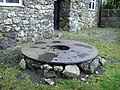 Tyring Platform, St.Nicholas
Tyring Platform, St.Nicholas by Martyn Harries, CC BY-SA 2.0, via Wikimedia Commons -
 A binding stone with a wheel on top at Parke's Castle in Co. Leitrim, Ireland. Stéphane Gallay from Laconnex, Switzerland, CC BY 2.0 <https://creativecommons.org/licenses/by/2.0>, via Wikimedia Commons
 -
 The binding stone outside Lee's Forge in Cappagh, Co. Kilkenny
A.-K. D., CC BY-SA 4.0, via Wikimedia Commons -
 Wheelwright's tyre bonding plate by Adrian S Pye, CC BY-SA 2.0, via Wikimedia Commons, in Lowestoft
 -
 Romanesque doorway of St Fiacre's Church, Ullard, Co. Kilkenny, with a circular depression in the large door slab which might also have been a binding stone. St Fiacre gave his name to the taxis in Paris who got their name because they brought people to the pilgrimage site associated with him.
Andreas F. Borchert, CC BY-SA 3.0 DE <https://creativecommons.org/licenses/by-sa/3.0/de/deed.en>, via Wikimedia Commons

.jpg)
.jpg)


See also
External links regarding tyring platforms
- Wikipedia
- Binding stone on Wikidata
- Results for "binding stone" in the Irish Schools' Collection on duchas.ie
- Results for "shoeing stone" in the Irish Schools' Collection on duchas.ie