Tag:historic=lime_kiln
Jump to navigation
Jump to search
 historic = lime_kiln historic = lime_kiln
|
 |
| Description |
|---|
Built structure which was used in the past to produce quicklime from limestone. 
|
| Group: historic |
| Used on these elements |
    |
| Useful combination |
| See also |
| Status: in use |
| Tools for this tag |


A lime kiln is used or was used in the past to produce quicklime from limestone. They are often found in the vicinity of quarries (landuse=quarry or disused:landuse=quarry). The quicklime was used in building roads, railway tracks or to manipulate land quality.
How to map
Ideally, map the area of the lime kiln, if there are still remains on the ground. Add the tag historic=lime_kiln.
Additional tags
name=*, if there is a name for this specific lime kiln. Do not usename=limekilnorname=lime_kilnstart_date=*and/ orend_date=*, if you have any information about this- if the lime kiln is a registered monument, add the reference applying for that area and the appropriate
heritage=*level. wikimedia_commons=*description=*capacity=*:capacity=1for a single lime kiln,capacity=2for a double etc.material=*: Some are built from bricks, some from freestone which is non-burning lime stone.
If it has been completely demolished, use the lifecycle prefix demolished: or use the combination of historic=archaeological_site and archaeological_site=lime_kiln instead.
Gallery
-
 A double lime kiln in Charlestown, Ireland. A.-K. D., CC0, via Wikimedia Commons
 -
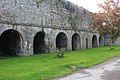 Multiple lime kilns at Talybont-on-Usk in Wales, UK. Martinvl, CC BY-SA 4.0, via Wikimedia Commons
 -
 Footpath and Lime Kiln near Whitewell. Tom Richardson, CC BY-SA 2.0, via Wikimedia Commons
 -
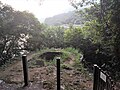 Top of a lime kiln in Hong Kong. Underwaterbuffalo, CC BY-SA 4.0, via Wikimedia Commons
 -
 Lime Kiln Ogden Canyon Utah. GreenGlass1972, Public domain, via Wikimedia Commons


