Proposal talk:Tag:service=bus bay
Physical separation
If it is not physically separated, then there should not be a separate highway=*. A lowered kerb is not a physical separation. --ToniE (talk) 11:45, 14 August 2024 (UTC)
- That's mentioned throughout the proposal, most notable under when not to use it (though I could probably be more clear that one shouldn't draw a way in that situation either).
- I would like to see some examples. Paint or a different surface are in general not sufficient to be mapped as separate highways in OSM. Please remember that we do have lane tagging that allows to map an additional lane in great detail without the need of a separate highway. --Mueschel (talk) 17:31, 14 August 2024 (UTC)
Why not bus_bay=yes?
The text here is wrong: bus_bay=right, bus_bay=left and bus_bay=both do exist --ToniE (talk) 11:42, 14 August 2024 (UTC)
- You're misunderstanding the point. What I meant here are alternatives I've considered and my conclusion to use
service=bus bayoverbus bay=yesis that the current definition ofbus bay=*is about the existence of a bus bay but not whether a way is a bus bay.- OK, understood. I've seen so many
highway=servicew/o anyservice=*mapping bus bays as separate OSM ways, where the bus bay is not physically separated in reality. This is due to the lack of knowing thatbus_bay=*exists? - My concern: Mappers could fall back to the old, incorrect behaviour of mapping those bus bays as separate OSM way, because of "why should I add bus_bay=* to the main road when a separate
highway=servicewithservice=bus_baylooks so nice on the map?" - --ToniE (talk) 14:10, 14 August 2024 (UTC)
- I actually can understand your worries. I've just added a description that a barrier can (and should) be drawn between the main and the bus bay way, though the "when not to draw section" should further explain others to avoid this. Incidentally, I've also noticed that some cycle lanes also drawn as their own ways (which also is to be fixed) so such mappers will always exist. *sigh* --ManuelB701 (talk) 13:38, 23 August 2024 (UTC)
- OK, understood. I've seen so many
Would love to see images
"A picture is worth a thousand words." Please add images especially for the cases "when" and "when not" to use service=bus_bay --ToniE (talk) 11:49, 14 August 2024 (UTC)
- As mentioned in the thread (which I've now linked), I'm missing out some images. I've already uploaded one but have yet to embed it into the page, not mention I still need some examples of the different types of bus bays (I have one easy to access whose only separation is by kerb, at least, but still need for other examples). --ManuelB701 (talk) 13:48, 14 August 2024 (UTC)

Are there any implied access restrictions/grants?
Could you please add a statement whether or not highway=service with service=bus_bay implies any access definitions like bus=yes or even bus=designated together with motor_vehicle=no or so? --ToniE (talk) 14:36, 14 August 2024 (UTC)
- Probably a good idea to say that
highway=service+service=bus_bayhas the same default access rules ashighway=busway. --JeroenvanderGun (talk) 14:50, 14 August 2024 (UTC)
- One of the challenges with it is that pedestrian routes won't take the bus bay way into consideration if
access=*defaults tonowhen sidewalks aren't mapped separately already. I think if I have to chose the default access restrictions, it'sbus=designatedwithvehicle=no(exceptions can always be handled manually by tags) which is less strict thanhighway=busway(impliedaccess=no. On that aside, I'm strictly against a variant onhighway=buswayfor the reasons I specified in the draft (non-throughfare purpose). --ManuelB701 (talk) 13:46, 23 August 2024 (UTC)
- One of the challenges with it is that pedestrian routes won't take the bus bay way into consideration if
Here in Norway I often see the bus bay sharing surface with the shared bicycle/footpath that goes parallel with the road. Implying access restrictions on the bus bay would mean breaking the path for pedestrians and cyclists. Pbb (talk) 10:54, 18 August 2024 (UTC)
Underscore
The proposal inconsistently uses both bus_bay (with underscore) and bus bay (with space) in tags. Please use the underscore consistently. :) --JeroenvanderGun (talk) 14:46, 14 August 2024 (UTC)
- Fixed.--ManuelB701 (talk) 05:36, 15 August 2024 (UTC)
Definition problems from examples
- 467609377
 467609377 L425 Rheinhessenstraße
- Unsure whether center platforms are considered "bus bay"
- There are also island platforms without raised separation for bus with left-side doors that may fit
bus_bay=leftononeway=yesmore, but these are notservice=bus_bayhttps://nacto.org/publication/transit-street-design-guide/stations-stops/stop-configurations/median-stop-left-side-boarding/
- 494916789 494916789 Bahnhofsplatz
- Why is this a "bus bay"? How do you distinguish small
amenity=bus_stationfrom them? - As I mentioned on Discourse forum, this is an example how
service=bus_bayis awkward. Thehighway=servicehasbus_bay=bothof its own, and thehighway=unclassifiedeven hasbus_bay=leftcontradictory withbus_bay:left=separate.
- Why is this a "bus bay"? How do you distinguish small
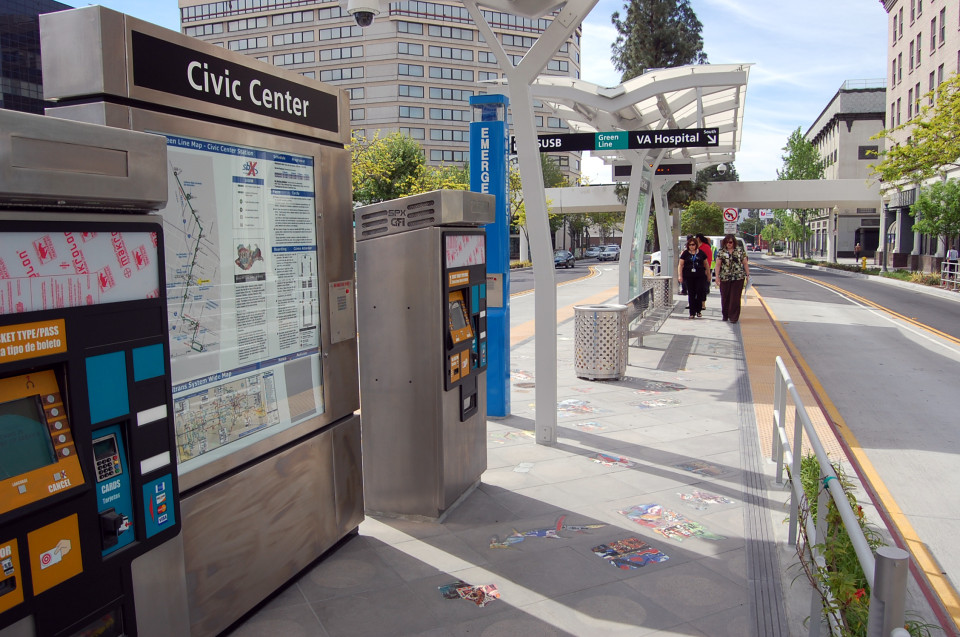
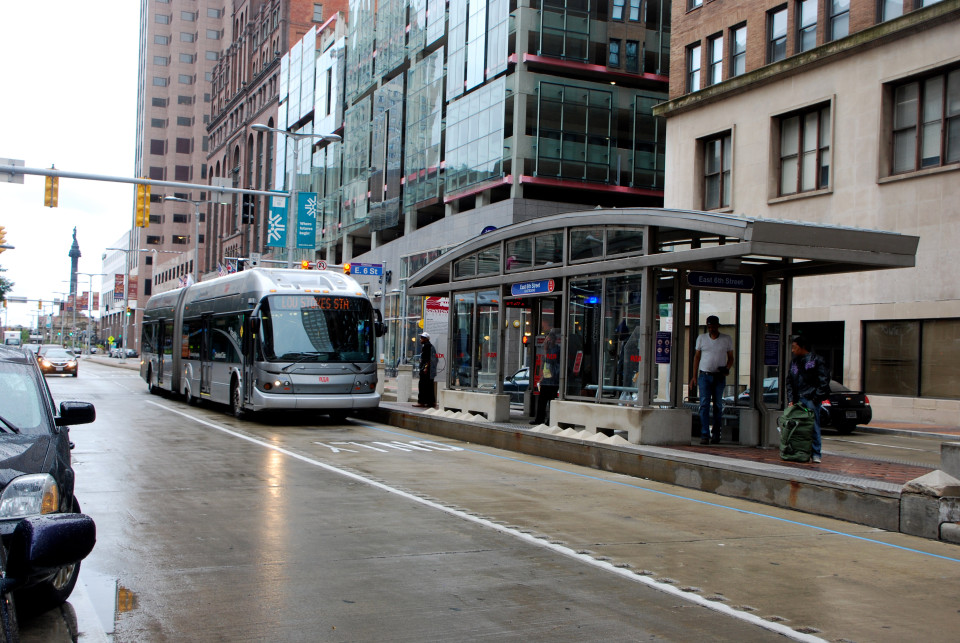
—— Kovposch (talk) 05:31, 15 August 2024 (UTC)
- Okay, for starters, this formatting is quite bad and should have been split among multiple level 3 headings (you do you, I merely reply in the same format).
- As of 467609377 467609377: For all intents and purposes, it's basically the same principle as the canonical example, just towards the median and not the kerb (and by the virtue of). If it were a simple island platform (no separation), you'd certainly tag it with
bus_bay=left(in RHT) instead. - As for 494916789 494916789: It's been quite a while since I've seen this street. I might actually remove it for this reason. It is not contradictory with
bus_bay:left=separateper-se (especially because I called it an "at most") much like how a parallel footway doesn't stop the highway from having its own (tagged) sidewalk or — in a better example — a non-compulsory cycleway exist parallel to cycle lanes on the carriageway however rare that is (you wouldn't use cycleway:side=separate but first and foremost tag the cycle lane). However, it's been a while since I've seen this street and forgot / didn't realise it has its own bus bays (I'll probably move it to dubious).
Whether it's a small bus terminal or not is a different story and I don't see it as a conitradiction in this situation (it's basically a way inside a bus terminal).
- As of 467609377
- --ManuelB701 (talk) 06:44, 24 August 2024 (UTC)
Bus terminals
Using inside amenity=bus_station shows how this fails at 2 aspects.
- Each bus stand can have its own bus bay. And this again causes conflict in the meaning of
bus_bay:*=separatewith stands or roads next to them on each side. - Doesn't show the usual characteristics of
bus_bay=*as being on streets
—— Kovposch (talk) 05:47, 15 August 2024 (UTC)
- I've decided to rework the page and drop the
bus_bay=separatepart (reducing it to an aside and how it's more useful for regular bus bays) and also mention the distinction between trunks and platform ways for bus terminals (and how they don't always need to come off from a normalhighway=service). --ManuelB701 (talk) 17:56, 16 October 2024 (UTC)
Straight stops and "bay" definition
Unlike the cover photo File:Mainz_-_Bushalt_Sankt_Bernhard.jpg , a "bus bay" is similar to parking=street_side parking bays for being an extension of the roadway protruding out from the side. These straight on-line stops similar to parking=lane , or a "bus bypass" and short bus "lane", are better considered as bus stops with raised separation on their own, not bus_bay=* . Key:bus_bay cover photo File:[email protected] illustrates the meaning.
—— Kovposch (talk) 06:00, 15 August 2024 (UTC)
![File:[email protected]](/wiki/File:1033@970.jpg)
- You be you. In my definition, this is a special kind of bus bay. Basically, if it looks similar a duck but walks like a duck, quacks like a duck, it most likely is a duck but with some unique characteristics. --ManuelB701 (talk) 17:59, 16 October 2024 (UTC)
Redefinition and naming
This interpretation of bus_bay , and use of bus_bay:*=separate , actually conflicts with existing definition from original proposal. bus_bay=* was to be reserved for use on either the main roadway, or the highway=service , not mixed in referring to each other.
- "A bus bay must be a bay outside the main carriageway (not included in lane count) and not physically separated. "
- "If the boarding place is physically separated (splits off) from the main carriageway, make a highway=service for it and do not use this tag unless there is really a bay along the carriageway of highway=service. "
Key:bus_bay https://wiki.openstreetmap.org/w/index.php?oldid=1495374#Definition
As in my Discourse forum comment, using service=bus_bay creates risk of users wrongly drawing a separate highway=service when there's no raised separation.
—— Kovposch (talk) 06:03, 15 August 2024 (UTC)
- On one hand, I understand your worries. But on the other hand, this has happened countless times before and when these mappers do come up, they should be reminded that when there is no separation in real life, you don't draw separate way on OSM. Heck, I've even seen some bicycle lanes (not tracks!) drawn as their own ways as well as turn lanes drawn at where they start and not where where the carriageway splits of so this is by far not a unique situation. For this reason, I don't see adding
service=bus_bayin conflict withbus_bay=*but rather see it in a similar light ashighway=buswayand the (IMO deprecated)busway=*(in other words, the reason why a rawhighway=serviceshould be used is because no established tagging for bus bay ways exist now). - In any case, I've decided to rework the
bus_bay=separatestory and even before that, I've also added an instruction to draw a barrier if it wasn't done so already (essentially the [sic] on OSM). --ManuelB701 (talk) 18:10, 16 October 2024 (UTC)