Ko:Tag:motorroad=yes
 motorroad = yes motorroad = yes
|
.svg) |
| 설명 |
|---|
고속도로가 아니면서 고속도로와 유사한 교통 규칙과 접근 제한을 가진 도로. 
|
| 그룹: 제한 |
| 해당 요소의 사용 |
    |
| 의존하는 태그 |
|
| 함축하는 의미 |
| 유용한 조합 |
| 같이 보기 |
|
| 상태:사실상 표준 |
| 이 태그를 위한 도구 |


motorroad=yes 태그는 고속도로와 비슷한 교통 규칙과 접근 제한이 적용된 법적 도로 분류의 하나이지만, 고속도로는 아닌 도로에 사용됩니다.
이 키는 주로 도로표지 및 신호에 관한 빈 협약을 따르는 국가에서, 교통 표지판으로 표시되는[1] 자동차전용도로를 나타내는 것을 의도하였습니다.
Signs notifying an entry to (...) a road on which the traffic rules are the same[2] as on a motorway
/

Sign E, 6a, "ROAD FOR MOTOR VEHICLES", shall be placed at the point where special traffic rules begin to apply on roads other than motorways which are reserved for motor vehicle traffic and do not serve properties bordering on the road. (...)


이 태그는 빈 협약을 따르지 않는 다른 국가에서도 교통 법규가 유사한 표지판이나 개념을 사용한다면 사용될 수 있습니다. (고속도로와 비슷한 통행 규칙에 고속도로가 아닌 도로)
국가에 따라, motorroad=yes 는 다양한 접근 제한과 또다른 도로 속성을 암시할 수 있습니다. 예를 들어, 이 태그는 흔히 자전거와 보행자가 출입할 수 없고 주정차가 금지되어 있음을 암시합니다.
몇몇 국가에서는 expressway=yes와 비슷한 정의에 따라 이 도로의 일부가 고속화도로로 공식 인정될 수도 있습니다.[3][4]
표현 방법
자동차전용도로에 해당하는 도로에 motorroad=yes 태그를 추가로 적용하세요. 주로 highway=primary 또는 highway=trunk이지만 highway=motorway는 아닙니다.
법규에 따라, "고속도로와 유사한 교통 규칙"의 의미는 기술적으로 다양한 경로 탐색상의 고려를 포함합니다. 이 부분의 일부는 아래의 국가별 문단에 "암시된" 태그로 언급되어 있습니다. 소프트웨어의 지원 여부를 확신하기 어려워, 이 태그를 접근 제한, 제한 속도에 관한 명시적 태그로 보충하는 것을 생각해보세요.
해석에 따라, highway=trunk 는 motorroad=yes를 암시할 수도 있습니다.
고속도로와 유사한 규제가 없는 경우 명시적으로 motorroad=no로 태깅될 수 있습니다. Tag:motorroad=no 항목을 참고하세요.
소프트웨어 지원
접근 제한, 회전 제한, 제한 속도와 같은 고속도로와 비슷한 교통 규칙은 경로 탐색에 중요하며 탐색 엔진에 의해 널리 이해됩니다. 하지만 motorroad=* 태그는 더 애매하고 널리 지원되지 않습니다. 이 태그의 다양성과 간혹 도로에 대한 모호한 적용으로 인해, 이 키를 지원하는 경로 탐색기조차 여기 적힌 모든 태그가 추론된다고 보장하지 않습니다.[5]
지역별 정의
몇몇 지역에서는 이 키의 존재가 다른 태그의 값을 추정하는 데 사용될 수 있습니다. 이는 foot=no, bicycle=no, moped=no, horse=no가 될 수 있습니다.
대한민국
대한민국에서는 이 태그가 자동차전용도로임을 나타냅니다. 본선상의 시종점에서는 , .svg) , 자동차전용도로로의 진입로에서는
, 자동차전용도로로의 진입로에서는  표지판을 통해 표시됩니다. 고속도로(고속국도)는
 highway=motorway 태그를 사용하여 motorroad 태그로는 표현하지 않습니다. 아래 예고표지를 통해 자동차전용도로가 끝나기 전 미리 안내됩니다.
.svg)
자동차전용도로에 암시된 태그:
minspeed=30maxspeed=90motorcycle=nomoped=nomofa=nobicycle=nosmall_electric_vehicle=noagricultural=nohand_cart=nocarriage=nofoot=noemergency=yes
벨기에
 자동차전용도로 (Dutch: autoweg, French: route pour automobiles). 고속도로처럼 보이지만 교차로나 신호등이 있기도 합니다. By definition:
 motorroad=yes. 자동차전용도로의 highway 키 값은 대부분 trunk 입니다. 반대로, 벨기에에서 trunk로 태그된 모든 도로가 자동차 전용도로인 것은 아닙니다.
자동차전용도로에 암시된 태그:
foot=nohorse=nobicycle=nocarriage=noagricultural=nomoped=nomofa=nospeed_pedelec=noatv=noparking:both=no
 고속도로 (Dutch: autosnelweg, French: autoroute)에
 motorroad 태그를 사용하지 마세요. These are instead tagged zone:traffic=BE:motorway (highway=motorway for the main carriageways). Motorways have the same implications as motorroads, and additionally imply minspeed=70 (unless maxspeed=* is lower).
브라질
Undefined, as the federal law does not restrict access to any type of motorized highway based on a combination of transportation modes.
칠레
고속도로와 자동차전용도로에 암시된 태그:
프랑스
자동차전용도로에 암시된 태그:
foot=nohorse=nobicycle=nocarriage=noagricultural=nomoped=nomofa=nospeed_pedelec=no
and others...
핀란드
핀란드에서는, 이 태그를 통해 도로가 Moottoriliikennetie인지를 나타냅니다.
minspeed=60(not a minimum driving speed; rather, vehicles must be designed to be operated at this speed)foot=nobicycle=nomoped=nohorse=noparking:both=no- (
u_turn=no) - (
reversing=no - No towing with a rope, cable or any other similar – except to the first exit only in case of a breakdown.
독일, 크로아티아
독일에서는 이 태그를 통해 도로가 wikipedia:de:Kraftfahrstraße인지를 나타냅니다 (§18 StVO). 60km/h 이상으로 주행할 수 있는 자동차만이 허용됩니다. ("bauartbedingte Höchstgeschwindigkeit")
minspeed=60foot=no(implied by motor_vehicle)bicycle=no(implied by motor_vehicle)moped=no(implied by minspeed)horse=no(implied by motor_vehicle)agricultural=noagricultural vehicles are by definition slower than 25 km/hparking:both=nono reversing and no stopping except in case of emergency (emergency does not include needing to use a toilet or running out of fuel)maxspeed=110in Croatia only
Hong Kong
It is now used for Tunnel Area by some, per Cap 368A Road Tunnels (Government) Regulations, and other legislations for BOT private tunnels. Despite this naming, it is not used on all tunnels (viz Lin Cheung Road Underpass is a significant tunnel with exposed sections, resulting in similar restrictions without being a Tunnel Area) , nor limited to sections with tunnel (see East Kowloon Corridor, or Heung Yuen Wai Highway north of Cheung Shan Tunnel).
Due to historic usage and original guidelines, the status quo have them as highway=motorway, rather than highway=trunk or other normal functional classification. Excluding 485404214 485404214 Tung Wing Road (Airport Tunnel), the exception now is 36072108 36072108 Discovery Bay Tunnel (
highway=secondary). This may be migrated away in the future.
-
 Note this is a sign for a special road class with legal effects, similar to blue motorway (green "Expressway in HK) white "chopsticks" signs. It has its own set of rules and restrictions. It is not a general warning sign for tunnels as found in other countries, nor a pure informatory symbol for navigation.
 -
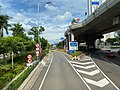 Typical set of restrictions for a toll-free Tunnel Area, aside the default no "red minibus" ("public light bus" that are not "scheduled service")
share_taxi=nothat can be overridden. Headlight restrictions at tunnel portal not shown at entry here. Pay attention to the blue "Tunnel Area" white text sign, emphasizing "tunnel regulation applies".


This indicates a road which is mainly built for motor vehicles, with motorway-like design, no footpath and pedestrian/bicycle/learners banned by presence of road sign but itself not a motorway.
However, if the road itself is in motorway-like design, but foot and bicycle are allowed on that, foot=yes/bicycle=yes may be added.
This is at odds with the definition of legal designation and signage of this tag, as raised in Talk:Proposed features/Motorway indication#Already exists (with an inferior name)?. Tunnel control area may be more suited to this.
Such usage have been removed in 2022.
Italy
In Italy, the tag must be used when one of the following road signs is present:
.svg) or
or  (strada extraurbana principale)
 (strada riservata ai veicoli a motore)
 (a superstrada having the same access limits as a strada extraurbana principale)
The access restrictions for an Italian motorway apply:[6]
minspeed=80foot=no(implied by motor_vehicle)bicycle=no(implied by motor_vehicle)moped=nohorse=no(implied by motor_vehicle) (and more generallyanimal=no)agricultural=no- no access to motorcycles equipped with a thermal engine having a displacement smaller than 150 cm³ (
motorcycle:conditional=no @ (displacement < 150 cc)) - no access to motorcycles equipped with a electrical engine having a engine power less than 11 KW (
motorcycle:electric:conditional=no @ (power < 11 kW))[8] - no access to sidecars equipped with a thermal engine having a displacement smaller than 250 cm³ (
sidecar:conditional=no @ (displacement < 250 cc)) - no access to motorcycle-like vehicles (motoveicoli)[9] (other than those listed above) having unladen mass less than or equal to 400 kg or a max gross weight less than or equal to 1300 kg with the exception of motorized tricycles (trikes) designed for carrying people, with no more than 2 seats (1 driver + max. 1 passenger), having a displacement grater than or equal to 250 cm³ or more and an engine power grater than or equal to 15 kW.[10]
Implied tag might be
quadricycle:conditional=no @ ((empty_weight <= 400 kg) OR (maxweightrating <= 1300 kg)).
motorized_tricycle:conditional=no @ ((empty_weight <= 400 kg) OR (maxweightrating <= 1300 kg)); yes @ ((displacement >= 250 cc) AND (engine_power >= 15 kW) AND (seats <= 2))
- no access to vehicles without tyres
parking:both=nostopping=noreverse=no
Netherlands
In the Netherlands, motorroad=yes is used to indicate  autowegen.
In accordance with NL:The Netherlands roads tagging, motorroad=yes is used on highway=trunk, and in some cases trunk_link or motorway_link (Taginfo). Conversely, some highway=trunk are not autoweg themselves but merely connect between auto(snel)wegen. As of January 2024 some 16% of highway=trunk is therefore tagged with motorroad=no (Taginfo).
motorroad=yes has the following implications:
- Various access restrictions (see OSM tags for routing)
maxspeed=100(inzone:traffic=NL:rural, not inzone:traffic=NL:urban)parking:both=no- No U-turns
- No reversing
Norway
In Norway, Motortrafikkveg (prev Motorvei klasse B) is a property of a way when signed with  . Only used on trunk and primary. May or may not be a dual carriageway. Can be as little as two lanes. Default
 maxspeed=* is, like any other non-urban road, 80km/h. Other speeds will be signed.
Access (Trafikkreglene §4-2): foot=no, bicycle=no, moped=no. There is no minspeed, but any vehicle must be able to drive at least 40km/h on a flat road.
There will be no driveways. No backing up or turning (Trafikkreglene §11-2). No stopping (Trafikkreglene §17-1-e). No parking (on any road with maxspeed higher than 50km/h).
Poland
In Poland, motorroad=yes is used to indicate roads which are not tagged as highway=motorway but do have motorway-like access rules. According to the law, this is indicated by the  B-6/8/9 prohibitory sign, which bans all vehicles other than road transport vehicles. The Minister's Decree explicitly specifies that the sign should be applied to a road when an entry ban on vehicles not allowed on a motorway is desired.[11]
Implied tagging is:
foot=nohorse=nobicycle=noagricultural=nocarriage=no
Portugal
In Portugal, the tag motorroad=yes is used to identify "vias rápidas", which are ways with motorway-like access rules, but are not highway=motorway (autoestradas). According to the law, the access is indicated by the  C4e prohibitory sign. There's no minimum speed, but the maximum speed allowed is 110 km/h, instead of the 120 km/h limit in motorways.
The vertical signs used to identify these highways are H25 and H39 (beginning and end respectively):
 |
 |
Implied tags are:
Spain

In Spain, the tag indicates whether a road is a Vía para automóviles  , or other type of road with similar restrictions. Autopistas
  and autovías
  are not usually tagged with this tag, as they are tagged as
 highway=motorway.
minspeed=60foot=nowheelchair=nokick_scooter=nosmall_electric_vehicle=nohorse=nocarriage=noagricultural=nobicycle=nomofa=nomoped=no
Turkey
Key to be used only where the  road sign is present.
Note: The sign is de facto not used for any roads in Turkey, therefore usage of this tag is discouraged. Please tag with signs that already present at the road.
United Kingdom
You can use the key on British primary routes with motorway-like access restrictions signed or similar (according to GOV.UK Transport). Examples include the A40 Westway, the A12 between Wanstead and Hackney Wick, and the A13 between Dagenham Dock and Thurrock.
You need to add motorroad=* manually because all classes of traffic may use British primary routes by default.
Unless specified (such as the speed limits at the Blackwall Tunnel in London), the tag implies the following:
maxspeed=70 mphfoot=nobicycle=nohorse=noparking:both=nosidewalk=no(i.e. any pavement on such roads are irrelevant because pedestrians are already banned. However, it is included for sake of completeness)
United States


In many U.S. states, state law technically distinguishes between expressways and freeways (i.e., motorways) but does not formally tie the expressway classification to a set of access restrictions. Instead of the motorroad symbol sign used in many Vienna Convention countries, the MUTCD specifies a "selective exclusion sign" that explicitly lists the prohibited modes of transportation. [2] The exclusions can differ between two expressways in the same state, so always add explicit access tags according to the specific exclusions on the sign posted at entrances to the expressway. Despite the absence of classification-based access restrictions in the U.S., motorroad=yes has sometimes been applied in addition to the access tags on various highway=trunk and highway=primary ways, which typically happen to be expressways.
expressway=yes is commonly used in the U.S. to explicitly tag an expressway, regardless of road classification or access restrictions. This tag supports the common American cartographic practice of displaying expressways with a distinct color or line pattern. Historically, highway=trunk has often been interpreted to correspond to expressways in the U.S., so the need for a separate tag was often overlooked. However, as of 2021, there is a proposal to expand the definition of a trunk road to include non-expressways, making expressway=yes necessary for distinguishing these high-performance roads from conventional surface streets.
Vietnam
This key has a different meaning in Vietnam than in most other Vienna Convention countries, because the motorcycle remains the primary motorized vehicle on the road. As of 2021, motorroad=yes has been tagged on roads posted with  ,
,  , or
, or  . (For example, all the carriageways visible from [3] are tagged
 motorroad=yes despite the differing access restrictions.) The values of motorcar=*, bus=*, and motorcycle=* cannot be reliably inferred, but in any case, foot=no and bicycle=no are likely implied.
Japan
"Motorroad" is not defined in Japan. (Proposed "JapanTagging/RoadTypes/motorroad" was rejected.)
같이 보기
expressway=*- 통행방향이 분리되고(dual-carriageway) 고속화된 설계 특성과 제한된 접근성을 가진 도로를 표현하기 위해 북미 지역에서 더 흔히 사용되는 태그highway=motorway- 고속의 자동차 교통을 안전하게 이동시키기 위해 설계된 고용량의 도로highway=trunk- 고속도로가 아니지만 가장 중요한 도로highway=primary- 큰 도시를 연결하는 도로- Proposed features/Motorway indication -
highway=motorway가 아니지만 물리적으로 고속도로와 유사한 도로를 태그하기 위한 버려진 제안
각주
- ↑ Convention on Road Signs and Signals, consolidated version, p. 47
- ↑ In practice there can be (subtle) differences between the rules on motorways and the rules on roads for motor vehicles, even in signatory countries of the Vienna Convention. Especially the default speed limit is often higher on motorways (which is also explicit elsewhere in the convention).
- ↑ “Express road”. Glossary for transport statistics. Luxembourg City: Publications Office of the European Union. 2019. p. 34.
- ↑ “Express road”. Statistical Terms Glossary. Beirut: United Nations Economic and Social Commission for Western Asia. Retrieved October 3, 2024.
- ↑ 예를 들어, Valhalla는 이 키를 오직 국가별 특정 접근 제한을 추정하는 용도로만 사용합니다. [1]
- ↑ Nuovo codice della strada (DL n. 285 del 30/4/1992) art. 175
- ↑ Regolamento di esecuzione e di attuazione del nuovo codice della strada (DPR n. 495 del 16/12/1992) art. 372
- ↑ Conversione in legge, con modificazioni, del decreto-legge 10 settembre 2021, n. 121, recante disposizioni urgenti in materia di investimenti e sicurezza delle infrastrutture, dei trasporti e della circolazione stradale, per la funzionalita' del Ministero delle infrastrutture e della mobilita' sostenibili, del Consiglio superiore dei lavori pubblici e dell'Agenzia nazionale per la sicurezza delle infrastrutture stradali e autostradali (Legge n. 156 del 9 novembre 2021)
- ↑ Italian laws use the word motoveicoli to define a category of vehicles that includes motorcycles, sidecars, motorized tricycles and quadricycles (that are not considered moped).
- ↑ Conversione in legge, con modificazioni, del decreto-legge 16 luglio 2020, n. 76, recante misure urgenti per la semplificazione e l'innovazione digitale (Legge n. 120 del 11/09/2020)
- ↑ Dz. U. z 2019 poz. 2311