OpenStreetMap logo OpenStreetMap

dekstop's Diary

Recent diary entries

If you’re subscribed to the HOT mailing list you’ve seen a recent invitation to help develop a funding application for the Knight Prototype Fund, coordinated by Russ and Blake. The intention was to discuss project proposals that may be suitable for this grant. The initial IRC meeting then developed into a larger conversation around current HOT needs for better tools: the resulting Google Doc with meeting notes lists six project ideas.

The strongest candidate was a proposal to develop a HOT/OSM tool to support Quality Assurance (QA). You can read some details in the grant proposal writeup, however it’s a fairly high-level text. Informed by our discussion I also developed a draft specification, with a more detailed list of considerations and potential features.

I’m posting this draft specification here to get your feedback, and to hopefully stimulate some debate about what a good QA support tool might look like. The proposal is a result of conversations with HOT practitioners, and based on my own use of HOT and OSM data. However there are likely many community members with further ideas, and some may even have worked on HOT QA initiatives. We would love to hear from you! In particular we would love to hear from validators, and from existing users of HOT data. What specific data quality concerns arise in practice?

(I should also state that I don’t have a deep understanding of the Humanitarian Data Model – there are likely some useful concepts in there that could be more emphasised in the spec.)

Considerations

Our general ambition is to make HOT progress more visible. More specifically, the proposal aims to support our existing QA processes around HOT validation. Crucially it further aspires to provide a means of demonstrating HOT data quality to prospective users of the maps.

Aims of the proposed QA support tool:
See full entry

HOT validation as prerequisite for community growth?

Posted by dekstop on 6 August 2015 in English. Last updated on 9 August 2015.

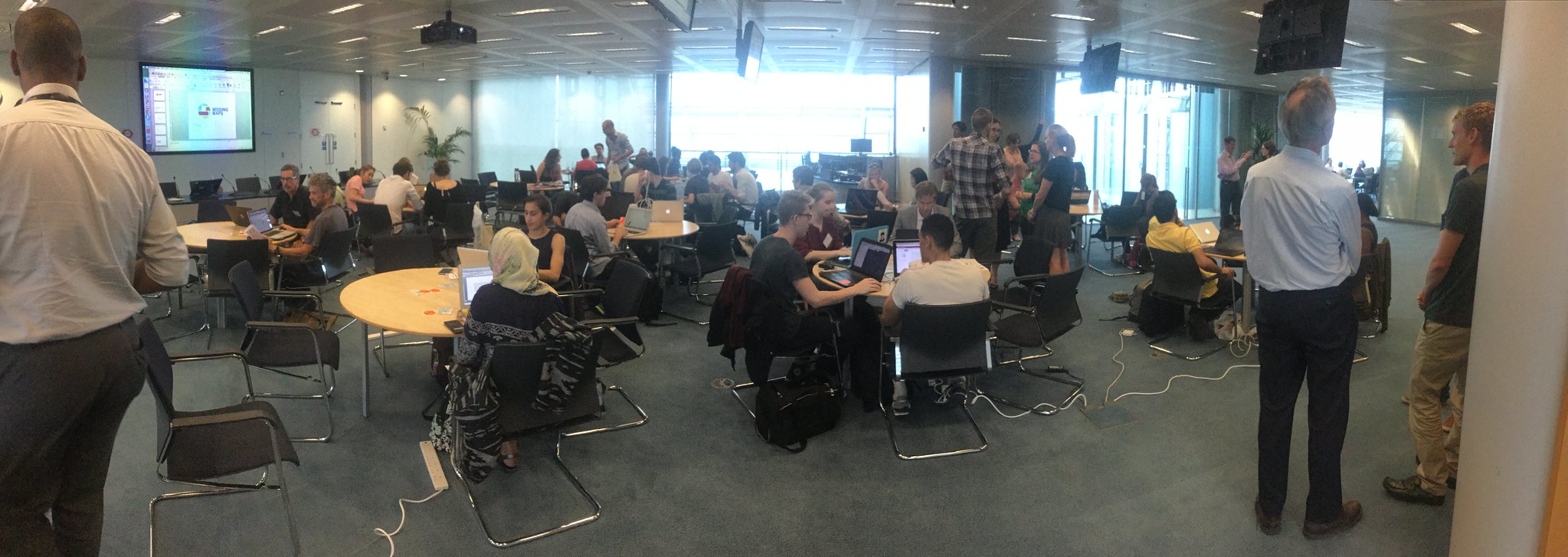
Missing Maps London mapathon in August 2015

In a response to an acute shortage of validators, Missing Maps in London are now training people up at their monthly events: first to learn JOSM, then validation. I think that’s great! It’s particularly fitting that validators are trained from the same volunteer pool as new HOT contributors. That way, at least in principle, their numbers can grow together. While currently validation is often on the shoulders of a few expert insiders, in this new model it instead can become an important training aspect for larger numbers of highly engaged HOT contributors. Becoming a validator could be an important rite of passage for certain new contributors.

See full entry

Initial activity and retention of first-time HOT contributors

Posted by dekstop on 22 June 2015 in English. Last updated on 6 July 2015.

(Hallo! I’m Martin Dittus, a PhD student at UCL. You can read more about my research in an earlier post.)

The volunteers of the Humanitarian OpenStreetMap Team (HOT) and its affiliated projects have spent many thousands of labour hours on the creation of new maps for humanitarian purposes. Yet mapping all the undocumented and crisis-stricken regions of the world is a formidable task. The 2014 response to the Ebola epidemic illustrated this well: even after months of work by thousands of volunteers, the new maps of Central and West Africa are still nowhere near complete.

Many people within HOT now believe that this can best be addressed by growing the community by a few orders of magnitude. An MSF article about Missing Maps articulates this ambition:

To reach our goal, we need the Missing Maps Project to be the biggest instance of digital volunteerism the world has ever seen.

So let’s say we’d want to grow HOT to a million volunteer contributors. How can we train new contributors at that scale? What are our barriers to entry? How can we retain contributors once they’ve had first experiences? Etc… many open questions.

As a first step let’s learn from existing experience. How does engagement compare across the different mapping initiatives right now? Let’s start with a simple comparative study.

Comparing three large HOT initiatives

I’m particularly interested in the engagement profile of first-time contributors: people who may have OSM experience, but who have never before contributed to HOT. How much work do they provide in the first couple of days? How long do they stick around?

In this post I’ll compare the first-time contributor engagement profiles of three initiatives. Each has a different purpose, and a different mode of organisation:

See full entry

Hallo! My name is Martin Dittus, and I’m a PhD student at the ICRI Cities at University College London. I research community engagement in the Humanitarian OpenStreetMap Team (HOT), a volunteer initiative with thousands of contributors. At its core this is quantitative work, and my main outputs are statistics and data visualisations. I also spend a lot of time with the HOT community, am a contributor myself, and have spent much of the last decade with a range of similar community organisations.

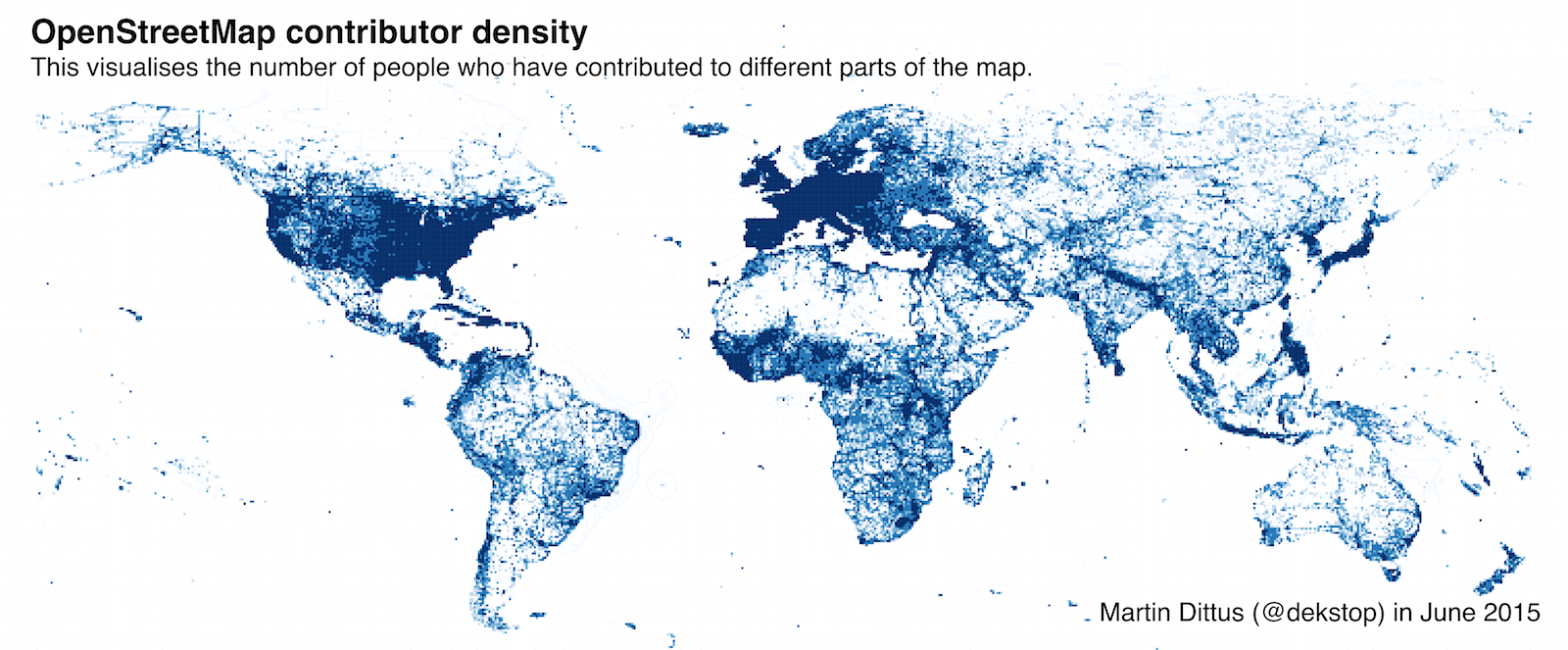
I like that my job allows me to combine my experience in large-scale data analysis with my personal interest in community organisations. I spend a lot of time exploring data sets, producing things like this:

OpenStreetMap contributor density map

See full entry

Location: Fitzrovia, London Borough of Camden, Greater London, England, W1T 5EE, United Kingdom