
OpenStreetMap logo OpenStreetMap

dekstop's Diary

Recent diary entries

So I completed a PhD on community engagement in HOT and Missing Maps...

Posted by dekstop on 15 September 2019 in English. Last updated on 20 September 2019.

… two years ago, and I haven’t even managed to write a diary entry about it. Has it really been that long? I’ve been meaning to post a summary for the longest time, but somehow life got in the way. Fortunately, this week David Garcia and me will host a workshop at the HOT Summit and present a talk at State of the Map in Heidelberg. I’m super excited about both sessions – you should join us if you’re coming! And it became the perfect excuse to dust off my draft for this post, and make sure all the research outcomes are finally assembled in one place.

But let me start in the beginning.

Hallo, my name is Martin Dittus, and between 2014 and 2017 I’ve accompanied HOT and Missing Maps for my PhD on community engagement in humanitarian mapping. We’ve had an amazing time together! During the PhD, we were trying to understand how best to build HOT volunteer capacity online and offline. How can we best train our volunteers so that they are available when needed? What kinds of support can we give them to ensure they don’t drop out early? And the age-old question: are the most highly engaged contributors “born or made”?
See full entry

Another round of HOT board elections is about to close, and for the first time I’m participating as a voting member. As I write this I don’t yet know the results, we will review them at the member AGM tomorrow. An exciting moment! The community discussions around this also made me aware that these election cycles are always an opportunity for a new generation of HOT members to become our representatives. From personal experience I know that this can be a daunting transition, so I invite all candidates to lean on your community for support: we believe in you, and we can offer you advice and support, if desired. (Chances are you’re already very knowledgeable and experienced.)

Such a moment might feel particularly daunting if you’re not used to being in such a prominent position within a large public organisation. This is likely true for most humans! Possibly with some exceptions – as a white male I practically get status thrown at me, and I mainly just needed to learn how to accept it with grace. But people’s experiences differ. Maybe you were taught modesty as an important virtue, and to not be too assertive in your interactions. Through many conversations over the years I have learned that such small differences can affect our respective self-image, regardless of our actual competencies; and they may inform how we approach the prospect of becoming a board member.

I’m writing this post in anticipation that we may see some new faces on the board, if not this round then later. I’m writing to share the things I’ve been taught to take for granted; and I think you should take them for granted too. (This is not a universal set of recommendations. Many people won’t be able to relate to this, or only in parts. That’s fine. You will know if this speaks to you.)

First of all, I believe in your achievements, and I will call you an expert without thinking twice about it.

See full entry

Validation feedback can provide important social affirmation

Posted by dekstop on 8 February 2017 in English. Last updated on 27 March 2017.

After my talk at State of the Map in Brussels, Nick Allen asked: are newcomers to HOT more likely to be retained if we give them positive validation feedback? And conversely, do we discourage them if we invalidate their work? I had no answer at the time, in part because many validation interactions are not public. However, I agreed with his observation that these are likely important early encounters, and that we should make an effort to understand them better. In particular, we should be able to provide basic guidance to validators, based on empirical observations of past outcomes. What are the elements of impactful feedback?

I spoke to Tyler Radford about these concerns that same day, and within a few days we signed an agreement which gives me permission to look at the data, provided I do not share any personal information. The full write-up of the resulting research is now going through peer review, and I will share it when that’s done. In the meantime, I thought I should publish some preliminary findings.

Manually labelling 1,300 messages…

I spent the next months diving into the data, reviewing 1,300 validation messages that have been sent to first-time mappers. I labelled the content of each message using models from motivational psychology, and feedback in education settings. For now I’ll skip a detailed discussion of the details, but feel free to ask questions in the comments.

I assessed the impact of different kinds of newcomer feedback:

  • Positive performance feedback: messages including comments like “good job”, “great work”, “looks good”, …
  • Negative performance feedback: “doesn’t look complete”, “missing tags”, “needs improvement”, …
  • Corrective feedback: guidance about specific improvements to improve future work, including links to documentation.
  • Verbal rewards: messages containing positive performance feedback, gratitude (“thanks!”), or encouragement (“keep mapping”).

See full entry

HOT Voting Member 2017 Personal Statement

Posted by dekstop on 1 February 2017 in English.

Thank you Ben Abelshausen for nominating me as a HOT voting member, and to Jorieke Vyncke and Harry Wood for additional support!

How did you become involved in HOT?

I have been aware of humanitarian mapping activities on OSM early on, but first really got to know HOT as an organisation through Kate Chapman’s recorded talks. In 2013 I attended State of the Map in Birmingham where I met Ben and Jorieke, and learned about the growing range of development and aid activities that had grown out of the wider OSM network. In Summer 2014, a group of people started the first regular HOT mapathons in London (they would later co-found Missing Maps). I became an early participant, and my involvement grew from there.

Could you tell us about your involvement in HOT, mapping and/or humanitarian response?

I initially became active in HOT as a PhD student researching community organisations, and after some months of exploration decided to make HOT the centre of my work. Over the last 2-3 years I’ve gradually expanded my involvement. At some point during this time I also joined a growing volunteer team around Ivan Gayton, Pete Masters and Andrew Braye to help run their mapathons and other HOT-related activities.

My first tangible contribution is maybe the talk I gave at the first HOT Summit in 2015 (slides). I showed empirical evidence of some HOT community activities and outcomes, and discussed the implications. The talk resonated well, and sparked great debate during the session. Based on the feedback I got I think this helped people gain a different understanding of their work, and their priorities. (Unfortunately the video was never published, maybe we can get it online sometime.)

See full entry

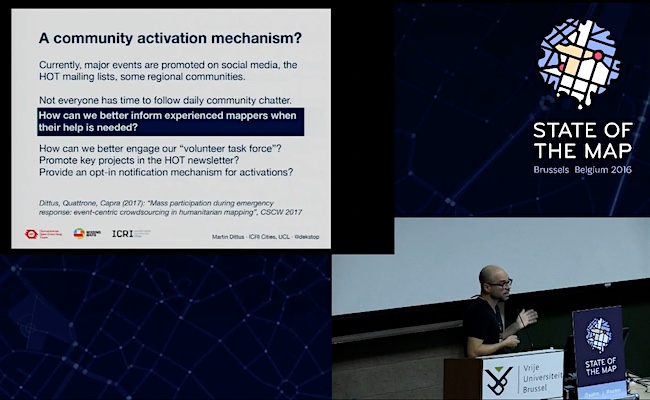
I just saw that the video for my SotM16 talk has already been online for a month… many thanks to the organisers and video team in Brussels for making this happen so quickly, and in such a high quality! You can find some summary notes further below, along with recommendations to HOT organisers.

The recording: Youtube: Building large-scale crowdsourcing communities with the Humanitarian OpenStreetMap Team

See full entry