 OpenStreetMap

Beware! Zeppelins! (a sound idea to detect them)
Posted by alexkemp on 31 May 2018 in English. Last updated on 23 June 2022.Kilnsea:
 Dungeness:

Register article on Sound Mirrors
Sound Mirrors at andrewgrantham.co.uk
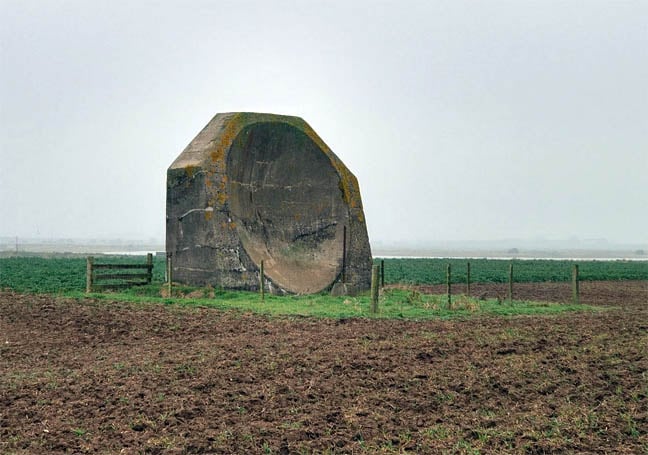
These are Sound Mirrors, some WWI-era devices which — for the Kilnsea device at least — are not yet mapped on OSM.
- Map locations
(drawn from the Register article): - Kilnsea (53.627804, 0.131642)
- Boulby (54.561587, -0.836114)
- Fulwell (54.929724, -1.393937)
- Hartlepool (54.710461, -1.246876)
- Redcar (54.598064, -1.049855)
- Seaham Dalton-le-Dale (54.830041, -1.363016)
There is a good chance that most of the readers of this diary will be aware of the arms-race between Germany & England throughout the 19th & 20th Centuries that led, as just one example, to radar just in time for WWII (and, as I understand it, it also led to microwaves when a morning technician on an airfield discovered that the latest radar upgrade had cooked a flock of pigeons).
The same spirit of innovation was in play even earlier, and this time it started in France in 1783 with the Montgolfier brothers when, for the very first time, human kind slipped the surly bonds of Earth (the phrase is from “High Flight” by John Gillespie Magee). The technology deployed in September 1783 is very much low-tech, consisting as it does purely of hot-air captured in a paper balloon. It was quickly superseded by Hydrogen (obtained from coal-gas or by blowing super-heated steam through white-hot coals) and that was the choice by Germany to lift Zeppelins & bombs into the air during WWI.
The devices at the top of this article are Sound Mirrors. They were cast from concrete and were paired with a microphone at the apex of the mirror reflection. The intention, obviously, was to allow early warning of a Zeppelin approach. Zeppelins initially terrified the populations of English towns but that proved to be short-lived, as the hydrogen that gave them their lift was also a terrifying vulnerability due to the ease with which it could be ignited & the ferocity with which it burnt. Shortly after their introduction Sound Mirrors became redundant due to the fact that Zeppelins became redundant.
Fun-Facts
Hydrogen was superceded by Helium for use in balloons, mostly because the latter is not flammable. Helium is obtained from natural gas fields, today almost entirely from the USA. It’s original source is via decay of radioactive elements deep near the Earth’s heart.
Both Hydrogen & Helium are regarded as the first elements created immediately after the Big-Bang, but I think that the best fun-fact about each is that, shortly after release into the atmosphere, each of them truly escapes the ‘surly bonds of Earth’ because their natural speed through the atmosphere is higher than Earth’s escape velocity. Thus, they re-join their fellows within the depths of space.
Update 23 June 2022
Andrew Grantham has changed his website to prevent foreign sites (such as OSM) using his images, so I’ve had to replace the Dungeness picture.





Discussion
Comment from Warin61 on 31 May 2018 at 22:28
While Hydrogen is ‘easy to ignite’ in the lab (explosive range is something like 6% to 96% .. that is very wide!) .. not so easy within an air balloon. Considerable effort was made to get the bullets to ignite the zeppelins.
Hydrogen is being used as an experimental car fuel … don’t hit one of these! A crash could lead to a loud boom …
Comment from alexkemp on 31 May 2018 at 22:50
That is fair comment. They needed incendiary (or tracer) bullets to ignite the hydrogen. Nevertheless, Zeppelins turned out to be a dead-end and easy to bring down. I also have the picture of the Hindenburg burning in the ’30s etched into my eyeballs & ears. Possibly static-electric discharges within the structure was one vulnerability for both the Hindenburg & the Zeppelins.
Comment from ChristianSW on 10 November 2018 at 19:21
From the geograph project:
http://www.geograph.org.uk/of/Sound+Mirrors