 OpenStreetMap

House Numbers & Street Names
Posted by alexkemp on 9 July 2016 in English. Last updated on 8 February 2019.I’ve been mapping since 21 March, 2016 and have placed several thousand houses on to the Map in Nottingham NG3 & NG4 in that time. It is hardly surprising, then, that I’ve become a little obsessed with street names & house numbers & names. I did some research to try to settle all that inside me; so, here is a miscellany & glossary of facts about English house-numbers & street-names.
-
Forget the Postage Act of 1765
According to Mark Pack there is zero direct mention within the 1765 Postage Act (pdf) of house numbers. -
The first record of a house number in England is dated 1708
The British Postal Museum & Archive cites Prescot Street in Goodmans Fields, London in 1708 as the first recorded instance of houses being numbered rather than having a sign, or a name (Hatton’s New View of London (Google Books)). That fact indicates a significant change within the population.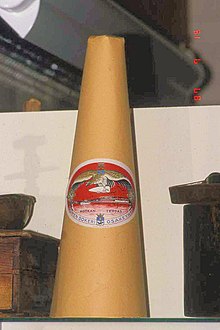 Above is a sugarloaf, in the traditional size & shape in which sugar was delivered to shops in the medieval period (the shopkeeper would break it up with a hammer before resale, which is how the tradition of sugar lumps came about). It is also the shape of the device that was hung outside of a shop to show that it was a shop. Very few people were literate at that time, so few could read a name, or even a number. Therefore, shapes & signs were hung outside of buildings to indicate what they were.
The appearance of house numbers is therefore a sure sign of the penetration of literacy through the population (as also is the popularity of the GPO — General Post Office — of course). The use of house numbers increased throughout the 18th Century, and in a completely unregulated fashion. No bureaucrat was going to stand for that… -
Towns Improvement Clauses Act 1847 Enforces Street Names & House Numbers
This 1847 act is the earliest that I’ve been able to find, and is enforced at the local level (eg the Borough Council of King’s Lynn and West Norfolk):—Houses to be numbered and streets named
The commissioners shall from time to time cause the houses and buildings in all or any of the streets to be marked with numbers as they think fit, and shall cause to be put up or painted on a conspicuous part of some house, building, or place, at or near each end, corner, or entrance of every such street, the name by which such street is to be known; and every person who destroys, pulls down, or defaces any such number or name, or puts up any number or name different from the number or name put up by the commissioners, shall be liable to a penalty not exceeding £25. -
Householders Must Show a House Number, or pay a fine
This is the next section of the same act as above. I cannot tell you how often this one is ignored in practice:—Numbers of houses to be renewed by occupiers
The occupiers of houses and other buildings in the streets shall mark their houses with such numbers as the commissioners approve of, and shall renew such numbers as often as they become obliterated or defaced; and every such occupier who fails, within one week after notice for that purpose from the commissioners, to mark his house with a number approved of by the commissioners, or to renew such number when obliterated, shall be liable to a penalty not exceeding £20. -
You can Call your House Any Name that you Like
As far as I’m aware, there is zero legislation on this. Certainly, the advice from the English Government is that you are free to choose what you want:—
Provided your home already has a number, then the property owner can add a name to it without contacting the council.
Councils have no powers over house names, the only guidance being that the owners should not choose one similar - or the same - to any other in the immediate locality.
The new name can be added to an existing postal address, but the postal number cannot be deleted from the address. The property name in this case will not officially form part of the property address; therefore the property number must still be displayed and referred to in any correspondence.
In my own observation, there has been at least one case where a road had house-names but no house numbers. That involved an “unadopted road” (a private road; the council has zero responsibility for maintenance of the road, which reduces annual charges immensely; it also normally means that the roads are difficult to drive down). Government, councils & the GPO do not like houses not having numbers.
I’ve also had one single instance in which a house had neither a name nor a number. The householder was reported to be a recluse & lived not very far from the “unadopted road” mentioned before. His house did not have a number, and none of his neighbours knew what it was supposed to be called. If he was in, then he did not want to come to the door when I knocked. I let him be & gave it an enigmatic name (I did not think that he would mind, or even notice).





Discussion
Comment from Wynndale on 9 July 2016 at 22:19
There are all sorts of weirdness in road numbering. Just today I encountered a road where the odd numbers go from south to north but the even numbers on the other side go from north to south.
Comment from Warin61 on 10 July 2016 at 08:33
In ‘outback’ Australia ‘stations’ (a farming property with a central concentration of buildings one of which forms the main residence) have names that are in common usage. They may have a property lot number and possibly the post office may allocate a reference number, but everyone uses the name. The remoter properties get their mail weekly .. by aeroplane. It is still common practice to have the name painted in large letters on the roof to aid navigation by aeroplane.
In the early days of Australian settlement houses had names .. these too were in common use and numbers were little used. Modern practice is to only have a number.. a lost cultural practice.
Comment from chillly on 10 July 2016 at 12:10
The laws might exist but if they do they are often ignored in the UK.
According to the censuses from 1841 to 1911 only one road in the village I live in had a name (which has changed twice since), and only then after about 1881 when the post office was moved to that road. Only the houses there had numbers. Not all houses in the village were even named. In a small village people just knew were everyone lived.
Today there are three roads where there are only house numbers, two are unadopted, but one is a main thoroughfare (B1231) with not a number in sight. Houses newly built on that road have names and no numbers. The planning applications make no mention of numbers.
A near-by village (Ellerker) has street names but very few house numbers at all. I have helped the parish council add all the names to produce a map for local deliveries. The lack of numbers is repeated in many small villages in the East Riding and I expect more widely too.
Comment from chillly on 10 July 2016 at 12:14
Sorry, that should have been ‘three roads where there are only house names’.
Comment from EdLoach on 11 July 2016 at 09:43
Adding house numbers in rural Tendring there are many places that only have house names (and one hamlet, Raven’s Green, doesn’t seem to have a road name). New houses added in ones or twos also then tend to gain names, but if a new housing development (with new road name) gets built, they then tend to get numbers.