 OpenStreetMap

Mapping Local POIs Part 2: All the Brands, not All the Places
Posted by alan_gr on 28 October 2024 in English. Last updated on 28 July 2025.Brands
As part of my systematic update of local POIs (see Part 1), I added the “brand” and “brand:wikidata” tags wherever I could identify them. Before I started I thought I might find quite a few POIs that I had not previously recognised as brands.
Spoiler: I was wrong, yet again. It’s good to have your preconceptions challenged by actual data. I guess.
It turned out that the reason I hadn’t heard of most of the brands displayed on POIs in this area, and the reason not many POIs had the brand tag before I started mapping, was that … they aren’t brands. It’s possible there are a few shops belonging to brands so obscure or localised that I couldn’t find any reference to them online, but I don’t think I can have missed many.
Out of 376 POIs, only 36 - less than 10 percent - are now tagged as brands.
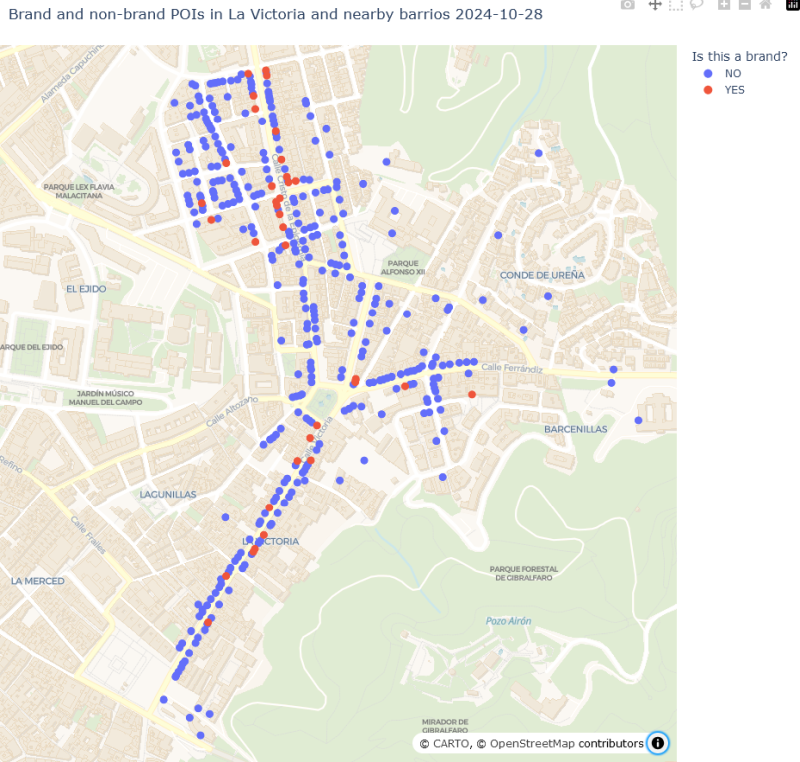
Of the 36, about a dozen are banks and insurers, and the remainder are mainly shops. Quite a few of the shop brands are relatively local, with branches only in the city or province of Málaga. Perhaps that’s one reason that nine brands them have no wikidata entry. Of all the food and drink amenities, only one cafe is branded. And no, it’s not Starbucks, it’s Tejeringo’s - another local brand.
I find this interesting for reasons that go well beyond OpenStreetMap. I have often read that European cities are becoming increasingly homegeneous, that international brands have taken over, and that a shopping street in one city is hard to tell apart from a similar street in a different city. Yet the mix of shops in these neighbourhoods isn’t repeated in other parts of Europe - it isn’t even repeated in other cities in Spain. Sure, this isn’t the most fashionable or most touristy part of Málaga. But it’s not the most out-of-the-way either: you can easily walk from the Cathedral to the southern end of this area in 10 minutes.
What does all this mean for mapping in OSM? It certainly helped motivate me to map POIs in this area, and I hope it will continue to inspire me to keep the data up to date. Making a small fruit shop or dressmaker visible on the map feels more worthwhile, and certainly more interesting, than confirming that a large Spanish shopping mall has a branch of Zara. (It might be quicker to add “zara=no” to the rare shopping centre that doesn’t).
But that positive view implies its own negative. What of the many similar areas that don’t have local mappers to carry out a painstaking survey, one shop at a time? If 80-90 percent of POIs are not part of a brand, it reduces the chances of getting data in a uniform format that might speed up the mapping process.
All the Places
As I was carrying out my local mapping campaign, I read quite a lot of discussion on OpenStreeMap forums about the possibility of using data from All The Places (ATP) to help map POIs in OSM. ATP is a project to gather data from business websites, typically those operated by large brands, and make it available in a consistent format.
Could ATP have helped to speed up my survey? Not in its current form. It only contained three valid POIs in this area (three branches of DIA supermarket).
Could ATP help if more brands were added? The potential for this particular area seems limited. Adding a “spider” to scrape business information is not a trivial task, and would only be worthwhile for brands with a substantial number of branches. Of the POIs I surveyed, the major Spanish banks and insurers seem the most likely candidates. As I mentioned, most of the others are relatively localised brands, so the effort of developing a spider would probably be out of proportion to any mapping advantage.
All in all, I can’t see ATP ever covering more than 5 percent of POIs in this area. Of course it could be very different in a shopping mall full of international and national brands. But for this kind of neighbourhood of small local businesses, it looks like ATP will only ever be of marginal help.
In my next entry I’ll look at the process of getting from 258 to 376 POIs over two months.





Discussion
Comment from Mateusz Konieczny on 4 November 2024 at 08:11
Thanks for mapping all these things!
As person who started this ATP threads: I do not see such projects as replacing manually added POIs at all.
I see it exactly as augmenting/helping. Though I think that pointing out few missing shops/offices is still helpful.
But if it would become possible to update just 3% of opening hours of POIs using this dataset and help map additional 1% of global POI coverage… Given how many POIs are there it could be equivalent of having many extremely dedicated POI updaters.
Ironically here ATP struggles with location being inaccurate and not pointing to specific plane within mall. Many brands prefer to set POI location at parking (where client is expected to arrive), not actual shop location.
Comment from alan_gr on 4 November 2024 at 08:26
Indeed, I understand the aim of the ATP work and that it is not intended to replace manual mapping. I just thought it interesting that in an almost-central zone of European city, even if we had perfect information about all brands, it would only cover a small fraction of POIs.
Yes the location within malls does seem to be a problem. Probably not helped by the fact that (near me at least) there is no consistent addressing system for malls (even the name of the mall is often missing from published addresses, so there is just the name of a long avenue with no number).