OpenStreetMap logo OpenStreetMap

SK53's Diary

Recent diary entries

Well over a year ago I extracted all the https://wiki.openstreetmap.org/wiki/Tag:amenity=pub objects for Great Britain. Nearly 860 keys are used across all the elements. I’ve spent some time delving into these keys, trying to classify them, and hopefully learn a bit about two things: the kinds of information people want to know about pubs; and why synonyms exist for certain keys and tags. I’ve been prompted by SomeoneElse’s list of building tags.

The Top House, Lizard - geograph.org.uk - 903767 A pub which I recently edited on OSM adding https://wiki.openstreetmap.org/wiki/Tag:real_fire=yes.

See full entry

Location: Landewednack, Cornwall, England, United Kingdom

Mapping Crematoria

Posted by SK53 on 12 March 2024 in English.

A recent discussion on the osm-gb IRC channel was about how to map chapels within crematorium buildings.

Cheltenham Crematorium - geograph.org.uk - 670230

I thought it was worth summarising some of that discussion. These notes pertain to crematoria in England and Wales. I have attended a funeral at that in Geneva, but that was twenty years ago.

One of the difficulties is that most visits to a crematorium are likely to be to attend a funeral service. This is not conducive to any kind of sophisticated micromanaging, but does allow a decent amount of basic observation. In addition I’m not aware of well-developed tagging standards for various features, as may become apparent by looking at some of my examples

In general

See full entry

Location: Harp Hill, Charlton Kings, Cheltenham, Gloucestershire, England, GL52 6FD, United Kingdom

Do people map single tennis courts?

Posted by SK53 on 26 April 2023 in English.

In a comment on their recent diary entry publicerination suggested that use of https://wiki.openstreetmap.org/wiki/Tag:leisure=pitch with https://wiki.openstreetmap.org/wiki/Tag:sport=tennis was always intended for single tennis courts. I had my doubts given that someone in San Francisco was adding quantity, and I have added pitch:count and there is also a documented tag courts. Were we just the odd mappers out?

Looking east across the tennis courts, Regents Park - geograph.org.uk - 1407669

A relatively quick way to answer this was looking at tennis courts in the UK as I have a 1-2 year old import available for Great Britain. Overpass can also be used to collect the data, but it’s not possible to calculate areas directly. I ran a query which pulled tags, the geometry and the area of each pitch in square metres and saved this first as geojson and then as a csv file.

See full entry

Location: Southfields, Tooting, London Borough of Wandsworth, Greater London, England, SW18 5RL, United Kingdom

Speed limits on highway=primary

Posted by SK53 on 13 April 2023 in English.

For a number of years I have sporadically looked to resolve missing speed limits on major highways (highway=trunk and highway=primary) in the UK. I use a simple Overpass query to find these in a manageable area (usually former regions of England + Wales, Scotland and Northern Ireland.

The other day a discussion arose on IRC about some distinctly English placenames in North Wales. Looking at the area I realised that the A493 had no speed limits added. As both Mapillary and now Bing Streetside imagery are now available in the iD editor, I was able to add limits from Aberdyfi to Tywyn. In the past this nearly always required a survey.

I was going to write about looking at limits elsewhere, but found it easier to add various pictures in a short Mastodon thread.

tl;dr: There’s lots of work everywhere to improve the mapping of maxspeed on highway=primary.

Location: Aberdovey, Gwynedd, Wales, United Kingdom

I started drafting this after b-unicycling’s report on her trip to Anglesey as it reminded me that when mapping solar power on the island, I’d noticed a lot of old windmills.

Llangefni windmill

In most of Wales there were abundant sources of water power. So water mills were common before steam engines were available. Many were corn mills, but woollen mills were also common. There was even a tidal mill at Carew.

The only one of these Anglesey windmills I knew about beforehand was the one on Parys Mountain. The stump of the tower is visible from afar. It was used for pumping water out of the copper mines (at one point the largest in the world).

See full entry

Location: Llangefni, Isle of Anglesey, Wales, United Kingdom

In the UK and Ireland stone circles are amongst the oldest built structures. They are usually mapped with https://wiki.openstreetmap.org/wiki/Tag:historic=archaeological site, https://wiki.openstreetmap.org/wiki/Tag:archaelogical_site=megalith. https://wiki.openstreetmap.org/wiki/Tag:megalith_type=stone_circle. However, mapping in Wales it is soon apparent that there are quite a few modern ones.

Plaza de los Colonos Gaiman

Most are Gorsedd Stones, relics of National Eisteddfodau. However there’s a small covey near the entrance of the show cave at Dan yr Ogof. Most are mapped as monuments or memorials, although I think when the Eisteddfod returns to a site they are used for their original purpose.

See full entry

Location: Rincón del Valle, Gaiman, Municipio de Gaiman, Departamento Gaiman, Chubut, Argentina

Steep paths : refinement of approach

Posted by SK53 on 9 January 2023 in English. Last updated on 11 January 2023.

Lord's Rake, Scafell - geograph.org.uk - 1329625 Lord’s Rake: one of the steepest paths marked on OSM in Upper Wasdale

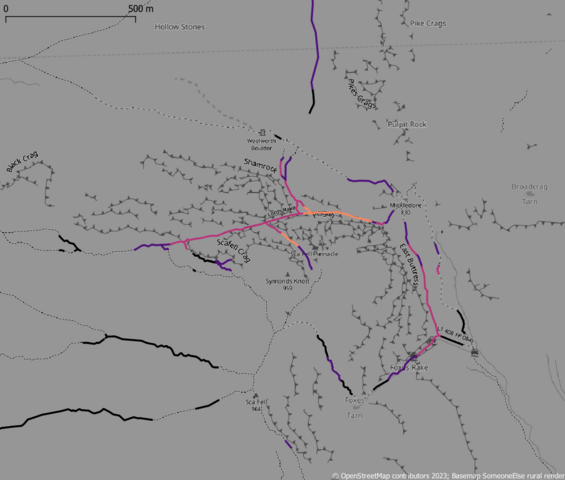
In my last diary I introduced the idea of using elevation models (DEMs), specifically a DTM (terrain model) to find sections of hiking paths on OpenStreetMap which may cause problems for regular hikers. In this sequel I describe a refined approach using a higher quality terrain model and a vertex-based approach to calculating slope angles actually likely to be experienced by walkers.

See full entry

Location: Wasdale, Cumberland, England, United Kingdom

Finding steep paths which may need review

Posted by SK53 on 8 January 2023 in English. Last updated on 11 January 2023.

Recently there has been quite prominent press coverage of mountain rescue incidents in the English Lake District involving people using various outdoor activity apps (The Guardian, Grough). It turns out that these incidents involved paths mapped on OpenStreetMap, and have been discussed by the local UK community.

Steep paths on OSM around Scafell (brighter is steeper)

See full entry

Location: Eskdale, Cumberland, England, United Kingdom

Colour-coding OSM data by age in OverpassTurbo

Posted by SK53 on 14 December 2022 in English.

A few days ago i provided an example Overpass query to show buildings with a mapped start_date colour coded by age. This was in response to a query by long-time Latvian contributor richlv. Another user based in Latvia asked on Mastodon if it was also possible to look at data by how long ago since it was edited.

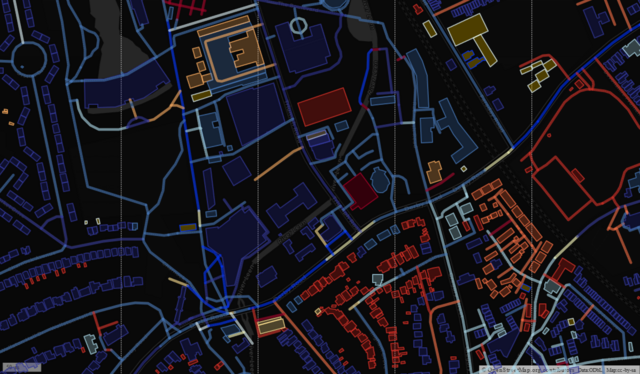
Building & Highways coloured by edit age

This proved to be quite a lot harder than my previous example. The issue is that the “@timestamp” field in Overpass-Turbo is always treated as a string and is never cast to a number or date. This meant that the MapCSS queries have to deal with regular expressions, so I’ve just done the bands in years (“way[@timestamp=~/YYYY.*/]”), as I haven’t experimented with how rich the regexp implementation is for MapCSS. An example of the amended query for roads and buildings in a given bounding box is here.

See full entry

Location: Old Lenton, Lenton, Nottingham, East Midlands, England, NG7 2FE, United Kingdom

Colour-coding buildings by age in Overpass-Turbo

Posted by SK53 on 2 December 2022 in English. Last updated on 10 April 2024.

The other day richlv asked on IRC if there was any OSM-based rendering showing the age of buildings. Although I could think of a couple of examples where people have done this, they did not use OSM data (other than the extremely early work.

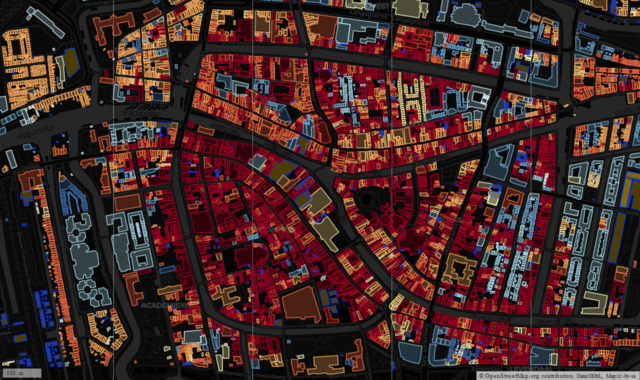
buildings in central Leiden colour coded by building age

I made use of open data of buildings from Portland Oregon to look at clustering, but the inspiration, and awareness that the data existed, came from a MapBox blog post.

A similar approach was taken by Waag who made use of the BAG open data on buildings for the whole of the The Netherlands.

I wondered if it was possible to use MapCSS styling within OverpassTurbo to create a simple way to achieve the same effect. After a bit of experimentation I was able to do this. I used Dutch localities as test areas as all buildings have been imported from BAG and therefore have start_date tags in a consistent format (“yyyy”). I also looked at other places with some buildings (usually those with a heritage protection) have start_date tags.

See full entry

Location: Binnenstad, Leiden, South Holland, Netherlands, 2312 DH, Netherlands

Completing mapping of solar power in Wales

Posted by SK53 on 12 August 2022 in English.

Back in March I was amused to see Amanda tweet that the UK OpenStreetMap community ran a solar power mapping project “several years ago”. This was the theme of the [quarterly project(osm.wiki/UK_2019_Q3_Project:_Solar_Power) in Q3 2019, but the project keeps trucking on.

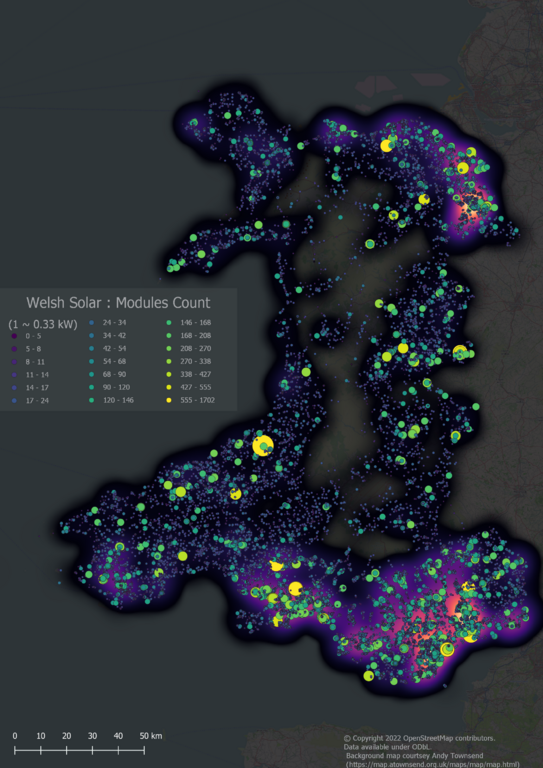
Small-scale Solar Power in Wales; Heat map overlaid with individual solar arrays

All small-scale Solar Power in Wales (i.e., excluding solar farms of more than 1MW capacity)

In the past few days we reached a milestone of having comprehensive solar cover for Wales, one of the constituent countries of the United Kingdom. I think this is the first country to have solar power mapped at such a fine level of detail either on OSM or anywhere else.

The rest of this post discusses aspects of the how & why of this work.

Solar Mapping in the UK

See full entry

Location: Llannon, Carmarthenshire, Wales, United Kingdom

A few days ago a few mappers in the UK noted that Bing imagery seemed somewhat out-of-date. I noticed it because it appeared not to show recent housing developments until zoomed in at z20. I found a development just outside the village of Llanbedr Dyffryn Clwyd whilst mapping rooftop solar in Denbighshire. My workflow for solar mapping uses Josm. As all the new houses had solar panels I wanted to add the buildings themselves, and I find the way in which imagery can be aligned easier to use in iD than in Josm (particularly as the offset needs cancelling in Josm which does not fit task-based mapping over several thousand square kilometres). So I did it a little crudely in Josm, only to discover that at z20 the imagery was available in iD, so I tidied things up a bit.

I didn’t think much about it until a local mapper in the area commented that Bing seemed a bit behind. This seemed a bit more significant, so I looked at my local university campus which is under continual development and therefore has lots of features which enable one to age imagery. To my consternation the zoom levels down to z19 showed a building which was demolished at least 7 years ago. Whilst looking at this area just now, the z20 imagery appears to be disappearing from cache.

A short distance South of the University is the Nottingham tram line which was well under construction in 2013 because a major bridge was put in place in September of that year. The ‘updated’ Bing imagery now pre-dates the tram development, and any construction work on the Chinese Studies building which opened in January 2013. It does show a new lecture theatre on the main campus which was built post-2009. It therefore appears that the imagery has reverted to a state around 2011 or 2012. Co-incidentally or not, this seems to be the same as ESRI Clarity.

I’ve looked at a couple of other places where I know construction work bridges this period:

See full entry

Location: Maes Famau development, Llanbedr Dyffryn Clwyd, Denbighshire, Wales, LL15 1BF, United Kingdom

For the past few weeks I’ve been making a concerted effort to map solar panels across rural areas of North & Central Wales (Powys, Gwynedd and Ynys Mon - Anglesey), so far with good results. I’m using a thorough search technique which looks at individual clusters of buildings from Ordnance Survey Open Data (which is complete for Great Britain). This means I see lots of other things which need mapping, but from experience I know it’s important to focus on the specific task. However, I have followed up some of the more striking things, which I plan to report in a series of posts.

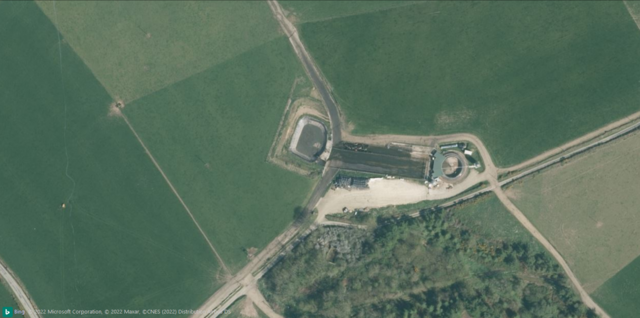
First up was a striking structure in the middle of farmland on the Llyn Peninsula. It was pretty obviously a high-tech milking machine: milking parlour seems a bit quaint for a pretty sophisticated bit of kit.

Bing imagery of Cefnamlwch milking parlour Bing Imagery (close-up view).

See full entry

Location: Buches Cefnamlwch Dairy, Tudweiliog, Gwynedd, Wales, United Kingdom

Mynydd Rhiw : unmapped Welsh heathland

Posted by SK53 on 18 November 2021 in English.

Whilst writing my previous post on Welsh Heaths I discovered that a hill on the Llŷn Peninsula shown as heath in the Phase 1 survey has no landcover mapping on OSM. I walked up Myndydd Rhiw in 2008, just before I started contributing to OSM – so I failed to take enough photos. The weather was not very good that day so I’d opted for a car journey to visit locations on Llŷn rather than brave the rain in Snowdonia. Rhiw was the only place which wasn’t chosen because of personal associations: not only had we holidayed there several times during my childhood, but my great-grandmother’s family come from Llŷn,

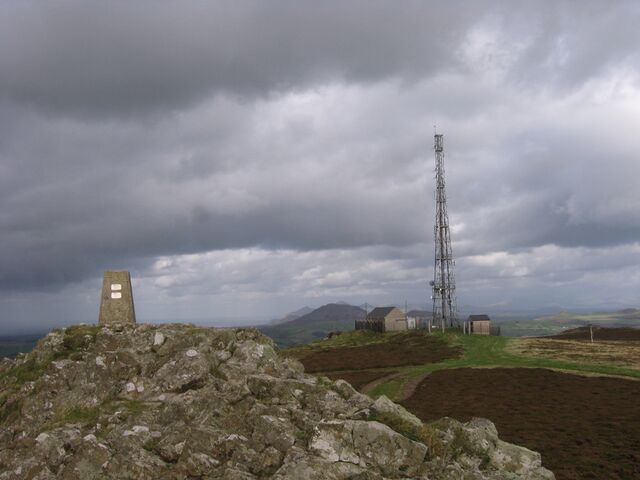
Summit of Mynydd Rhiw Summit of Mynydd Rhiw

See full entry

Location: Aberdaron, Gwynedd, Wales, United Kingdom

A couple of weeks ago a research group in Oxford published a worldwide dataset of predicted solar power locations in the journal Nature (Kruitwagen et al., Vol. 598, 604-610). There is also a blog post by Lukas Kruitwagen himself on The Conversation.

Apart from the subject’s intrinsic interest, the study is noteworthy because it used machine learning (ML) to make the predictions. The base training dataset came from OpenStreetMap (although the paper makes a single mention and then, incorrectly, adds an “s”). The role of OSM is much better described in The Economist (paywall):

“For this, they turned to OpenStreetMap, an open-source rival to Google Maps in which volunteers had already tagged large numbers of solar plants. But there was little consistency. “Some people had just drawn rough outlines around an entire field,” Dr Kruitwagen says. “Others had gone in and traced the outline of each row of panels separately.” Fixing that involved a great deal of manual labour.”

There is also a New & Views piece in Nature as well. These are usually reserved for articles judged to have particular significance.

The Data

See full entry

Location: Lare, Lhasa, Tibet, China