
OpenStreetMap logo OpenStreetMap

Gregory Peony's Diary

Recent diary entries

A few days ago I found what appears to be a criminaly underviewed video (currently with 81 views) about imagery interpretation. I almost cannot believe I hadn’t seen it up untill now. It’s breif, contains many of the points I’d write to others about, and there’s next to nothing which I dissagree with. A wonderful addition to my feedback toolbelt.

I want to give this video a signal boost in all relevant mapping channels, since it’s a fantastic resource which can help contributors improve their imagery interpretation. An Introduction to Aerial Imagery for New Mappers

The video is titled for beginers, but the fundamentals don’t change; check it out!
Dear diary,

Yesterday, I was in a meeting of the HOT QCQA WG, when Patrik_B asked a question at the very end of the meeting. How can you download select data within a given complex geometry via overpass; the geometry in the JOSM layer isn’t visible when downloading?

The Objective

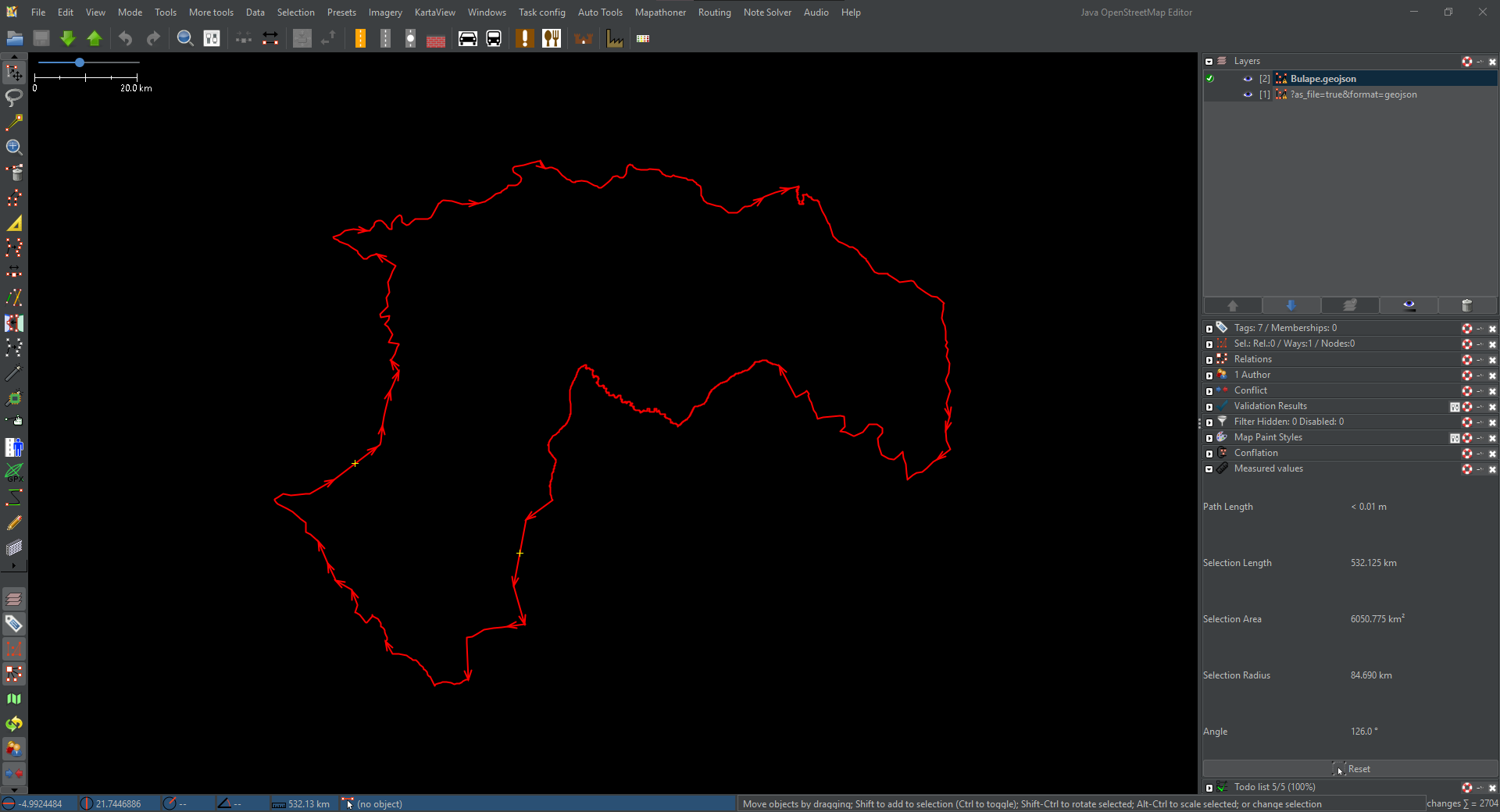
 Download all desired data via overpass within this boundary.  Bulape Health Boundary in JOSM Fig.1. Area of Interest.

Download Along to Highlight the Boundary of the AOI on the Slippy Map

Ralph was first to answer the question. His solution was to download data from OSM using the download along plug-in. The area of downloaded data would then be visible on the slippy map and this could be referenced when drawing a bounding box to download the data. Very clever.

See full entry

Preface

I created this template to aid project co-ordination in tasking managers, and contributors seeking feeback. It has gone through several iterations; this is the one that I currently use. I think that there will likely be some alterations, because I see some potential impovements, though I haven’t yet received feedback regarding it from mappers.

Following interest in the template I use for validation comments from other validators, I am going to share the current version I use in this diary entry. Please, try it out and share your ideas, experiences, and results.

The template is formatted using Markdown.

Thank you to anthaas for the idea of publishing a diary entry about it.

My experience is in using the HOT TM so there may be some idiosyncratic parts which should be modified to be accurate/function within whichever TM is being used.

I have not yet seen what if any impact this has on 3rd pass validation.

Design Rationale

It was over two years ago now that I (in)validated my first tasks on the HOT tasking manager. I took a break from that until ~ 7 months ago when I started validating some more tasks here and there. Then ~ 4 months ago SColchester put me onto a good project for a beginer validator, and after that I was validating tasks at a significantly greater rate. It was also his comment on a previous diary entry of mine that insired a change in this temlpate.

After (in)validating a greater number of tasks via the HOT TM, I soon found that I was repeating myself quite a lot. For instance, linking to learning resources, events and thanking users for their contributions was very standard. I didn’t exactly fancy writing the same thing over and over, and I wanted to reach more contributors, so I decided to create something that’d make the process more efficient and idealy result in a higher quality of contributions.

See full entry

Today I realised that it’s probably significantly more efficient (in terms of effort and time) to simply state the reason(s) for (in)validating a task in the task comments, and ask contributors to read the project comments where I can post some more detailed comments, explinations, pictures etc. related to common mistakes I find while validating the project.

This efficiently accomplishes at least four objectives;

  1. Contributors who read the comments recieve feedback regarding their contributions
  2. It is easier to get an overwiew of quality issues in the project.
  3. It saves time in comparison to giving feedback on each individual task.
  4. Contributors to the project who map areas yet to be mapped and read the project comments can get a heads up, before contributing increasing the likelihood that they will avoid making the same mistakes.

Farewell to giving feedback on every task, unless it is truly unique. 😌