OpenStreetMap logo OpenStreetMap

Users' Diaries

Recent diary entries

Demo narzędzia

Właśnie wydałem nowe narzędzie osm-revert dla społeczności OpenStreetMap. W założeniu jest to bezpośredni następca do RevertUI. Jest to szybszy i skuteczniejszy sposób na wycofywanie zmian na mapie. Korzysta z Overpass API, aby zredukować ilość zapytań do serwerów, co czyni go szybszym w procesie odwracania. Potrafi także automatycznie rozwiązywać konflikty, co było niemożliwe w przypadku poprzedniego narzędzia. Dodatkowo, nie posiada ograniczeń dotyczących rozmiaru zestawu zmian, co pozwala na cofnięcie nieograniczonej liczby zmian w jednym zestawie.

See full entry

Posted by NorthCrab on 9 January 2023 in English. Last updated on 11 August 2023.

Tool demo

I released a new tool called osm-revert for OpenStreetMap community. It’s aimed to be a direct successor to RevertUI. It’s a faster and smarter way to revert changesets on the platform. It uses the Overpass API to reduce the amount of API calls, making it faster at reverting changesets. It can also automatically resolve conflicts, something that the previous tool, RevertUI, couldn’t do. Plus, it has no limits on the size of the changeset. This solves problems like changeset too big and node and way conflicts.

See full entry

Hi all, I’ve written a new post based on OpenStreetMap data on roads, landuse and other features in Australia, to answer the question: is the total length of roads within towns and cities less or more than the total length of roads between towns and cities. Town boundaries were generated from OSM’s landuse, leisure and other tags. Hope you find something of interest. Cheers.

https://little-maps.com/2023/01/09/city-or-the-bush-where-are-the-most-roads/

Have you ever taken a look at your own mapping done over a year or two ago? If you haven’t yet done that, take a few minutes and check out some old projects or areas you have mapped. A few questions you might ask yourself upon a glance at your own mapping would be; Did I really map these features?; What happened to my mapping skills?; How could this happen? Of course! that is you.

But you should rest assured that is not your doing. I came across an area mapped by an experienced mapper who was and has been my inspiration since I joined the OSM community and at the first glance I was disappointed. But upon checking the history of the mapped features, I realized the digitization was done years back.

This realization brought back theories I learned in class during my undergraduate studies. “Maps do not stand the test of time”, meaning they are easily outdated. But this is true when it comes to paper maps since it takes a lot of money and effort to make them and yet they do not last in terms of representing newer environmental development.

Its a different story for OSM, yes area never gets mapped, but we can constantly keep updating data to catch up with the ever-evolving and ever-changing environment so that the world does not classify OSM data are not good enough. Let’s Keep Mapping Daily, The Work Never Ends!

Location: Valco Estates, Community 12, Tema, Tema Metropolitan District, Greater Accra Region, Ghana

I’ve run across a few places where there seems to be some disagreement and confusion about how to distinguish between roads that should be tagged as highway=service versus highway=track. I see quite a few ways that get switched back and forth between the two tags each time a different mapper touches them.

So I figured I’d write up how I make the distinction. I understand that other mappers might think about these things differently, but here’s how I think about the two types of roads.

Service roads (highway=service) are:

  • used to provide motor vehicle access from a through road or a local road to a specific destination (building, etc.)
  • typically very short
  • typically used for a single purpose
  • often one lane (although sometimes wider)
  • typically not named or numbered (i.e. no name or ref tags)

Some examples of highway=service: a driveway, an urban alley, a parking aisle, a short access road for utility equipment, an access road leading to one or more campsites, or an access road in a municipal dump.

Track roads (highway=track) are:

  • local roads that are only wide enough for a single four-wheeled vehicle (i.e. dual-track on the ground)
  • can be short or long (i.e. many miles)
  • typically used for multiple purposes
  • typically named and/or numbered when they are approved public routes of travel

Some examples of highway=track: a dual-track dirt road, a remote single-lane paved road, a graded single-lane road along a canal or railway, or a dirt road along the path of a power line.

The place that seems to cause the most confusion is where a longer road is used to access some sort of infrastructure. For me, this is typically a highway=track. Although roads like this can be used to access infrastructure (e.g. towers for high-voltage power lines) they can also be used for through travel, recreation, and other purposes. Roads like this are often designated for multiple uses by the land manager responsible for them.

See full entry

Posted by SK53 on 8 January 2023 in English. Last updated on 11 January 2023.

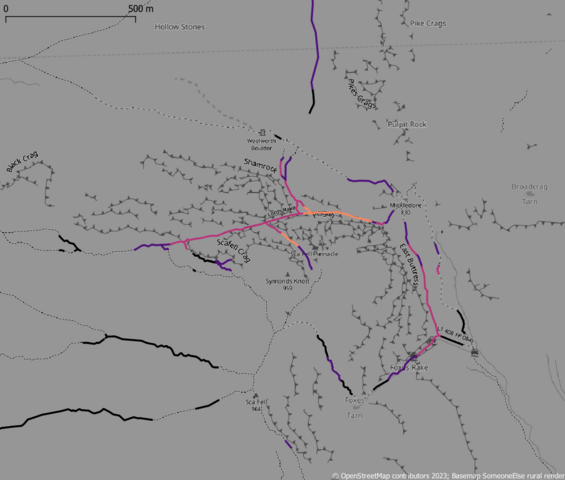
Recently there has been quite prominent press coverage of mountain rescue incidents in the English Lake District involving people using various outdoor activity apps (The Guardian, Grough). It turns out that these incidents involved paths mapped on OpenStreetMap, and have been discussed by the local UK community.

Steep paths on OSM around Scafell (brighter is steeper)

See full entry

Location: Eskdale, Cumberland, England, United Kingdom
Posted by SimonPoole on 8 January 2023 in English. Last updated on 2 May 2024.

I haven’t done a contributor statistics diary post in a long time, but I suspect that the latest update of the graphs on the wiki is likely to lead to some questions.

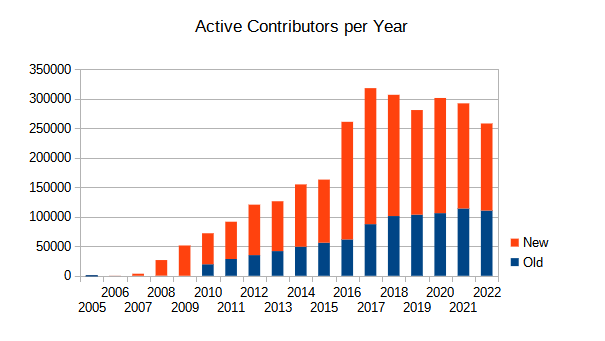
As we can see in

active contributors per year

the number of new contributors to OSM has dropped quite a bit in 2022. As the overall number of contributors has always been dominated by the new contributors it isn’t a surprise that the overall number is down too.

The interesting question is if we can pinpoint any “source” of this reduction. As a 1st investigative step I gave the numbers for editing apps used by new editors a look. I’ve been producing the numbers for a long time, but have never published them previously, if we look at 2021 and 2022 we see:

See full entry

Posted by Quite Frankly on 8 January 2023 in English. Last updated on 22 September 2023.

I am embarking on a project documenting and updating bike lanes throughout Melbourne, and eventually Victoria, in as much detail as possible. This work draws on a range of sources including aerial imagery, street-level imagery, local surveys, other OSM users, and input from councils. I am drawing on global tagging conventions, and other tagging schemes developed specifically for detailed documentation of cycling infrastructure such as here and here.

In the first iteration I will capture the most basic attributes, such as whether a lane exists and if so, what basic category, e.g. exclusive, advisory, shared, separated, etc. If a survey reveals no lane, I mark the way explicitly as cycleway:side=no. Otherwise, the type of lane is captured using cycleway:side=? and cycleway:side:lane=? (side = both/left/right, depending on the way). See this tagging guide for specifics.

This step in itself is quite a large undertaking, and I’m finding even this basic categorisation can be somewhat subjective in cases where cycle lanes haven’t been properly maintained or markings are particularly sparse or unclear. I will post some examples of these edge cases in due course.

Note that where a cycleway tag already exists on a way, but I cannot validate its accuracy, I will not remove the tag. I will only update existing tags if I can confirm the tagging is incorrect, outdated, or could benefit from more detail (such as specifying :side and/or :lane).

Following this, I intend to add additional attributes such as lane width, buffers, separation type, traffic calming, etc. as well as updating the off-road network. This work aims to support better city planning, journey planning and cycle route suggestions across the state.

I have nearly completed the first sweep of City of Melbourne, City of Darebin, and City of Casey and am currently in the process of validating this with these councils.

See full entry

Location: East End Theatre District, Melbourne, City of Melbourne, Victoria, 3000, Australia

Wprowadzenie

Stworzyłem stronę https://starsep.com/osm-wtp/. Można na niej znaleźć porównanie danych OpenStreetMap transportu publicznego aglomeracji warszawskiej z danymi Warszawskiego Transportu Publicznego. Głównym celem jest możliwość łatwego znalezienia błędów oraz brakujących danych. Porównuję dla każdego wariantu linii listę przystanków. Dodatkowo znajdowana jest część błędów związanych z tagowaniem w OpenStreetMap.

Treść strony

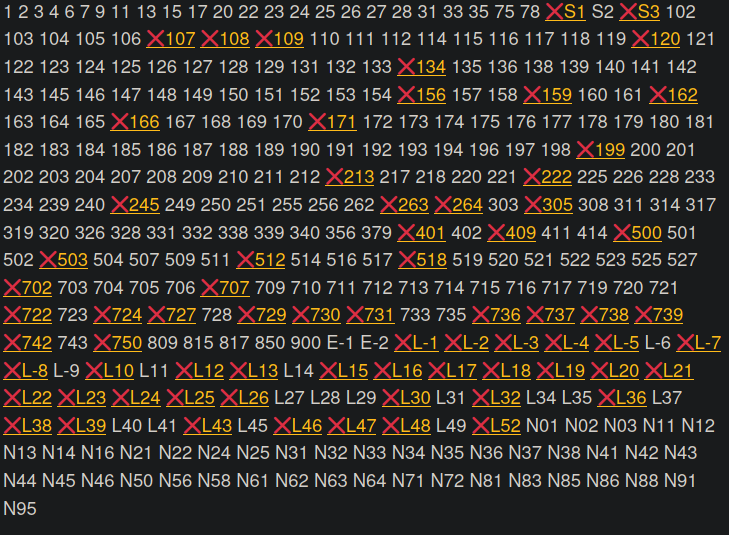
Na górze znajduje się lista linii. Dla linii z błędem wyświetla się link z ❌.

lines

Dla linii z błędami wyświetlone są tabelki porównujące nazwy i numery przystanków z OSM i WTP. Kolory oznaczają, co należy zrobić w OSM, aby doprowadzić do stanu z WTP: zielony dodać przystanki, czerwony usunąć, pomarańczowy zmienić. W nagłówku są przydatne linki.

See full entry

Das Thema ist mir zu komplex, um es (gleich) in englisch zu schreiben. Ich bin auch kein Experte, kenne nicht mal die Probleme und Notwendigkeiten so genau. Das hier ist also eher ein Brainstorming mit einigen Schlagworten:

  • Anything will be an area
  • There has always be Vector Tiles
  • Don’t tag vor the Vector Tiles
  • Make the problem to the solution

Area als neuen Objekt-Typ ist nur Tagging-Sugar, die Verpackung wird einsichtiger, der Inhalt bleibt. Ein Kreisverkehr braucht kein area=no mehr, der Spielplatz keine identischen End-Nodes. Trotzdem bin ich dafür. Einige Editoren haben Areas ja auch schon im Interface. Ich sehe in Zukunft immer mehr Areas, auch für Wege. Am Ende ist jeder Fleck Erde Teil irgend eines Areas. Das ist gut für zoomed Rendern, für Rollstuhl-Karten und 3D Rendern. Es ist nur schlecht für rooting; vielleicht sollte im Way-Object eine Hilfe sein, eine Liste zu den anschließenden Wegen.

Vektor Tiles sind im Kern geordnete Informationen für ein Gebiet. Die brauchte man auch schon bei den ersten Bitmap-Renderern. Aus der Tagging-Anarchie wurden, und werden, Objekte in Layer gefiltert. Und dabei wird entschieden, was überhaupt sichtbar wird! Erst im nächsten Schritt werden die Objekte zu sichtbaren Linien, Flächen oder 3D Objekten. Daher dürfen Vektor Tiles nicht das aussehen festlegen und auch nicht bestimmen, was auf die Karte kommt. Allerdings gibt es “normale” Objekte, die jeder braucht und Seltene für Spezial-Karten. Mein Ansatz wäre: Immer zwei Tile-Dateien bereit zu stellen, eine die kompakt alles “normalerweise” notwendige enthält und eine mit wirklich dem ganzen Rest; schräge Sachen notfalls in einen Layer “sonstiges”. Den muß der Rendere dann nach dem Tagging der Objekte selbst sortieren.

See full entry

This is just an initial review and test of the Every Door mobile OSM editor. If you ever added stores and POIs with either a piece of paper and a camera you know that it is a long pain to add all the information to OSM. Even worse is that all your efforts can end up stale and you have to re-fix all the closed or new stores. Enter Every Door, the perfect tool that makes micro mapping or adding / updating POIs a breeze and not just simple things but adding handicap status, telephones, websites, payment information and other fine details are all there. It also has the easiest and seamless Opening hours editor which with a few taps you have it set quickly.

I went back to fixup and remap some shopping centers and places today and it was a breeze. I am able to quickly remove closed stores, quickly add new stores with the easy iD editor presets search and it does everything to streamline the process and give you just the right fields for the given. Adding the phone number is as easy as dialing it, and website as quickly putting in the url no need to worry about the http prefixes it does it for you. This app makes me want to do more field mapping as it takes out all the tedious parts and gets to the exploring and mapping right away with near instant gratification.

If you haven’t already download and try the app. It is for Android and iOS and is even on the F-Droid app store. So try it out I want more people to know about this as I am glad I found out about the app.

https://every-door.app/

Posted by mvexel on 6 January 2023 in English.

After tinkering a bit but finally successfully processing videos from my Viofo A129 dash cam and uploading them to Mapillary, there is one last thing I wanted to try: using the A129 time lapse mode to be able to collect more imagery before the storage space on my camera runs out…

This does not seem to be possible without recording your GPS breadcrumbs using a separate device, because the location information written into the movie stream by the camera is sparser than the video frames. Using

exiftool -m -p gpx.fmt -ee -ext mp4 -w! %f.gpx time-lapse-movie.MP4

I get 4 trackpoints for a movie that contains about 300 frames.

This could also be a result of limitations in the way exiftool parses the MP4 file, but looking at the relevant documentation section I don’t see a way to tweak this.

What I think I will do instead is:

  • Buy a larger micro-SD card (they are getting cheaper all the time)
  • Reducing the video quality

In order to be able to capture more of my longer trips. I’m about to make [this drive] and I’ll test it then!

Location: Ballpark, Salt Lake City, Salt Lake County, Utah, 84115, United States
Posted by b-unicycling on 6 January 2023 in English. Last updated on 7 January 2023.

Earlier today, I reached my 5 millionth edit. It came to my attention about 10 days ago that I was approaching it, because someone on Twitter had celebrated their 15,000th edit, and I went to check mine on neis-one. I then estimated that it would take me 10-14 days to reach it, and I was right.

My friend DeBigC had given me some praise already in his diary some days ago.

Next stop, 10,000,000, I think. Well, not really stop, just a goal.

It’s not that difficult to get that many changes when you’re working on a big project like Irelands #osmIRL_buildings project. We started on Co. Roscommon mid December 2022, and apart from buildings, I’ve already added 1150km of drystone walls. You read that right. dry stone wall statistics from ohsome.org Part of that was discovering several field systems of unknown date, but I have documented the use how I tag them on the wiki. I don’t expect many field systems like that to survive in many other countries, it’s just that history is all over the place in Ireland.

See full entry

Location: Onagh, Taghmaconnell Electoral Division, Athlone Municipal District, County Roscommon, Connacht, Ireland

Ich habe highway=milestone DE aktualisiert und man kann sagen: naja.

Na gut, es sind über 1000 milestones hinzugekommen, aber 800 allein auf wahrscheinlich einen einzigen Mapper in SH. Oder ich hab ‘nen Knick in der Optik.

Entweder hier wird in den Kommentaren ordentlich rumgemault oder ich schau demnäxt nochmal selbst, wie das genau kommt…

Ich habe https://wiki.openstreetmap.org/wiki/User:Dex2000#fertig “Autobahnen und Abfahrten ohne Lanes” aktualisiert und da kamen innerhalb der letzten 12 Monate über 300 (von 33 in ‘22) dazu. Mir fehlt grad die Zeit zu schauen, wo das herkommt, Freiwillige vor ;)

P.s. und Disklaimer: fehlende Lanes sind kein Fehler im Datenmodell! Aber (imho) nicht wünschenswert.

I run a Mapillary supplied BlackVue dashcam uploading my take via the mapillary_tools in two “stabs”. The first is usually same day for road speeds segments below 55kph, the second is up to 2-3 months later. This gives town/village streets and remote road intersections/signs coverage first, for other mappers. I am also taking 1FPS rear left (webcam) and right angle left images (Samsung phone) at less than 40kph for immediate geotag, process/upload. (after manually culling privates)

See full entry