Posted by Daniel Heritier on 12 November 2022 in English.

Today was my second mapathon and i really enjoyed it cause was fun mapping. i thank all the people who help me learn this new skill
 OpenStreetMap
Today was my second mapathon and i really enjoyed it cause was fun mapping. i thank all the people who help me learn this new skill
This is my first attempt on the subject of the title divided in 6 topics. Sorry for the long text (but could be far longer).
Disclaimer: low experience as OSM mapper!
While I do have prior advanced experience in other areas, as you can see from my account, I’m so new to the project that as a newbie user of iD left after the tutorial in India I got scared that if someone touches something, after that validators will assume that person is responsible for errors in that something. In my case it was “Mapbox: Fictional mapping” from OSMCha.
So assume that this text is written by someone who one day ignored iD warnings for something I touched, still not sure how to fix the changeset 127073124 😐
Some parts of this post, such as reference to notability (from this discussion here osm.wiki/Talk:Wiki#Use_Wikibase_to_document_OSM_software) and gives some hints of unexplored potential which not even current OpenStreetMap Data items are doing (from this discussion here Remove Wikibase extension from all OSM wikis #764) are the reason for the dismistifing part of the title.
I tried to find how OpenStreetMap defines notability, but the closest I found was this:
For sake of this post:
What I discovered is that Commons already is used as a suggested place to host for example images, in particular what would go on the OpenStreetMap Wiki.
Wikipedia is likely to be far more well known than Wikidata and (I suppose) people know that Wikipedias tend to be quite strict on what goes there.
I recently found a video on youtube decribing the current tools. Instantly I tried “Street Complete” and started tapping on my smartphone on my walk around after a hard day with brainwork.
It makes me feel good to share parts of the world, I discover.
Again, though there are still potentials: Thank’s for the great improvment of tools over the last decade… Great Job!

Union of Brazilian Mappers of Openstreetmap
Union of Brazilian Mappers of Openstreetmap

UMBRAOSM - Uniao dos Mapeadores Brasileiros do Openstreetmap comes to inform the world community that we have projects underway in Brazil and donations can be made to ours through our email: umbraosm@gmail.com
I recently discovered that the county assessor has put a version of the parcel database online, searchable by a web map interface. Most of the parcel entries in the database have address information that can be entered into OSM.
My workflow is to use a split screen. On one side I have a browser window open to the assessor’s web map interface. On the other I have JOSM running. I use the address tool to manually fill in the information.
While Whitman County is a little larger than the state of Delaware in area, it only has a population of around 50,000. I plan to start with the small communities and rural areas of the county then progress to the city of Pullman.
前几天记录了442路的轨迹,已经发现在玉带河大街桥那个地方轨迹和已有的图对不上了,我的轨迹里面东六环西侧路玉带河大街桥附近那段是绕弯的,而且穿越了已有的图的东六环。
刚才画图的时候用卫星影像对了一下那个位置,发现现有的数据图层是和影像匹配的。接着我找了个近期发布的442路,发现不是我的GPS出了问题,而是实际的路就是这样的。
接着我用高德地图看了一下,发现它的东六环和西侧的通运西路已经改成弯的了,但是高德的卫星影像里面都还是直的,也就是说高德的卫星影像也是有延迟的。
所以卫星影像的延迟到底有多大?
442路POV: https://www.bilibili.com/video/BV1AG41177FY 文中所说的是这个视频02:35开始的那一段。
KAMPANAT THUMWONG
This was my original question on the Wiki :
The OpenStreetMap Foundation ("OSMF") already had discussions and even a committee on takeover mitigation and this question focuses on this topic. The Humanitarian OpenStreetMap Team United States Inc ("HOTUSI"), which it's grow up over 100x OSMF budget (using 2020 as year, 26,562,141 USD vs 226,273 GBP), on its board minutes date 2022-01-24 (archived version here) already admitted interest on trademark agreement "with clear, irrevocable rights to the name" as option to "Ensure that the HOT Brand name is not in danger and is formerly in HOT’s hands", however this explicitly require OpenStreetMap Foundation approval at least once in its history. Already before this election, the new discourse community, which is public know have receive support from HOTUSI, had a paid HOTUSI employee closing a discussion about HOTUSI which also asked why the site redesign still being delayed to a point of know to not happens before the OpenStreetMap Foundation election, even if this already was asked on OSMF mail lists, and the incident sparked a discussion on handling conflict of interest on moderation channels. At this very moment of the history of OpenStreetMap, majority of candidates in this election do have links with HOTUSI, so it is viable that the result will allow a single corporation to make decisions in self interest against OSMF, in which you hopefully will win as a candidate. So the question to you is: how will you handle conflicts of interest in the OpenStreetMap Foundation board itself under this challenging context?
Regardless of this, I’m actually very okay with the set of official questions proposed for candidates to be asked to answer, since common themes were grouped. And the fact to point to the Trademark Policy was better than the ones I used to contextualize. Fantastic!
‘터널(tunnel)‘은 완전히 땅 속에 파묻혀 있는 굴입니다.
그 밖에 ‘터널’과 비슷하지만 ‘사태방지시설(tunnel=avalanche_protector)‘은 시설물의 벽체가 겉으로 드러나 있습니다. 산사태나 눈사태 같은 것을 막기 위해 만든 구조물입니다.
그에 견줘 ‘건물 통로(tunnel=building_passage)는 건물을 뚫고 지나가는 모양새입니다.
건물을 지나가려는 것이 아닌 복도는 ‘highway=corridor’를 써야 합니다.
I love mapping its so much fun
먼저, ‘불탑’(일반적인 ‘탑’(tower)과 구분하기 위하여 불교 유산인 탑은 ‘불탑’으로 표현하였습니다.)과 ‘사리탑’, ‘부도’의 번역부터 애매모흐~~~
쓰임새 : 부처의 (몸과 관련된)보물 보관
다보탑의 경우 탑이면서 안에 사리가 들어있었다고… 그럼 다보탑은 pagoda일까, stupa일까?(미치겠네… ㅡ.ㅡ) 또 다른 보기로, 부도탑은 탑과 비슷하게 생겼으나 여덟모꼴인 것만 다름. 부도탑 보기
게다가, Tag:man_made=stupa 항목에서는 ‘1미터 정도의 작은 조각품 같은 것에는 붙이지 말라고 되어 있…… (어쩌라고요… ㅡ.ㅡ;;)
여기서도 OSM이 서양 시선에 기울어 있는 걸 볼 수 있다고 생각하는데, 서양 특유의 유산은 꽤 다양하고 여러가지로 정의되어 있는데 견줘, 동양 특유의 유산에 대해서는 보편적이지 않거나 서양에 먼저 알려진 특정 나라, 특정 문화권에 치우쳐 있는 경우가 많다고 봅니다.(제가 서양 문화를 다 이해하고 있는 게 아니므로 그 정확성까지는 말하기 어렵습니다만, …) 이것은 특별한 자격이 없는 여느 사람들이 만드는 위키 데이터의 특성상 어쩔 수 없는 면도 있다고는 생각합니다만, 여전히 바로 잡기 어려운 측면도 있다고 생각합니다.
이와 얽혀서 OSM 사랑방에 올린 글입니다.
Gestern mit einer Veedelstour am Roten Kreuz in Quadrath Ichendorf vorbei gefahren. https://bit.ly/3DN9aZC Hab das beeindruckende Wegekreuz, das fast niemand kennt, auf OSM gesucht und einige Attribute, wie beispielsweise den Namen, aber auch ein Bild ergänzt.
genea togny berton
Americans love cars. More than 90% of households own one, more than 20% of households own 3 or more. Cars stand still most of the time and for that, we need huge amounts of parking.
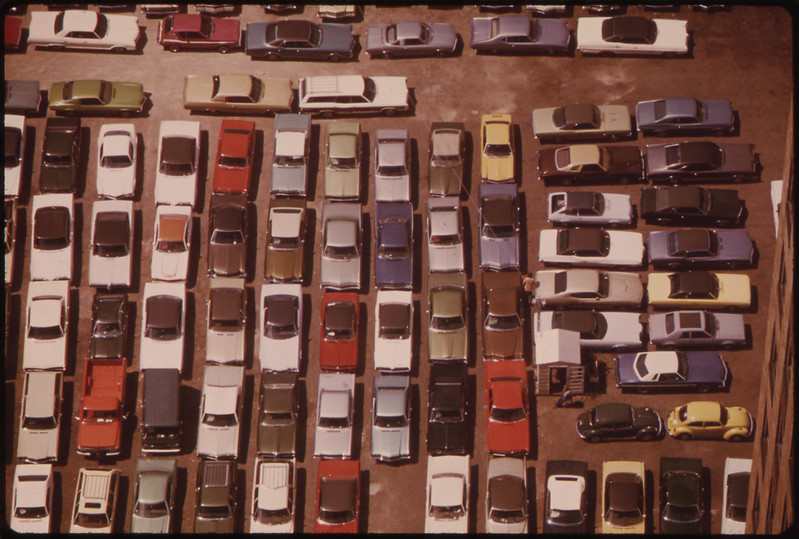
Image source: Flickr Commons
The simplest way to map a parking area in OSM is to draw an area and mark it amenity=parking. It will then show up on the map as a grey area with a blue “P”. In the United States, almost a million areas exist with the amenity=parking tag.
I’m looking for an oasis in the desert
but i can’t find
All I found was a dusty stretch of sand
who seems to laugh at my despair
I’m feeling dehydrated now
throat tightening
as if I can no longer walk this leg
stepping on the dusty grains of sand
can’t feel anymore
I will continue this journey
I’m tired and tired
I can no longer endure
in this barren and arid field
I can no longer endure
in this absence
in this helplessness
I hope that a traveler will come
bring a drop of water that will cool this soul
a soul that hurts because of love
I often use apps using OSM data to find nearby restaurants to go to. However I noticed that most restaurants in my area do not have cuisine information, and many that do have typos or other non-standard values that can’t be processed by the apps I use. This makes it harder to find a place to eat. So I cleaned up all the cuisines in my country to improve the usability of the data that is already there.
Using JOSM I was able to do this at scale. I would do it for more places but it requires some knowledge of local cuisines. I left instructions at the bottom of this post so you can do it for your area if you like.
First I researched all the existing uses (mostly using taginfo) and updated the Key:cuisine wiki to reflect current usage. With a clearer picture of what tags are in use and which are duplicates, I felt confident in sorting through thousands of tags and determining which ones had issues that needed to be fixed.
JOSM allows me to easily download and filter objects. The Tag Editor plugin allows me to easily edit a large list of objects. With these tools I was able to focus on making edits and not on repetitive tasks or on sorting through objects I don’t need to see. The exact steps and filters I used are below.
I want to be clear that I’m specifically trying to avoid making decisions about which tags should or should not be used, and I’m not making any decisions about what cuisines a restaurant serves. I’m merely matching the original mapper’s intent with current tagging standards. Mostly this means fixing typos and syntax, and occasionally moving the information to a different tag.
Hallo ich hatte seit November 2019 in meinem Landkreis alle Orte systematisch überprüft und fehlende Gebäude, Straßen, … ergänzt. Die Daten wurden mit den Karten des Landesvermessungsamtes überprüft. Im Mai 2020 war der nördliche WAK komplett abgearbeitet. Da inzwischen eine überschaubare Zahl von Neubauten zur Ergänzung ansteht, habe ich geplant, das in den nächsten Tagen zu bewältigen. Und musste feststellen, das nette Zeitgenossen das Projekt sabotieren. - Beim Hauptort Behringen der Gemeinde 99820 Hörselberg-Hainich sind fast alle Hausdaten gelöscht worden. In verschiedenen Straßen von Eisenach zum Bsp. Okenstraße, Friedrich-Ebert-Straße ebenso. Wie kann man das rückgängig machen,
En navigant les données de la Sibra dans les différentes cartes (Apple Plan, Google Maps, OSM…), je me suis rendu compte qu’il y avait pleins d’informations qui n’était pas à jour ou alors pas unifier sur chaque platform.
J’ai donc commencer à modifier les arrêts de bus sur OSM puis j’ai trouver les données GTFS de la Sibra sur transport.data.gouv.fr mais il y a pleins de chose qui ne vont pas dans le fichier stops.txt: stop_id incohérent, arrêt dédoublé, lat/lon incorrecte, manque d’info… Et ce genre de problème sont dans tous les fichiers. J’ai donc décider de créer un repo GitHub Sibra-GTFS dans lequel je met toutes les données de manière uniforme et à jour au fur et à mesure que je fait les modifications sur OSM.
L’objectif final est de refaire tout le réseau Sibra (ouf…) sur OSM ainsi qu’au format GTFS.
Pour être sûr que les données soient cohérentes sur l’ensemble du réseau Sibra, j’ai mis en place une nomenclature des différents éléments du réseau:
Un point sur une route qui désigne l’emplacement d’arrêt du bus. Les attributs suivant le désigne (exemple Meythet Centre):
Généralement une ligne qui désigne la zone d’attente (sur le trottoir) des voyageurs. Il y en à un de chaque côté de la route. Les attributs suivant le désigne (exemple Meythet Centre):
Des attributs supplémentaires peuvent être ajouter:
Surface de l’abri d’un arrêt de bus. Les attributs suivant le désigne (exemple Meythet Centre):


