
I just converted over from mapbox tiles. I think I did everything right?
Looks nice to me Fediverse Observer
 OpenStreetMap
I just converted over from mapbox tiles. I think I did everything right?
Looks nice to me Fediverse Observer
A well.. appears I cant accurately add building to this map since the satellite images are old. The images available show the site before the foundations where put so it is hard (or maybe impossible) to add buildings without any reference point (plus I’m new to this so I know nothing).
Anyway, I’ll just keep studying the site and hopefully, I may figure out a way to add the buildings.
People should be wary of the imagery offset especially using high resolution products. In OpenStreetMap, Mapbox often provides high resolution images in densely populated areas within the US. However, just because Mapbox provides high resolution imagery does not mean the offset is not a thing. In fact, Mapbox has created a lot trouble as it pretends to be accurate but actually not.
Keep in mind that whenever your local municipality has its own orthoimagery published, always use it to draw features (of course it has to be compatible with OpenStreetMap, if it is missing in iD, maybe you can bring it in). The imagery could be dated, but it is accurate. Your local municipality will spend more time to process with the data. These “commercial” providers, like Mapbox or ESRI or Bing, do not have a lot of time to carefully examine everything in a specific area especially when it is not that popular.
I’m going to post an example here. The orange area is OSM data fetched by QuickOSM in QGIS, drawn by a random person who has not noticed the offset for years.
De Felipe
L’association OpenStreetMap France a été créée le 8 octobre 2011, il y a 10 ans.
C’est l’occasion de revenir sur cette première décennie et pour commencer sur la génèse de l’association.
La première trace de discussion sur le principal canal de communication (talk-fr) date du 16 novembre 2009:
https://lists.openstreetmap.org/pipermail/talk-fr/2009-November/016188.html
Robin Prest pose la question “Voulez vous créer une association OSM France ?” après que Pieren et Etienne Chové mentionnent “une association française qui mettrait en place des serveurs (avec peut-être un soutien pour l’administration) et qui a surtout besoin d’un porte-parole”. Le sujet des serveurs est en effet important à l’époque, pour mettre en place des services (comme osmose) et les dons ne sont envisageables qu’avec une structure officielle. L’Université de Nantes fera ainsi le “mirroir” pour le don d’un lot de serveurs venant de chez free (voir: https://lists.openstreetmap.org/pipermail/talk-fr/2009-November/016284.html).
Un vote est lancé sur un Doodle… une cinquantaine de “OUI” se dégage en quelques jours.
Le mode de fonctionnement proposé par Robin est le suivant:
D'ailleurs, je suggère que les statuts prévoient de "soutenir" le projet
plutôt que de le "diriger" - référence au message de **sly** sur la république
bananière - ce qui permet une certaine souplesse dans le fonctionnement
général. D'ailleurs, on peut avoir OSM tel quel avec sa communauté de plein
de gens anonymes qui participent sans se prendre la tête avec le côté
administratif  et une assoc OSM france dont un des buts est de soutenir le
projet d'une façon ou d'une autre (par l'hébergement via des serveurs, par
la collecte de dons, par les communiqué de presse, par ses relations, etc),
l'un n'empêche pas l'autre.
Just realized that I didn’t notice that on Tuesday (the 5th) I sent out the 10’000ths welcome message to a contributor.
I’ve been doing this for SOSM since December 2013, nearly 8 years ago, averaging a bit over 100 messages per month.
I’ve discussed our expectations (or rather the absence of them) before see @SimonPoole/diary/40071
PS: The happy “winner” was @JFischli
I was surprised no one had added the historic Green Gables house near the intersection of U. S. 1 (Harbor City Blvd) and Hibiscus Ave.
Added that and may add more buildings of historic interest later.
Dear HOT Voting members, HOT staff, HOT volunteers and people interested in HOT, Humanitarian and Open Mapping,
I hope this message finds you and your loved ones well and healthy. I would like to present to you my end of term report as President of the Board. On 10 February 2021 I shared a detailed annual report for 2020. In this new report I would like to focus on challenges, ongoing efforts, key learnings and achievements.
Of all the anticipated challenges while participating as a Board Member, a global pandemic was not on our list. It was a difficult and challenging time for Voting members and staff and the Board members were not an exception. Board members, like many other people, were facing difficult situations with loved ones getting infected, trying to find a balance between working from home and taking care of their families, among many other difficult situations.
This could be one of the reasons why not every Board member was contributing equally. Being part of a Board requires certain commitments such as time and asynchronous participation to be able to be part of the decision making process, often outside of Board meetings. Some Board members were not responsive or slow on providing feedback in discussions, this caused delays in progress and decision making.
My suggestion to future Board participants is to review in advance the Board Procedures and other relevant documentation to make sure you can commit to this two year period.
Hi all,
I hope you are all well and safe.
As many of you know, we have been working on a new model to ensure Tasking Manager (TM) continues to get the love and attention it well deserves. As we unpacked the value of the project, we started to realise just how much we value the inputs and contributions of a large collective of contributors lodging issues, PRs, code, resources etc. I went through every single issue on TM’s Repo and was really blown away by just how much support the project gets both in front of and behind the screens.
Moving forward, we really want to return TM to its former community-lead glory and as such have put together this proposal for what TM’s Tomorrow could look like.
https://docs.google.com/document/d/1tTT4oKUN34FThzbNFZKfj0lhQOMRB4uTF1n2rO1iHrc/edit?usp=sharing
I invite everyone to comment in the doc on things they like or don’t like or questions they have so we can reenergise our love for the TM and it’s sustainability and evolution. There is a long list of Frequently Asked Questions (FAQ’s) at the end of the doc, but I also invite you to add your questions as a comment to the FAQs so we can endeavour to answer them as well.
I really look forward to your feedback.
Kindness,
bo
p.s. we are also now on the hunt for a possible community representative product owner for TM, so if this sounds like something you could be interested in, please get in touch.
 Bibliobús municipal de Málaga junto al colegio María Zambrano. Fuente: trabajo propio (CC BY-SA 4.0) disponible en Wikimedia Commons.
Hace algún tiempo me propuse mejorar la información geográfica disponible en OpenStreetMap relativa a bibliotecas y librerías. Otras ocupaciones me han distraído de este empeño, aunque continúo trabajando en ello. Recientemente se han incorporado al mapa los datos abiertos del Ayuntamiento de Málaga relativos al equipamiento municipal de bibliotecas.
Now it is one week since I started working with OSM. Sadly, my initial enthusiasm has waned. While there were many nice experiences, above all encountering some helpful fellow mappers, a feeling of meaningful connection with the purpose of the project did not develop.
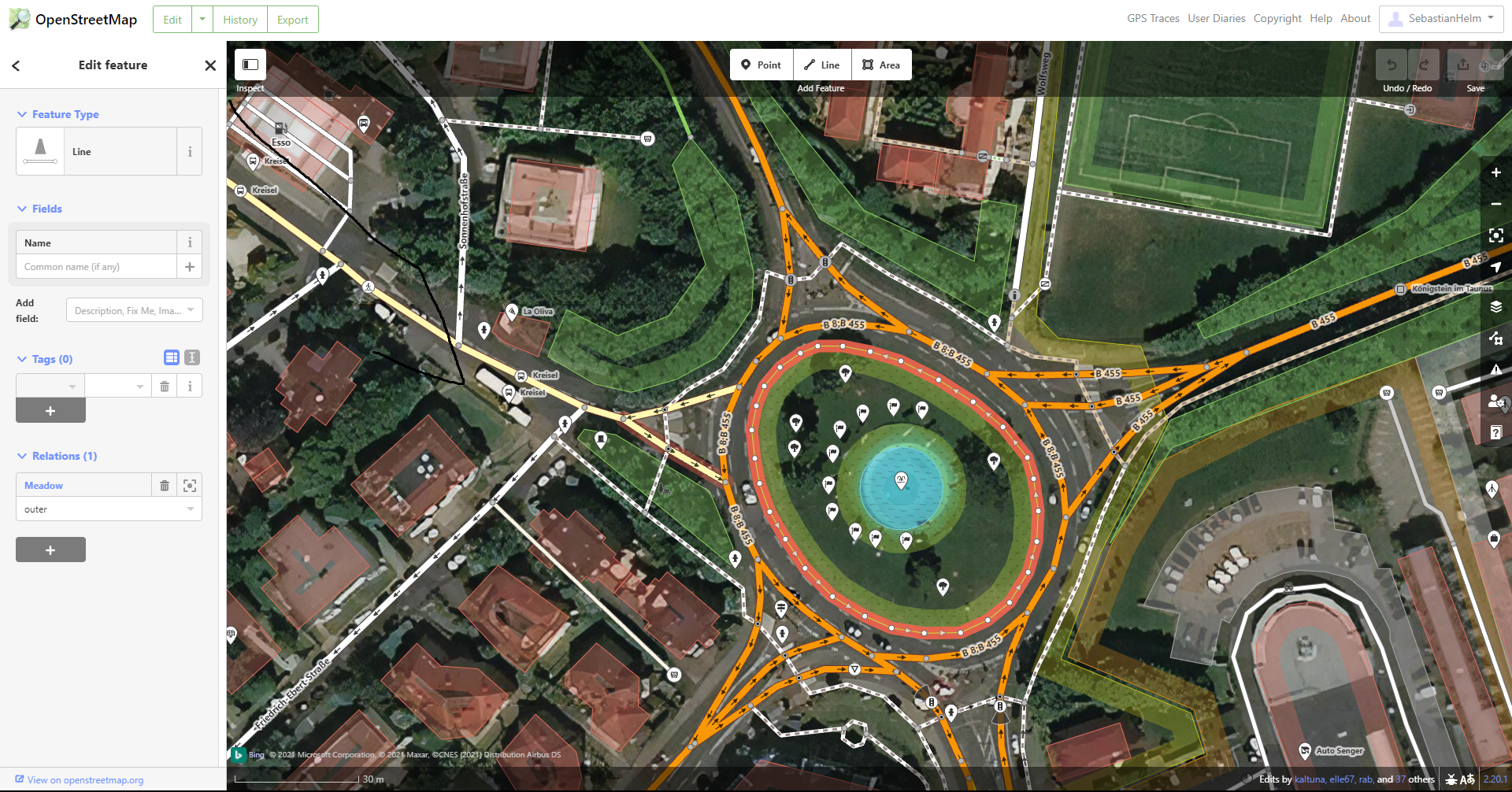
The apps I used show little consideration for what’s meaningful to the average mapper or end user. The below example from iD may serve as an illustration for how haphazardly it has been decided what gets displayed and what gets hidden. This matters because the UI displays no settings button to override that decision.
Hi everyone,
A new version of MapComplete has been deployed. It has a lot of exciting new themes and features, which I’d like to highlight in this diary entry.
The Flemish touristical agency (Toerisme Vlaanderen) has asked me to create a tool to help them to map charging stations, restaurants, café’s, …
This has resulted in quite some fun new themes:
At last, the theme I’ve quickly made as demo with hackerspaces and makerspaces is online as well.
At the same time, I’ve been doing lots of work on improving performance. A lot has changed under the hood, resulting in a way more robust and fast experience. On high zoom levels, the OSM-API is used directly, bypassing overpass all together. If overpass-api.de is down, failover to other instances is now builtin. At last, caching is a bit more aggressive and if the data on your machine is recent, no new data is loaded at all.
Earlier releases had some important features to, which I’d like to highlight as they can be important for theme builders:
On 23rd of September 2021, I trained a group of students of 200 plus on how to contribute to OSM using mapswipe. After their examinations, they will be officially added to Youthmappers and to our local chapter OyomappersTeam (OMT).
_
Disclaimer #1 I’m not used to speak english anymore, I apologize if some sentences sound clunky.
Disclaimer #2 Last time I added pictures in the diary post, they would not always show up. Click on the link if it happens.
So now, I’d like to start with a provocative joke :
Marck Zuck. comes into his office and asks his colleagues :
– Hey, do you know why there’s a magnifying glass on the OpenStreetMap logo ?
– Well, it means that OpenStreetMap helps you find places and amenities on the map.
– Not a all ! It’s because you won’t notice the credits without one.
My point is that OpenStreetMap lacks a strong visual identity. I believe I started to notice it when I read some Facebook employee saying that a logo would be easier to credit on a map than the (c) openstreetmap contributors. 🤨
Dishonesty aside, he makes a point. The (not so) new OSM logo is gorgeous and deserve more consideration and would help OSM maps being more recognizable and popular. In times where we are constantly facing pictures, logos, visuals, a brand/company/project/whatever need a clear visual identity to exist in our digital world. The actual text only credit looks like good oldies websites.
Besides, sometimes, OSM credit is in competition with some other logo. I was thinking of Mapbox but I couldn’t find an example with an OpenStreetMap map.
You may have heard people talk about ‘priority countries’ in relation to HOT’s work and the regional Open Mapping Hubs (the Asia Pacific hub for example).
HOT has committed to furthering its longer-term vision across 94 countries through 2025. Initial priority countries were selected based primarily on disaster risk and acute deprivations needs (measured through the multidimensional poverty index).
I just wanted to flag that if you ever need to know which countries they are or the process for updating the list, there is now a page on the OSM wiki at https://wiki.openstreetmap.org/wiki/Humanitarian_OSM_Team/Priority_countries.
Please let me know if there is any information missing that you think should be there…
Ich arbeite in einer Leitstelle und wir greifen auf die Daten von OSM zurück. Manchmal ist es schwer ersichtlich, sofort und schnell eine Adresse zu erkennen, wenn Adress-Punkte teilweise neben Gebäuden versorgt werden. (Ich weiß nicht, wie das Ganze mit den Layern funktioniert, aber die Adress-Punkte “verrutschen” häufig und sind dann neben den Gebäuden.) Laßt doch bitte die Hausnummern in den Gebäuden und setzt nur Adress-Punkte auf Grundstücke, auf denen (noch) kein Gebäude steht. Danke.
While the heart of OpenStreetMap is the community of mappers, it has also a remarkable ecosystem of software developed and used for OpenStreetMap. Many people are surprised to learn that it is so federated that the OpenStreetMap Foundation does only a tiny part of it.
The key to understand that is that many software projects have developers out of personal passion. The long time editing tool Potlatch has been developed and kept alive by Richard Fairhurst, JOSM luckily has a whole team behind it, and also Vespucci, OSMAnd, Nominatim and Osmium each are closely tied to names, as well as many other tools. This both keeps each of the tools focused and gives them a direction. Large organizations cannot offer that, because more often than not the managerial fashion of the season will interfere with pursuing long term goals.
Nonetheless, outsiders that expect a single point of contact shall have one. This is where the idea of the Engineering Working Group comes into play: it has a more specific mission than the board in general, but it still can send people and inquiries to the right places.
The EWG does not replace issue trackers. The EWG is not the right venue for comprehensive visions of the future. But it shall help to improve the flow of information related to development of OpenStreetMap related software.
I’m happy to chair the just restarted EWG.
Go Map!! v3.0 was released today for iOS, and while superficially not much looks different, there are some big changes under the hood: All 38,000 lines of code are now written in Swift after a laborious conversion from it’s original Objective-C implementation. This make the code faster, easier to understand, easier to debug, and brings it in line with Apple’s direction for modern apps. It also greatly simplified a lot of refactoring to improve general readability of the code base. If you’re a developer this is a great time to get involved with the code.
My involvement with OSM started in March 2012 and I wanted to be out surveying and mapping on my iPhone. I had downloaded the few iOS apps that existed at the time (remember iLOE and Pushpin?) and found them too limited. Although I had a strong Windows/C++ programming background I was new to iOS, Objective-C, OSM, and GIS. Nevertheless I began work on the first version of Go Map!! writing in Objective-C and learning about the OSM API along the way. (Apple did not introduce the Swift programming language until several years later, and it took an additional several years to become stable.)
I wasn’t really sure whether a new mobile editor was something of interest to the OSM community, but in October 2012 I drove down to Portland, OR for my first SOTM US, where RichardF (author of Potlatch, the OSM web editor at the time) delivered a talk titled (IIRC) “Let a thousand editors bloom” where he suggested that OSM should have a wide variety of editing tools, and the more the better. I’d been working on the app for only a couple months and his talk inspired me to continue.
Nu när jag blivit varmare i kläderna efter några år av att ha kartlagt lite här och var där jag tidigare har bott i Höganäs, Skäret och Helsingborg. Städer jag känner som Malmö och Lund eller har vandrat i fjällen.
Nu har jag flyttat till Ängelholm och jobbar regelbundet i Ödåkra. Vilken skillnad det blir när man kan kartlägga säkrare och våga göra ändringar. Nytt är också att jag har skaffat körkort så jag börjar se över vägar utöver tidigare nästan uteslutande gående och cyklist perspektiv.
Jag känner dock ett problem nu när jag kom till Ängelholm. Denna staden är kartlagd för mycket länge sedan och staden har växt och förnyats. Den skiljer sig kraftigt från alla andra skånska städer som jag har kartlagt i och jag känner att jag behöver hjälp för detta är ett stort projekt.
Jag behöver hjälp med att förnya Ängelholm eller att arbeta om det så att det liknar dels verkligheten och dels liknar hur andra städer är kartlagda så att den hänger med.
Det tog sådan tid känner jag att komma igång trotts att det finns mycket information så finns det väldigt lite praktiska genomgångar som jag känner till för att börja kartlägga. Om jag skulle träffa någon som är intresserad av att hjälpa till så känner jag att det kan ta lång tid för personen att komma igång då det saknas en lätt väg in. Det är en rätt hög tröskel trotts att web-gränssnittet är enkelt. Det ligger mycket i rädslan av att göra fel och att om ett litet tag så kommer alla att ha en bättre eller sämre karta till följd av ens ritningar.


.jpg)
%20by%20Vince%20Emond.jpg)


