OpenStreetMap logo OpenStreetMap

Diary Entries in English

Recent diary entries

I had to add so many things to this place during my courent day in the job. I need someone that with me add to Getafe some things that there aren’t on the map. Please, write me in private to let me now who want to colaborate in this proyect that is name: Lets help Getafe!!!! Let me now who is interesed writting me. I will read your menseges. Bye Kitsunderoku

Posted by jimmyjamjar10101 on 10 November 2025 in English.

More recently I find myself addicted to OSM once more after a long hiatus. I guess working in the civil road design space has me interested in capturing features around the streets such as crossings, sidewalks, street furniture and recreation spaces.

I’m shocked by the number of sidewalks I have found that cross a street not as a crossing. I’m fixing these as I find them.

My end goal is to try and resolve as many items from StreetComplete as I can around where I live and work, adding to the accuracy of the overall map model locally.

Having grown up in the Current River Area there are many same details I was able to add to the map such as small back roads that are mainly used my locals. Additionally one thing I noticed with is that many features where outdates. There where restaurants and stores that closed down years ago and new ones have since opened up in their place. So I updated the map to have the newest data. From using openstreetmap I learned a lot about citizen mapping and the people who live in an area know it the best to map it. But also using a mapping website open to the public comes with risks of inaccuracies. What I found to be challenging was that some houses weren’t properly lined up so it impacted when I tried to add a new house.

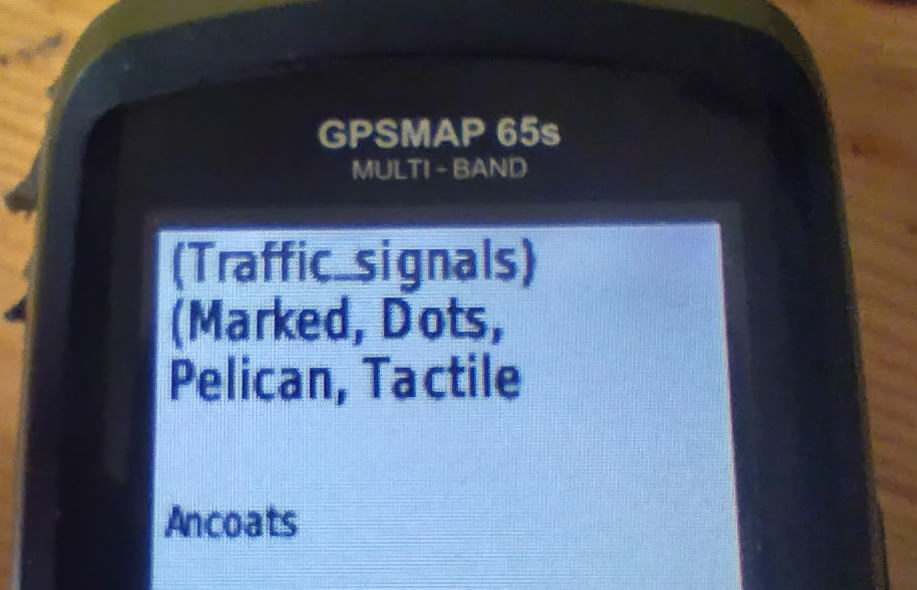
… and following on from the previous entry, Maps for Garmin devices at map.atownsend.org.uk now show crossing details too:

A picture of a Garmin handheld saying "(traffic_signals) (marked, dots, pelican, tactile"

The following tags from the top-level feature are shown:

  • traffic_signals or crossing
  • The value of crossing if it adds extra information
  • The value of crossing:island, crossing:marked, crossing_ref etc. if they add extra information.
  • Information from tactile_paving and kerb.

All of this might be truncated for length (it is here), but the most important information does appear.

Location: Central Retail District, City Centre, Manchester, Greater Manchester, England, M4 3AD, United Kingdom
Posted by Smith_VT on 5 November 2025 in English.

I am a new editor of OSM, and I thought I would explore the tools and update familiar areas for myself. I added and updated areas in Bronte Creek Provincial Park. The OSM tools made it really easy to add new areas, points of interest, add some walking trails and label everything with accurate details. The park was already mapped with buildings, trails, roads, parking lots and much more. A lot of what I found myself doing was adding newly labelled areas, ex. Cow Barn, Cow Pasture. I am very familiar with BCPP, and now anyone looking to go to the park can have a better idea of what is really there. OMS is very easy to navigate, and I enjoyed using this mapping software. Not only is it a great tool to add for other people to use, but it is also great to see what is really in your surroundings.

Posted by FrodoMappins on 4 November 2025 in English.

Ok, my good friend Butterball wanted to pay me a visit from Bree. You all know how he is, super braggy. He told me he just got a brand new iPhone version 1 with 20 KB of RAM. I was like, “Okay, cool, Butterball. We’ll see you. Just don’t be braggy.”

He wrote me a long letter promising me that he wouldn’t be braggy, but then he told me about a problem that he had. He had too many footpaths coming up on his map. He couldn’t find the way easily. Every time he brought up the map, his iPhone crashed. Check out the shire with all of the footpaths!

Crazy Map With Footpaths!

dense shire map

I told him, “Don’t worry, I’ll just modify his map with a new layer with just roads on it instead of all the other extra crap.”

I was like, Open Street Map is pretty awesome, but they include a lot of stuff in their layers, and then they let you just claw back what you want. I think what we want to do is modify it so we only show the tags that we want, so your map doesn’t crash. Does that sound like a good plan?

See full entry

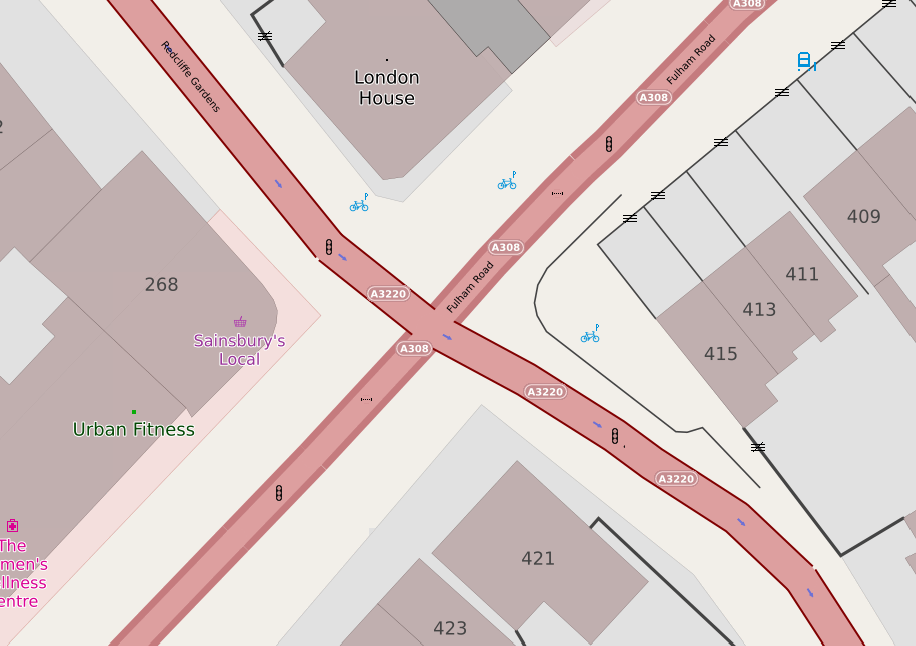
A map of part of London

I have a couple of web maps, and they are supposed to show pedestrian crossings. If there’s some crossing infrastructure (for example - zebra stripes, or tactile paving and a lowered kerb) you’re supposed to see a “crossing” icon. If there are traffic signals associated with the crossing, that icon should be replaced with a “traffic signals” one.

Years ago it was straightforward - you’d get a https://wiki.openstreetmap.org/wiki/Tag:highway=crossing tag on a node on the roadway, and there would be another tag, such as crossing_ref to say what sort of crossing it was. Some crossings (such as pelican, puffin and pegasus) have traffic signals; others (zebra and informal crossings) tend not to.

Unfortunately, it has got a lot more complicated.

Sometimes, the highway tag is crossing;<something> or <something>;crossing. Sometimes that something should be ignored and treated as a crossing.

See full entry

Location: Lot's Village, Brompton, Royal Borough of Kensington and Chelsea, Greater London, England, SW10 0PJ, United Kingdom

One of the most important things I learned about mapping with OpenStreetMap is how collaborative and detailed the global mapping community is. Every edit, no matter how small, contributes to a shared, constantly evolving map that supports navigation, humanitarian efforts, and local development. I realized how crucial accuracy and verification are, each feature needs to be placed and tagged correctly so that it’s useful for others. The most challenging part of editing OSM was learning the tagging system and ensuring that my edits followed mapping conventions. I mainly mapped in areas that lacked detailed data. Overall, the experience showed me how open data and collective participation can create powerful geographic resources that benefit communities around the world.

Location: Elbeu, Wolmirstedt, Börde, Saxony-Anhalt, 39326, Germany

I edited an area where I grew up and frequently return. I chose to focus on some features in this area, as I figured some would be missing or incorrect due to fewer resources to investigate them and their lower priority given the town’s smaller size. I decided to start with elements I knew were recent in the town, such as the opening, closing, or rebranding of businesses. Then I moved into land-use elements, as some areas were assigned to a broader category when a more specific use could be assigned. I updated some other features as well, like microfeatures in Murphy Park and Canada Post mailboxes, but I mainly focused on businesses and updating the elements around them. I learned that, in OSM, you can get a lot more detail on land use in an area, which I thought was a really nice feature. One of the challenges for me was finding the aforementioned resources. If I had not frequented this area, it would be difficult for me to understand what to update or add, as the larger mapping services are also outdated. I foresee this as a challenge with OSM: without someone in a small town committed to making changes, they will slowly lag behind the already slow giants in the industry.

Location: Smiths Falls, Eastern Ontario, Ontario, Canada
Posted by egknauff on 3 November 2025 in English.

The areas I mapped are familiar to me, so I was able to add new things that haven’t been marked on OpenStreetMap before. The most important thing about OpenStreetMap, to me at least, is how much contribution is needed to keep everything accurate and up to date. There were some edits in that area that were made 15 years ago, some that haven’t been modified to accurately display the area (under LuLu’s Variety, the block of houses is labelled as a park 15 years ago, when it isn’t a park now). The most challenge I had while editing was trying to accurately name certain buildings. For example, Itec Equipment is a building material supply store, but there weren’t any labels like “Supply Store” or “Building Supply Store”; the best I could label it with was “Rural Supplies Store, but I’m not sure if that is accurate.

Posted by aramimaidana on 3 November 2025 in English.

For this OpenStreetMap activity I focused on adding and improving features in an area I am familar with. I contributed information based on places I know, such as my University campus, which made the mapping process both meaningful and interesting to me. I think it is very important to share accurate and local information in OSM, because small details can make a big difference. I also noticed that some information around my area is outdated or incomplete, so in the future I would like to contribute more.

Posted by diwesser on 3 November 2025 in English.

I seem to have started on the questionable task of adding all the bus routes in Halifax.

I’ve been grabbing the route description from the Halifax Transit website, creating the route relations via Id and then adding to the relation with OSM Simple Route Editor. (I’d prefer to use OSM Relatify, but it seems to take a while to notice that the relation has been created or is having some other issue.) I have been using Relatify to verify that the route is correctly ordered and connected. I have also used the sort feature in JOSM “PT Assistant” plugin to deal with grumpy route alignment.

I have been doing inbound and outbound legs of the bus route as separate routes to avoid the complications from using the same way twice. In the case of the 1, they were already split like that with a master route that joined the two which seems rather elegant. But, it may be worth seeing if there is a way to join the halves together after the fact.

Here’s the overpass-turbo query I cobbled together to find current OSM routes (it mostly worked):

[out:json][timeout:25];
// gather results
(
  relation["type"="route"]["route"="bus"]["network:wikidata"="Q14875719"]({{bbox}});
  relation["type"="route"]["route"="bus"]["operator"="Halifax Regional Municipality"]({{bbox}});
  relation["type"="route"]["route"="bus"]["network"="Halifax Transit"]({{bbox}});
);
// print results
out meta geom;

So far I have found these routes either in OSM or via the current list of route descriptions:

See full entry

Posted by InfosReseaux on 1 November 2025 in English. Last updated on 18 November 2025.

Some news and visions about topic focused contribution monitoring capabilities of ProjetDuMois

ProjetDuMois platform

For more than 6 years, ProjetDuMois platform was used to plan, encourage and monitor “Projects of the month” by French community (and some other countries too). It has been a significant progress for people responsible of those very short projects as it has freed us from the hassle of counting changesets and provides a mappers-friendly customized editor.

ProjetDuMois web interface for EVSE inventory

See full entry

Posted by foxandpotatoes on 30 October 2025 in English. Last updated on 18 November 2025.

Bank and ditch

Preliminary

This is a provisional report about a future proposition for specific tags for the following types of banks and ditches:

  • bank and ditch barrier
  • hedge and ditch barrier
  • fossé bordier
  • talus
  • old way (e.g. Tiense Groef)

We have presently (30 October 2025) the following tags:

  • barrier=ditch - A man-made ditch or a trench is a long and narrow man-made barrier dug in the ground to prevent access to the other side. No precision about the type of the ditch. 82262 occurrences
  • military=trench - Is used to map a military trench: an excavation in the ground that is generally deeper than it is wide, dug into the ground as a barrier for military purposes (e.g. trench warfare). 25148 occurrences
  • natural=earth_bank - Not a man-made feature. 19672 occurrences.
  • natural=valley - Not a man_made feature. 59800 occurrences.
  • natural=cliff - Not a man_made feature. 916448 occurrences.
  • waterway=ditch - A simple narrow artificial waterway used to drain nearby land, to remove storm-water or similar. 4438049 occurrences.
  • waterway=drain - Artificial waterways, typically lined with concrete or similar, used to carry superfluous water like storm water or grey-discharge. 1801170 occurrences.
  • man_made=embankment - Is used to map an artificial slope or steep incline built for example to provide a level platform on top for a road or railway line or to otherwise shape or stabilize the terrain. For micro-mapped embankments, it is not possible to specify the dimensions (height, width). 307709 occurrences.
  • embankment=yes - Add this tag to a way that is already tagged with a highway=, railway= or waterway=* tag. 278223 occurrences.

None of them seem to exactly concern the banks and ditches mentioned above.

Bank and ditch

See full entry

I’m raising funds to purchase the historic 1:50,000 topographic map series of Eswatini (formerly Swaziland), so I can preserve and share them online as a seamless, zoomable mosaic - free for everyone.

In 2008 I successfully raised £1000 to acquire the equivalent series for Namibia (South West Africa). You can explore that project here: https://namibia-topo.openstreetmap.org.za/

Donate and more information: https://www.gofundme.com/f/purchase-historical-eswatini-topographic-maps

Location: Extension 3, Inkhundla Mbabane, Hhohho Region, H100, Eswatini

This is the story of how the cycling association measured streets in Bruges and got what they wanted - a cycling zone - 5 years after the initial campaign…

The setup

First some belgian road law. One of the peculariaties of Belgian is that we have the concept of a ‘cyclestreet’. This is a street where cars are not allowed to overtake cyclists - one of the tools to make cities more liveable. A cycle zone is similar, except that it is about multiple streets. It needs different traffic signs and is in effect until the “end of cycle zone”-traffic sign.

The cycling association of Bruges wanted a cycling zone in the entire city center. To force this, they devised a plan using a different law. The Belgian road code says that cars are not allowed to overtake a cyclist if the space between a cyclist and the car would be less then 1 meter.

In other words, if the cycling association could prove that most of the streets in Bruges are too small to legally overtake cyclists anyway, that would be a good starting point to force a cycle zone in the city. In practice, it would make the already existing situation more explicit.

Enter OpenStreetMap

As such, the local cyclist association asked me to help them in 2020, in the middle of the corona lockdowns.

I did create a custom version of StreetComplete to ask for the street width (a quest that StreetComplete would officially add about a year later).

And, as such, we got out into the city and, armed with a laser measurement device, took the width of every street in the historic center - a perfect activity to do during the corona lockdowns.

To display the information, I setup a custom map theme on MapComplete (which was quite young as well) to show the widths of the streets.

Using the measured width, parking and sidewalk information, MapComplete can automatically determine which streets are to small to officially overtake a cyclist.

See full entry

Location: Steenstraatkwartier, Brugge-Centrum, Brugge, Bruges, Brugge, West Flanders, 8000, Belgium

I have been mapping addresses on OpenStreetMap since a long time. During this time I have been also frequently referring to the wiki page for guidance whenever I felt my method was wrong. This post is the result of all the stupid mistakes I found during this checking of wiki. I hope that others wouldn’t make those same stupid mistakes.

Though this post is based on my experience in India, it should be useful to people elsewhere in the world.

The mapping process looks like this:

  1. Check if the neighbourhood or the street is present on the map. If it’s not, then add it.
  2. Create the building if it’s not on the map. Then add addr:street (or addr:place) and addr:housenumber (or addr:housename) to the building depending on the address.

That’s it. Now let’s elaborate on some things.

See full entry

Location: Naraina, New Delhi, Delhi, 110028, India