
OpenStreetMap logo OpenStreetMap

pitscheplatsch's Diary

Recent diary entries

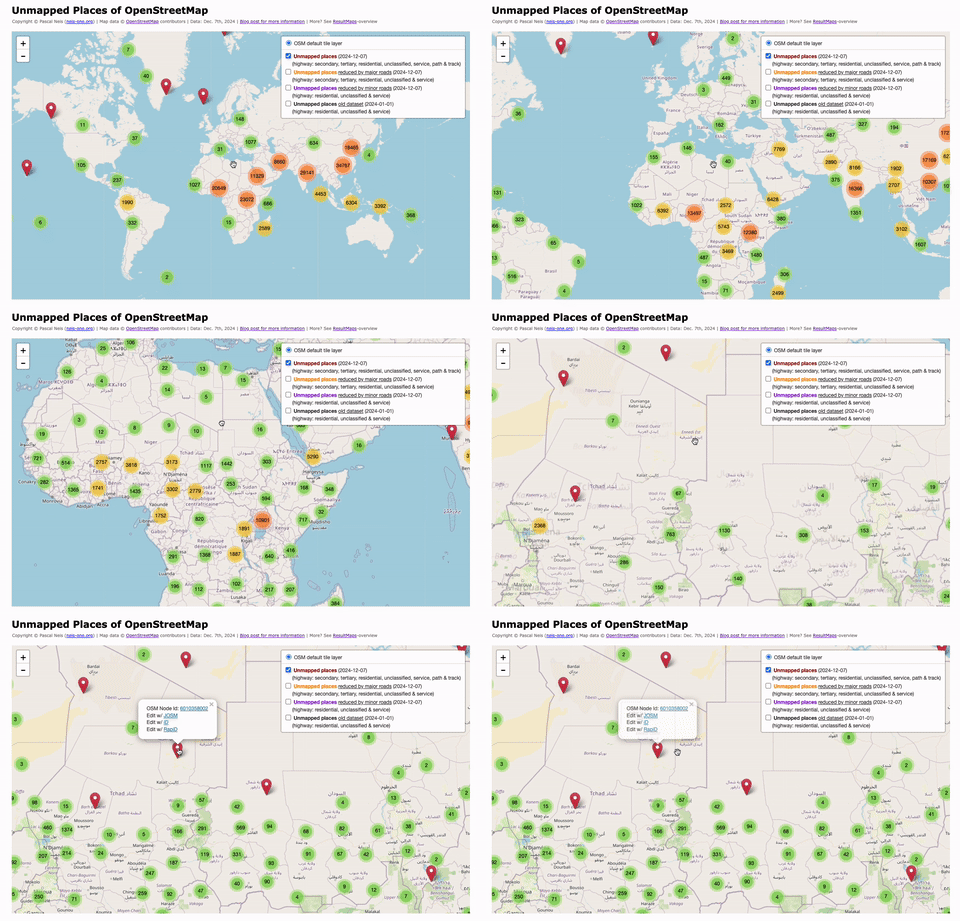
In 2010, I first conducted a study which identified regions (places) in the OpenStreetMap (OSM) project in Germany that still had potential for more detailed mapping. Later, in 2016, this analysis was repeated and extended to the entire world. I have since regularly carried out these studies and published the results. The algorithm and some more details are documented in an earlier blog post of mine.

For the year 2024, I have recalculated this analysis and published the results on my website: “Unmapped Places of OpenStreetMap”. For the study, the OSM Planet File in PBF format from Dec. 7th was used. It can be downloaded here. https://resultmaps.neis-one.org/unmapped
See full entry

Location: 0.000, 0.000

The OpenStreetMap (OSM) project has over 10 million registered members, with around 2 million user profiles having made at least one map contribution. However, a closer look reveals that there has been a slight decline in the number of active contributors over the last three years. Despite the extensive global mapping community, there are instances where individuals or automated bots disregard the consensus norms of the community when editing data. These situations arise due to disagreements regarding the appropriateness of certain tagging or features within the OSM database. To address these issues, a change rollback process, commonly referred to as reverting, is used to combat vandalism and correct ‘mistakes’ by restoring a previous version of the data.

Two years ago, I added additional statistics to the “How did you contribute to OSM?” page for quality assurance purposes. The numbers for each contributor profile were derived from an analysis of the full history OSM planet dump and changeset tags, including the specific editor used. While this pragmatic approach provides valuable insights, it’s important to acknowledge that the obtained numbers are estimations rather than exact figures. Furthermore, I received several inquiries regarding the implementation of the processing involved in identifying the displayed “reverted changes”.

Over the past few weeks, I have developed an advanced processing pipeline. This involved revisiting the comprehensive OSM planet dump and examining the evolution of each entity (node, way, relation) in relation to its previous states. Specifically, an entity with a higher version number was identified as a revert if it had the same latitude/longitude coordinates (for nodes), tags (key-value pairs), and/or members (for relations) as a previous version. In simpler terms, if a mapper changed “X” to “Y” and another mapper subsequently altered it back to “X”, it would be counted as a revert.

See full entry

Location: Ciutat de les Arts i de les Ciències, Quatre Carreres, Valencia, Comarca de València, Valencia, Valencian Community, Spain