The bus stop 2147027795 (Confederation Center) is in the middle of the road (and so is its near neighbour). They should be moved to the side of the road, but I’m not sure how to do the edit, in relation to other items.
Ref: highway=bus_stop
 OpenStreetMap

The bus stop 2147027795 (Confederation Center) is in the middle of the road (and so is its near neighbour). They should be moved to the side of the road, but I’m not sure how to do the edit, in relation to other items.
Ref: highway=bus_stop
Every object in the OSM database has coordinates (in degrees in the WGS84 projection/EPSG:4326), creation date, author and a description.
The imagery usually has offset issues. The problem is that imagery usually isn’t correctly placed with respect to the coord system. The iD editor has a tool for temporarily aligning the imagery with polygons and whatnot. It’s found at the bottom of the imagery dialog.
The Province has excellent resources online.
PEI National Road Network PEINRN Up to date, includes all the data you’d ever need.
Place names in Canada No type info, or population info! No indication of the precision of the lat/long. English and French.
Feature names in Canada. Not bad. 1869 items for PEI. Water and towns. Dowside: no population number, BUT it has categories that can do the same thing: locality, community, town, city.
Lakes and rivers- National Hydro Network - NHN - GeoBase Series
Natural Earth - motherlode of global mapping data. Seems to be of high quality. 1:10000 is their most-detailed recommended scale.
Global place names with pop. About 7300 places. Small towns missing.
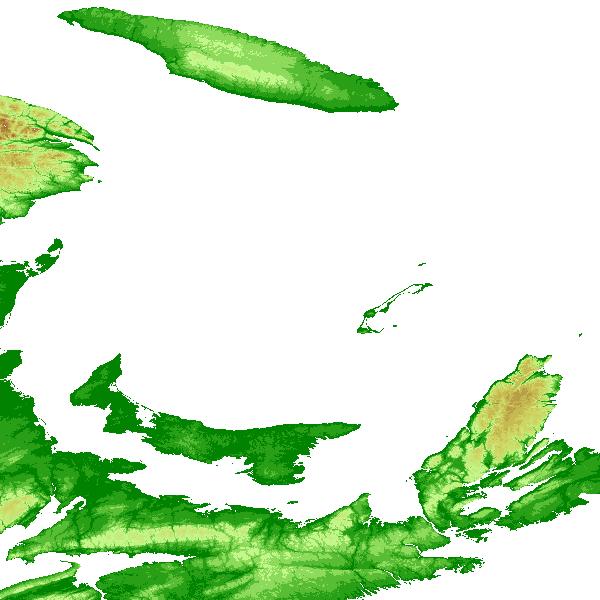
Global elevation data - the free versions of this data are usually based on data from NASA called SRTM. You can download it here. That original data set has holes, that can be filled by interpolating. The CGIAR data set interpolates. More info here. The resolution comes in 2 flavours, 90m and 30m. Here’s an example of it being used for shading. It’s certainly fine for indicating general elevation - example. Reference for mapnik.
It’s likely best to use transparency, and the alpha-channel, to render the hillshading.
Global elevation shading, $1000US
Also see OpenDEM.
Global Bathymetry - GEBCO may be low res, hard to say. Also see OpenDEM.
Bathymetry of the Gulf of St. Lawrence?
Note that large municipalities (including Charlottetown) handle their own civic addressing.There’s location data for each address. The exact point seems to line up with the driveway of a house, not the centroid of the house. This makes sense, for access by emergency services. The nominal precision is about 1 metre. Example:
91 PRINCE CHARLES DR CHARLOTTETOWN QUN 46.23739 -63.14737
I notice that Canada Post and the province now use abbreviated street names. What I mean by that is, for example, “Grafton ST” is used, not “Grafton Street”. The last part is abbreviated (and capitalized):
Here’s a link to the Provincial data.
It seems like the data in OSM for Charlottetown is manually entered, and not uploaded en masse using data from the province.
My feeling is that I would like to change the street names to match EXACTLY what’s defined by the Province. Reasons for doing so: