OpenStreetMap logo OpenStreetMap

Circeus's Diary

Recent diary entries

Reverting

Posted by Circeus on 10 February 2014 in English.

Erm, anyone can help me reverting this changeset? It’s not a major loss as such, since CDP boundaries are (I’m fairly sure) not appropriate for OSM, but those border are needed to trace Los Angeles’ in the area (they form an unincorporated enclave between cities).

ETA: Nevermind

The city limit stick so much to the streets in that area that it’s really not much of a problem.
Identical relation conflicting

Posted by Circeus on 8 November 2009 in English.

I've noticed that the use of identical boundary relations may cause display issue, witness 95672 and 95671. The first is a postal code (at https://wiki.openstreetmap.org/wiki/Tag:administrative_level=8 for some reason) with https://wiki.openstreetmap.org/wiki/Tag:name=3060. The other is the suburb (https://wiki.openstreetmap.org/wiki/Tag:administrative_level=10) with https://wiki.openstreetmap.org/wiki/Tag:name=Fawkner.

The result is that depending on zoom the displayed name will alternate between "Fawkner" and "3060". Surely there is no need to list https://wiki.openstreetmap.org/wiki/Tag:name=3060?, and arguably a single relation could be done to cover both? Also I might be crazy but are postal code realy independent administrative units in need of their own boundary definitions?

Location: Fawkner, Melbourne, City of Merri-bek, Victoria, 3060, Australia

Caved in...

Posted by Circeus on 27 September 2009 in English.

...and downloaded JOSM. So far I'm finding it a bit on the meh side. I'm using it primarily to add relations to the RTC network and a few other tasks (turning multiple-node intersection in a single one is a doozie with Merge node). Mostly I find it unintuitive and slightly overcrowded, and having to download the data constantly because you're running out of the original area is annoying, plus it does some simple tasks (primarily moving on the map) in ways radically different from Potlatch, and some tasks you would think would be simplified by it (why isn't there a "Duplicate relation" tool??) are barely so.

Finally, progress

Posted by Circeus on 7 September 2009 in English. Last updated on 21 November 2021.

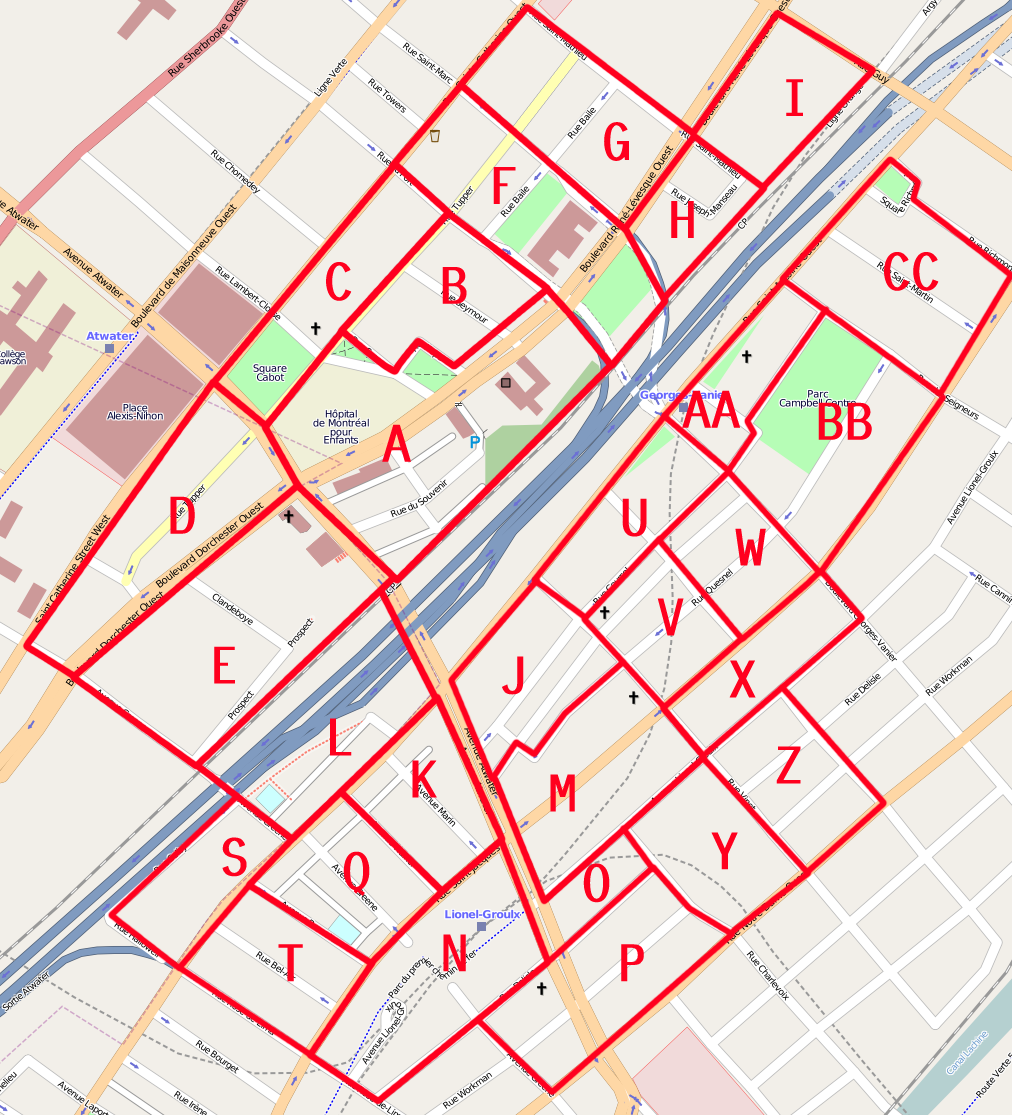
After a dearth of enthusiasm, I got off my lazy ass and did all missing slices in the northern half of my one-man cake.

At this stage, the only thing missing are the bus stops (which usually require to acquire a fairly large amount of data each, so I haven't done much with them yet).

-Slice H is going to undergo fairly major revision at some point in the future if a project to construct condos on the 1800 René-Lévesque lot goes through. That building used to face a street that no longer exists, hence why its entrance is on Joseph-Manceau, and the façade toward the highway. Otherwise its only odd feature is that Canada Post says there is a 1055 civic number on Saint-Matthieu, which I have not found, and also that there are no addresses actually located on Joseph-Manseau street. While looking for stuff, I also learned that the formal name of the jardin des Sculptures is "Esplanade Ernest-Cormier"

-Slice I was... interesting. It's got some pretty tightly packed up addresses, what looks like a private park-like thing (which is actually public access AFAICT. It's misleading because I do not map much urban furniture), and a missing street (Amesbury Avenue). Many postcode-owning buildings too. There's a weird dirt road going off behind the SPVM's Southern Logistic center, with a purported "920, Guy" CP address marked, but it's not recognized by Canada Post.

-Slice G had a lot of boring residential house numbering, but the alleyways were sometimes difficult to transfer from my notes to the map.

-Slice C, which I had expected to be by far the hardest, turned out to be easy EXCEPT where the alleys (part of which actually ran as a tunnel through Complexe Du Fort), which were a proper nightmare to map and transfer on data. You'll notice a small https://wiki.openstreetmap.org/wiki/Tag:highway=path segment. This is because although the pavement is continuous, this is a small space between the corners of two buildings where a normal motorized vehicle would certainly not fit.

Location: Ville-Marie, Montreal, Urban agglomeration of Montreal, Montreal (administrative region), Quebec, Canada

Missing street and billingual names

Posted by Circeus on 1 August 2009 in English.

My slice E turned to contain not one, but two missing streets, it also had some idiosyncratic street numbering on Prospect Street and Weredale Park (whose name I'm not clear whether it includes "Street" or not).

There was also an odd footpath extend from the corner of Prospect. It took me a while to figure out that it did not extend to Weredale Park (at first I thought it was the same as this footpath), but it in fact, does not even connect directly to the alleyway behind Clandeboye Avenue, but to the Weredale House parking lot. Also found a few permissive access shortcuts.

What this really outlined for me is that Westmount street names will be thoroughly frustrating to edit because they must be entered billingually and it is not entirely obvious whether the basic name should be French or English. Also, the street name indications on the ground do not include the "street"/"avenue"/etc. specific. AFAICT, most of the North-South (or rather NW-SE) streets are "Avenue" and the E-W (SW-NE) are "Streets, with various other oddly placed ways having other names (e.g. "Road", "circle", "crescent", there is even one called just "The Boulevard"). I've changed a few, but I'm not clear whether I should change the matching addresses too. This is really frustrating (though the street name on the envelope does not matter in the end: any addressing method is valid anyway, and you can generally leave out the part that changes anyway!).

Location: Westmount, Urban agglomeration of Montreal, Montreal (administrative region), Quebec, Canada

I just spent a while taking in, then entering data for my slice F. It was rather simple, except for a lot of fumbling around the first, which eventually led me to abandon the first attempt altogether.

Lotsa one-way fixes here. Turns out Tupper is one-way Waster from Gladstone to Atwater, two from Atwater to Du Fort, one-way eastward from there to Saint-Marc, and westward AGAIN thence to its end. Similarly Baile was one-way eastward, not westward, as previously entered between Du Fort and Saint-Marc (I forgot to check whether the segment from Saint-Marc to Saint-Mathieu was also one-way. Bad Circeus, bad!).

Overall the addressing was refreshingly easy to jot down and mapped easily into post codes, except where Place Dufort had four of them, and Post Canada sometimes list addresses with separate post codes (such as Place Saint-Marc and the H Post Office) as part of address ranges sharing post codes.

Also got to enter three turn restrictions, including the one from Atwater to Dorchester. Forgot AGAIN to make Tupper just https://wiki.openstreetmap.org/wiki/Tag:highway=residential instead of tertiary, though.

Location: Ville-Marie, Montreal, Urban agglomeration of Montreal, Montreal (administrative region), Quebec, Canada

More local editing

Posted by Circeus on 22 July 2009 in English.

Slice D was a <sarcasm>bundle of joy</sarcasm> to do. Complicated and messy with really weird post code and house numbers mapping.

Oddities:
-4039 appears to cover at least two separate buildings. It is recorded by Canada Post as "Reddy Memorial Hospital", but that seems to have closed years ago.
-4150 Sainte-Catherine has three associated postcodes!
-4020 and 4030 Tupper are apparently delivery docks for 4010, but do not share the postcode.
-The Atwater Library (a privately funded public library) and a branch of the Montreal Children's Library share the same building, but this is obfuscated because the addresses are on different streets.
-I really wonder why 4000 Sainte-Catherine (a small Asian fusion restaurant) has a separate postcode...
-Despite my mapping, there is no car (foot is okay) access between the Staples parking and the alley behind.

I am still rather frustrated with the difficulty of mapping in a fashion that makes relatively clear where on can circulate on foot. I decided not to apply any brute force edits anymore. It just makes a MESS of the render. Yes I know "Do not map for the render blah blah", but remember that data that no tool render/uses in a pertinent fashion might as well not exist as far as users are concerned.

Location: Westmount, Urban agglomeration of Montreal, Montreal (administrative region), Quebec, Canada

more mapping and hair pulling

Posted by Circeus on 21 July 2009 in English.

So I have completed most of Slice B (1898791 to 1899605) in my one-man cake around my home. It was really amazing (though understandably frustrating) how Mapnik updated in mid-upload.

I have a few uncertainty over these edits:
-I tagged the area surrounding the Canadian Centre For Architecture as https://wiki.openstreetmap.org/wiki/Tag:landuse=grass.* It's not a municipal park, but clearly private land where the paths should be tagged with https://wiki.openstreetmap.org/wiki/Tag:access=permissive when someone gets to it.
-I have two places where I need the ability to have two name= tags, because quite honestly I'm not going to start mapping buildings just to fix that. The issue are large apartment buildings with postal names and separate post codes (Sussex House and The Alden) which happen to have a https://wiki.openstreetmap.org/wiki/Tag:shop=convenience in the lobby (named respectively Dépanneur Le Rochefort 88 and Dépanneur Hap Tak)

*I think I'm going to start using https://wiki.openstreetmap.org/wiki/Tag:landuse=grass as my "default" tag for what I refer to as "institutional" landuse: the lands of convents, monasteries, large churchyards and public buildings, estates etc. that are sometimes nearly, but not entirely public access, and definitely not parks or commons, but frequently look like them. I'm not sure when I'll get to add landuse to the entire area around my home, though.

Location: Ville-Marie, Montreal, Urban agglomeration of Montreal, Montreal (administrative region), Quebec, Canada

Walking Papers is neat, but at the moment it is useless if you want to edit on the main part of Montreal Island or in Longueuil. Earlier this month, y'see, there was a screw up with some data that shifted several dozen points on the south shore, this has since been fixed in most mirrors, but Walking papers is nearly a week late, resulting in that mess making it impossible for me to use the service for my area (I just moved. If I still lived in Montréal-Est, that wouldn't be a problem).

The Cloudmade "minutely" upgraded no-name layers has devolved into an utterly useless farce. In someone else's words: "The minutely noname tile server is currently even more outdated than the weekly one."

The osm History Viewer is an awesome little tool that is very poorly documented. One has to make educated guesses at what the colors mean to get anything useful out of it.


I'm mapping again in my new neighborhood. It's crazy the sketchiness of the place! I feel like a little child again! I discovered that the Moroccan consulate is two street corners from my home! Any Montrealers interested in some cake slice sharing?

Location: Ville-Marie, Montreal, Urban agglomeration of Montreal, Montreal (administrative region), Quebec, Canada

tagging issue

Posted by Circeus on 2 May 2009 in English.

I've been wondering how to tag the area colloquially known as the Champ d'Hydro, near my old home.

It's basically an mix of fields, a ravine, and small, young groves kept clear due to the electric high-tension line. Trees over a given height are razed down every few years by Hydro Québec.

It's not quite any of https://wiki.openstreetmap.org/wiki/Tag:natural=meadow, https://wiki.openstreetmap.org/wiki/Tag:natural=scrub, https://wiki.openstreetmap.org/wiki/Tag:natural=heath, https://wiki.openstreetmap.org/wiki/Tag:natural=scree (it has ravines and very sandy/rocky soil), though it has some features of them all, and definitely not a https://wiki.openstreetmap.org/wiki/Tag:landuse=field (mildly confusing, apparently it's for farm field, it's rendered, but undocumented on the wiki), =wood or =forest.

In fact, I'm not entirely sure whether this is landuse or natural...

Any ideas?

A way to use Getmapping imagery

Posted by Circeus on 27 April 2009 in English.

There's one thing that came to me regarding the People's Map gorgeous (but unavailable to us) imagery. Basically, the principle is simple: you can't use it to map directly, but you definitely can use it to spot missing things. So basically what I'm doing is looking at the close-level imagery to spot missing streets or footpaths, and then entering OpenStreetBugs for people to map them (Yes I know, I should map them myself, but I live in Montreal, so that wouldn't be very practical :p).