 OpenStreetMap
BushmanK's Comments
| Post | When | Comment |
|---|---|---|
| Реки Сахалина | @Xmypblu, ну, за вопрос “а можно ли как-то автоматически вычислить положение рек и ручьев по SRTM” вас бы точно никто не съел. Собственно, касательно данного “импорта”, хотел добавить, что очень надеюсь, что у вас source подробно расставлен на самих объектах, чтобы можно было понять, что они автоматически сгенерированы и если кто будет корректировать участки - соответственно, можно было бы проставить указание на Bing или что-то еще. Есть еще одно развлечение - взять модель местности более высокого разрешения и попробовать ее интерполировать (сгладить) разными способами, а потом попытаться что-нибудь сгенерировать по ней. Но тут, конечно, очень много всего делается по ощущениям. |
|
| Реки Сахалина | @Xmypblu, про обсуждение по ссылке - это я к тому, что автоматическая генерация водотоков на форуме обсуждалась, соответственно, можно было, по крайней мере, упомянуть это там и обсудить. Что касается втягивания речной сети в Inkscape - предварительно нужно генерализовать данные. В QGIS это делает модуль Generalizer, в GRASS - v.generalize. |
|
| Реки Сахалина | @siberiano, “синие картинки” можно нарисовать с равным успехом в любом растровом или векторном редакторе (предварительно экспортировав геоданные в понимаемый им формат), если умеешь им пользоваться. Если не умеешь, как всегда, ничто не поможет, кроме как научиться. |
|
| Retaining New Users | To discuss that in a reasonable manner, it is required to break down the structure of new users by their motivation and by demotivation factors, affecting each group. Ironically, for different groups, different demotivating factors could be opposite. Like, there are initially strongly motivated people, “inclined to mapping” - they want to express themselves by joining the OSM project. We do have a whole bunch of such “lone wolfs” among the super-active users, who don’t really participate in any social activities such as meetings or conversations. And many of them, likely, do not want to be bugged right away. On the other hand, there are moderately motivated people who want to try something new and cool to entertain themselves. They need to be told what to do, but not in a restrictive manner. Very likely, they need more social interaction to keep their interest high, otherwise, everything becomes boring for them. And there are, for sure, non-motivated people who just want to “add a couple of amenities”, or those who have no idea what exactly they doing (adding personal points of interest such as “mom’s house” to the publicly accessible map). Trying to tell them about the whole project or telling that they just did something wrong makes them wonder, “What the hell is that?” Sure, there is a tiny chance that among them, there is a person who actually belongs to the second group, but had no idea of OSM before, but it’s really tiny one. So, my idea of that problem is that “carpet bombing” doesn’t make much sense anyway - only those from the second group can be effectively attracted. Now, question is, how to identify them. I think, that they should be interested in adding more stuff than just amenities and POIs as well as in editing (fixing data), not just adding new information. It doesn’t mean that everyone who doesn’t do that seems useless, but that’s an indication that particular person wants to improve a map, which is exactly a goal of the whole project. Another thing that should be kept in mind is that you can’t force anyone to become an active mapper - you can only guide one or show more potentially interesting things to do. Otherwise, it looks like a behavior of a Middle-Eastern street merchant, who grabs any person passing by his stuff close enough and tries to annoyingly convince one to buy something. |
|
| Реки Сахалина | @Xmypblu, вот это обсуждение вы, вероятно, пропустили: https://forum.openstreetmap.org/viewtopic.php?pid=419475 |
|
| OSM data in MapMyIndia | That’s pretty much obvious. But what’s the final goal - just to know that? |
|
| OSM data in MapMyIndia | “Dig more” - for what exact purpose? |
|
| Наблюдения: 信言不美、 美言不信 | Еще, пожалуй, добавлю, что будучи работником образовательного учреждения, обязан проходить тренинг по всякого рода bullying/harrasment prevention, и там никакой такой розовой мути про запрет критики и так далее нет и быть не может: критика - естественная составляющая многих видов деятельности, в том числе, учебного процесса. |
|
| Наблюдения: 信言不美、 美言不信 |
А какая разница, что они не считают эту задачу необходимой, если задачи проекта вполне ясно обозначены, а форум - канал общения, служащий коммуникации внутри проекта? С тем же успехом можно было бы нагнать на форум фанатов железнодорожного, речного и авиационного транспорта и объявить все, кроме тем, которые с этими вещами связаны, оффтопиком или второстепенной ерундой. Плюс, есть другая проблема, которая в конкретном случае не гипотетическая, а реальная: немалое число людей были активно против перепрофилирования форума. И в их число входили не только “зеленые тролли”. То есть, не говоря уже о противоречии с задачами проекта, дополнительно еще положили на немалую долю равноправных участников форума. Так что может с таким целеполаганием стоило продолжать тусоваться в чатике в Телеграме? От наличия аргументации суть возражения не меняется, она только становится яснее, и взрослый социально-адаптированный человек вполне в состоянии на нее отреагировать адекватно, то есть объяснить, почему она неверна или принять её. То есть я снова веду к тому, что воспринимать критику, как оскорбление, если критика - по существу, может только человек инфантильный или тот, кто страдает AvPD, упомянутым мной в первом комментарии. Почему канал коммуникации русскоязычного сообщества проекта должен подстраиваться именно под это (при том таких людей там вовсе не большинство) - мне совершенно непонятно. Ну и не будем забывать про конфликт интересов, который никуда не делся. Ведь именно с обиды, которая с этим конфликтом прямо связана, история с уходом участника Zerik с форума (и его последующим возвращением) и началась. Не утверждаю, что это единственная причина “путча” на форуме, но точно одна из главных. Собственно, я готов утверждать, что не голосуй участники за популистскую часть программы (избавление от тех или иных участников), а только за превращение форума в клуб розовых карапузов ради одного только прекращения неприятной критики maps.me, исход голосования был бы совсем другим. Но, как известно, “голосуют сердцем”. |
|
| Наблюдения: 信言不美、 美言不信 | @Zkir, возможно, я не до конца понял контекст, потому что вот эту фразу вы начали с “возможно”:
А дальше, задали вопрос, этого ли мы хотим, который предполагает, что ответ (решение о том, возможно или нет) зависит от чьего-то желания. Что, на самом деле, не так - логика ситуации не зависит от желания, потому само решение также не должно от него зависеть, как минимум, потому что желания - сиюминутны, корыстны и безответственны, а задача (в данном случае - то, для чего предназначен форум) просто перестает решаться, частично или полностью. Так что я ваши слова воспринял, как допускающие заведомо недопустимое. Критика вполне может восприниматься совершенно нейтрально (взрослыми социально-адаптированными людьми). Не тогда, когда она включает адресную брань, но, в том числе, и тогда, когда она включает известный элемент голословности, как в ваших примерах, вроде “твоя правка - плохая, я ее откатил”. Это всего лишь краткая констатация двух фактов, один из которых служит причиной другого. Имеет смысл, иногда потратить время и объяснить, чем же правка плоха, чтобы избежать повторения. А иногда на это нет времени. Или откативший не чувствует в себе сил хорошо это сформулировать. Или его все достало и он не хочет ругаться. Или он считает, что автор правки - надекватен и все равно не поймет. Или ошибка слишком очевидная. OSM - свободный проект, тут никто особенно никому ничем не обязан. И это явно не special needs school, а откативший - не психолог в ней на зарплате. Так что если кто-то обижается на такой откат или что-то подобное - это элементарно инфантильно. Должны ли участники международного картографического проекта относиться друг к другу по умолчанию, как к инфантильным личностям с ущемленным самолюбием? Очень сомнительно. А если да, то в это не очень вписывается поведение самих тех, кто чего-то подобного требует, вроде нарочитого панибратского “ты” в отношении незнакомых людей, или вроде попыток заклеймить тех, кто не согласен с постоянным потоком мусора в базу (не сопровождающимися никакими попытками объяснить, как этот поток предполагается уменьшить), нытиками и грубиянами. |
|
| Наблюдения: 信言不美、 美言不信 |
Человек, который не страдает психологическими нарушениями, связанными с избегающим поведением, естественным образом приспособлен тысячелетиями социальной эволюции (еще когда человеком не был) к положительным и отрицательным подкреплениям. На одном только положительном подкреплении нужно дрессировать только котов, потому что они социальными животными не являются и будут ссать в тапки даже под угрозой смерти от побоев, потому что концепция отрицательного подкрепления им чужда - они ее просто не понимают. |
|
| Наблюдения: 信言不美、 美言不信 | @Zkir, с концепцией клуба есть одна проблема: если это основной канал коммуникации, где можно обсудить всякого рода “процедурные” вопросы, такие как схемы обозначения, откаты, мероприятия вроде совместного картирования, вопросы легальности и так далее, к нему должны иметь доступ все желающие участники сообщества, а не только те, кто согласен общаться (в социальном смысле этого слова, а не в смысле “обмена информацией”) предельно приятным для всех присутствующих образом. Русскоязычный форум OSM несет именно такую функцию (так сложилось исторически), а потому только другие каналы (всякие там чатики и так далее) могут носить характер клуба приятного общения, а на форум эту концепцию распространять совершенно не следует. |
|
| Наблюдения: 信言不美、 美言不信 | Собственно, ничего другого от людей, склонных к избегающему поведению, ожидать и не стоило. |
|
| Предложение | Добавить куда? Если вы про встроенный в этот сайт редактор iD, то стандартный набор свойств в нем специально ограничен, чтобы новые участники проекта не путались (они все равно путаются, правда). Но это не препятствует тому, чтобы открыть список тегов объекта и добавлять теги вручную. Только их нужно предварительно изучить. Для чего существует весьма обширная документация. Год постройки, например, обозначается тегом, который описан здесь: osm.wiki/RU:Key:start_date |
|
| Towers and Masts | @dieterdreist, I’m pulling another reply from PM:
Anyway, you haven’t answered my last question, why exactly structural characteristics are less acceptable than a presence of space for people. This is actually pretty important question because there could be any number of views and opinions, but only the direct comparison can help selecting the most appropriate one. I have presented both my idea and arguments in favor of it (as well as certain arguments against your idea), but I haven’t seen any arguments in favor of your idea, just explanation of it and arguments against my idea (which I a kind of managed to logically dismiss). If it’s a formal discussion, it makes perfect sense to tell, why your method should work better (or to try dismissing the whole issue like non-existent, unimportant or something). |
|
| Towers and Masts | @GinaroZ, while I agree with you that since there is no definite criterion to distinguish As a gesture towards those who can’t just accept the idea of “really big” communication tower being equal to any other (communication) tower, I don’t see any problem in keeping their cherished tag, if they’d be able to come up with a real and usable distinctive property like certain size (which is usually known for “really big” remarkable towers) or a presence of working space, intended for a permanent use by communication personnel, inside the structure. Regarding of pictures you’ve posted, my opinion on it doesn’t matter: engineering definition is simple, anyone can apply it and you are most likely right in conclusions. Don’t take it as something impolite - I just want to avoid being referred to as an expert - anyone can be an expert, using simple definitions. |
|
| Towers and Masts | @dieterdreist, I believe, you’ve replied to me via private message accidentally, so I’ll continue here:
If you think that vertical structure should be tagged as And I still can’t see any reason why very simple widely accepted engineering definition that doesn’t require any special knowledge is so bad that something vague should be used instead of it. |
|
| Towers and Masts | @GinaroZ, by going deeper into other related issues such as large towers like ones historically used for the analog TV broadcasting, we increasing a chance to spread the effort, which is something I don’t want to cause. I agree with you that there are more or less significant mess and inconsistency in several schemes, describing vertical structures and communication infrastructure, but let’s just focus on the mast/tower issue since it seems independent enough to be eventually resolved in a positive way. |
|
| Towers and Masts | @GITNE, thank you for your support and understanding. Indeed, my original intention is very simple:
This by itself could improve the whole situation about vertical structures. Additional things I’ve mentioned, such as I’ll repeat that for the third time: currently, more than 200000 objects are tagged “by feel” because definitions do not make any practical sense. So, by sticking to an engineering definition, we can’t make things worse because information stored in these two tags is unusable. |
|
| Towers and Masts | @dieterdreist, I disagree with the most of the arguments you’ve presented (and some of them are targeted to statements I didn’t really make and had no intention to make). Indeed, there are borderline and mixed cases in the real life, however, these are exceptional, rare cases. I’m talking about guyed towers. The vast majority of vertical structures can easily be classified using a simple rule about guyed/cantilevered (freestanding) design, while tiny fraction (my rough estimation is one per ten thousand or even less) should be examined more thoroughly. This doesn’t make the engineering definition unacceptable for the OSM. Second thing, I didn’t say that We are going away from the main topic of tower/mast classification, while I feel like I need to address the whole scheme to convince readers that my vision only makes things more clear, not more complicated. While many towers have room inside it and could be also classified as buildings, we must not mix these features or make one a requirement for another. The presence of room inside a structure must only affect classifying it as a building. Many high (about 50m and higher) radio transmission steel lattice masts have cross-section large enough (to withstand the near-axial load) to have a system of built-in ladders inside. And these still are masts. In the same time, many lattice towers (similar to common power towers by design) have only bracket-shaped steps welded to it, so there is no room or even an access space inside it. And these are, by all means, towers. Another thing is that means of access are completely secondary to the whole design of a structure and independent of it. Therefore, accessibility or means of access can not and should not be used for classification. So, looking at this picture you’ve provided, I can clearly say that only the left one is a mast, not all of them, as you said:
The second picture you provided represents a structure with a central supporting mast:
Speaking of people who don’t read Wiki - that’s a factor I’m definitely taking into a consideration, but I have the completely different conclusion. Having a proper map symbol and editor preset icon could give them a hint. Simpler shorter definition used in editor such as “guyed mast” also helps. Unlike that nonsense currently describing these structures in OSM Wiki that brings only confusion and nothing else even to those who want to learn a good definition. |
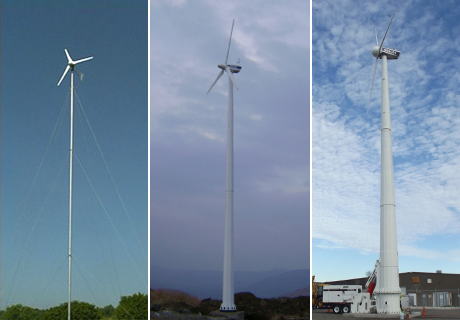 The one on the left definitely can not stand straight by itself and it is supported by an elaborate system of guy lines attached to it at three levels, which tells us that the stem is flexible enough to break if it will be supported at one point only. Two others don’t have any guy lines and they obviously don’t need ones, because they are rigid enough to withstand lateral force (bending - because of a larger progressive cross-section, and falling - because of massive bolted flange in its foot). So, these are definitely two towers.
 .
And it is pretty clear too because it has another massive guy line system. However, from the engineer’s point of view, the reason for adding that system is not the same as usual - it helps to withstand uneven vertical load caused by people walking by that fancy stair, not uneven lateral load caused by a strong wind. By the way, Aussichtsturm Wismar is usually described as the structure with a central supporting mast.
.
And it is pretty clear too because it has another massive guy line system. However, from the engineer’s point of view, the reason for adding that system is not the same as usual - it helps to withstand uneven vertical load caused by people walking by that fancy stair, not uneven lateral load caused by a strong wind. By the way, Aussichtsturm Wismar is usually described as the structure with a central supporting mast.