 OpenStreetMap

Aida
Users' Diaries
Recent diary entries

The OSM Urban Road classification guidelines for India dictate a number of high-level directions on mapping roads in Indian cities. When Devdatta and I tried to fix some classifications in Pune, we realised that the current guidelines don’t provide a solid base for decision making, in an “if X, then Y” way. So we decided to observe, annotate, experiment and retrospect on whether a classification makes sense.
We realised that to map a road, one must understand how a road is perceived, and its purpose in the larger scope of the neighbourhood, locality or city. This gives the road a purpose, and that purpose defines its classification. The purpose or intent of the road is not enough to classify it, so we tried to observe a few other factors that characterise roads in major Indian cities. Here’s what we found.
- Much like a river, a road begins somewhere and merges into another road. As roads connect with each other, the larger road essentially “collects” traffic from a smaller road. However, it is not necessary that a smaller road feeds into a larger road. Often, it might feed into a road of the same size, but with elevated purpose.
- Some roads serve the same purpose but could vary wildly in their characteristics, including the width of a single lane.
- Many collector roads can be easily identified using tell-tale signs such as the presence of speed bumps, traffic signals and dividers.
The observations led us to try and categorise roads based on a few factors:

We know from the pilot HOT unSummit programme that we need a better name (too many people thought it referred to the United Nations!)
Can you help us think of one?

It need to encapsulate one, some or all of the following aspects…
- It is a programme that supports / collaborates on open mapping-relevant events all over the world
- The objective is to inspire people and give them the means to take collective action on humanitarian / social problems through open mapping and OpenStreetMap
- It seeks to expand and strengthen the humanitarian open mapping movement
- It is supported by / powered by HOT, but in collaboration with many communities and organising committees
Once we have a new name, we will update the branding and the next phase of the programme will relaunch in June.

Решил вносить вклад в сообщество картографии. Актуальная и бесплатная информация очень привлекает меня и отражает мои взгляды на жизнь. Буду стараться развивать и развиваться в сфере osm.

Let’s recap some work done on the damn project.
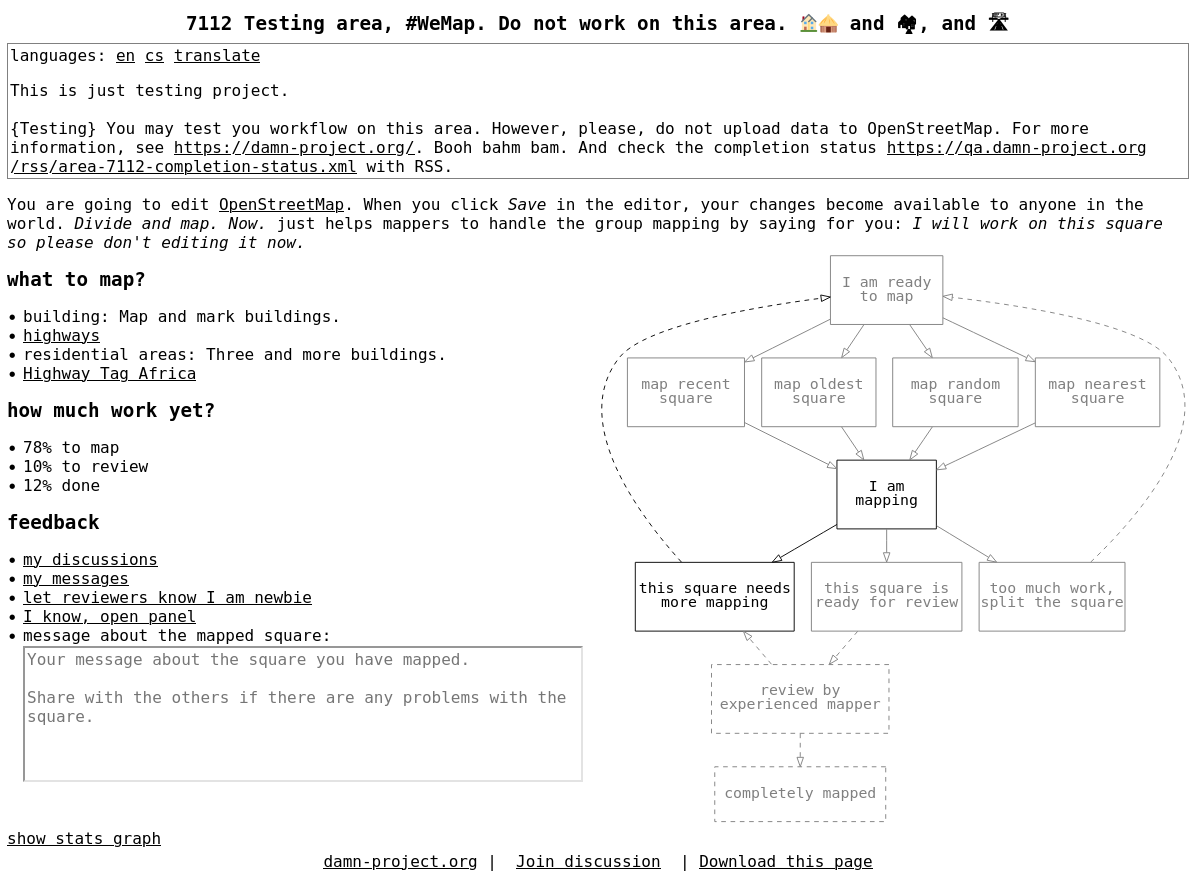
Divide and map. Now. – the damn project – helps mappers by dividing a big area into smaller squares that people can map together.
As outlined in Work for 2023, I have been working on the improvements to the web clients. The consequences are better clients and easier deployment (which is not yet documented). Also, I have restructured and slightly rewrote the https://damn-project.org/ web page.
Changes to the web clients
New client for beginner mappers is out, see
mapper. I was thinking of how to better
describe map-review-done
workflow. The original client has “Show mapping square workflow
diagram” showing ASCII art square’s state flow when clicked. I had and
idea to show SVG figure (generated by dot) instead of ASCII art,
because it is easier to generate, maintain, and translate. SVG is text,
too, so I can bare that. But wait! SVG is HTML element, isn’t it? So
it’s clickable, isn’t it? So it can be done interactive, can’t be?
Stollen

Maxijett olarak OpenStreetMap’teki Aydın’da yapılmış rota hatalarını düzenleyeceğiz. Gerekli çalışmalar sonucunda Aydın’ın bütün mahalle, sokak, cadde, bağlantı yolu vb. yanlışlıkları bularak OpenStreetMap’e yollayacağız.
Maxijett olarak OpenStreetMap’teki İzmir’de yapılmış rota hatalarını düzenleyeceğiz. Gerekli çalışmalar sonucunda İzmir’in bütün mahalle, sokak, cadde, bağlantı yolu vb. yanlışlıkları bularak OpenStreetMap’e yollayacağız.

Seit einigen Monaten mappe ich wieder 3D Gebäude, hier einige meiner Werke:
Rathaus Schneeberg
https://demo.f4map.com/#lat=50.5955008&lon=12.6409130&zoom=19&camera.theta=52.785&camera.phi=7.162
Haus der Wirtschaft, Selm:
https://demo.f4map.com/#lat=51.6951653&lon=7.4658714&zoom=20&camera.theta=63.352&camera.phi=142.094
Maggi Werk, LH:
https://demo.f4map.com/#lat=51.7703899&lon=7.4232912&zoom=18&camera.theta=76.849&camera.phi=33.35
Ascheberg Kirche und HIT Markt:
https://demo.f4map.com/#lat=51.7896585&lon=7.6180370&zoom=18&camera.theta=65.913&camera.phi=-96.83
Kreuzkirche Oelde-Stromberg:
https://demo.f4map.com/#lat=51.7997369&lon=8.2031816&zoom=19&camera.theta=52.212&camera.phi=-44.404
Vereinsheim SC Capelle (Gebäude wird im 3D-Druck Verfahren errichtet):
https://demo.f4map.com/#lat=51.7276&lon=7.590764&zoom=20&camera.theta=45&camera.phi=-71
St. Felizitas, LH
https://demo.f4map.com/#lat=51.7700841&lon=7.4449855&zoom=19&camera.theta=50.493&camera.phi=-37.489

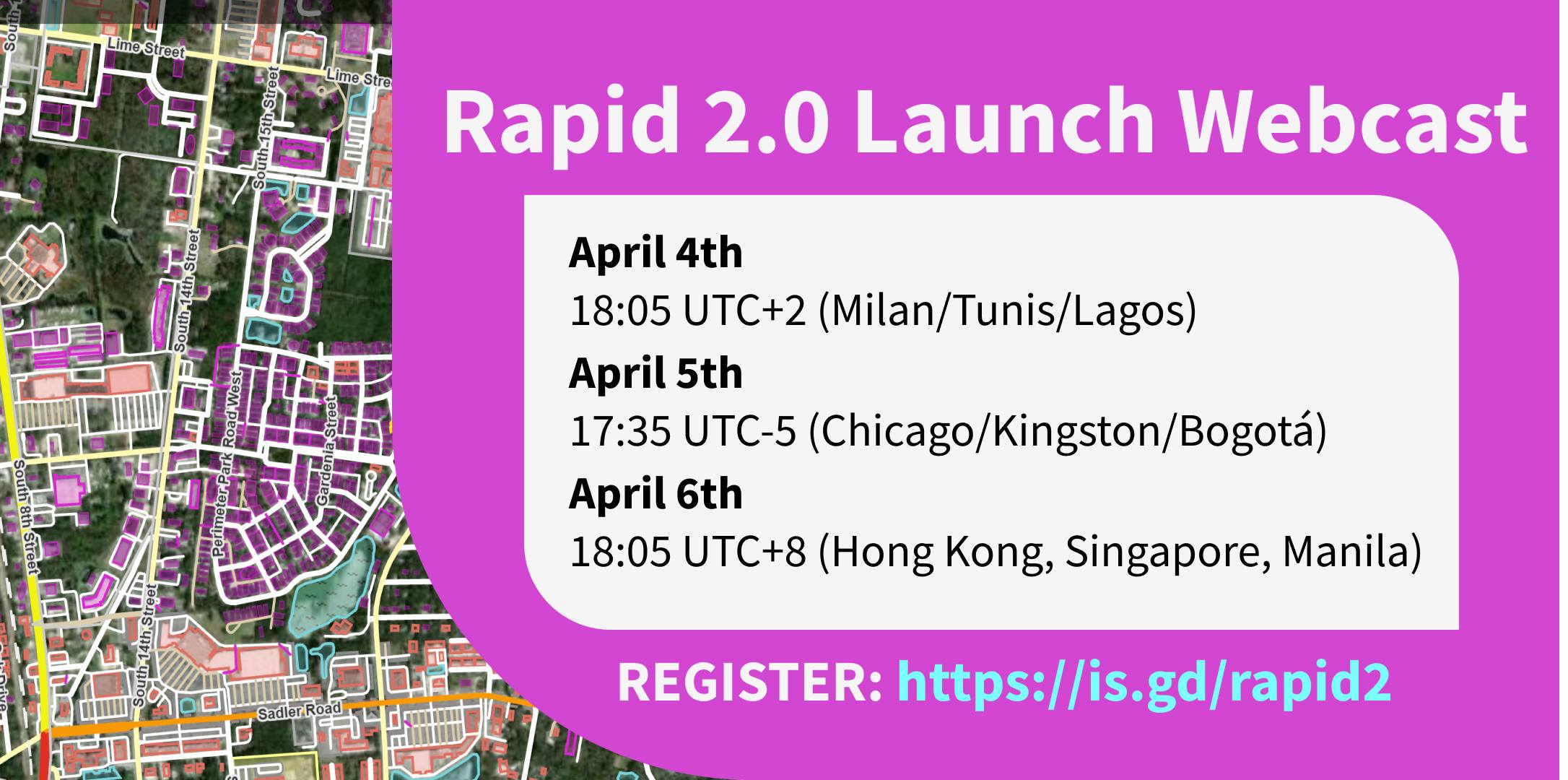
Rapid 2.0 launches this week. The Rapid team will host webcasts on April 4 (tomorrow at the time of writing), April 5, and April 6 for Europe / Africa, the Americas, and Asia / Pacific timezones respectively. You can sign up here. You can expect an overview of what’s new, and a live demo. You will also be able to ask the Rapid team questions.
What’s new
I wrote about the public beta of Rapid 2.0 before, and covered what’s new there.
One additional thing I wanted to call out is the ever-growing amount of external datasets available to mappers for efficient mapping of addresses, buildings and other features available as open data. There is a page on the OSM wiki that lists them all, and Esri has an interactive map with all the data sources available and considered as Rapid layers.
Posted by chris_debian on 3 April 2023 in English.
Last updated on 4 April 2023.

Ok, following on from my earlier writing, I can confirm that I have installed and tried capturing data with both the SmartRoadSense and Roadroid Android applications, on my Pixel 6. Both apps had good points, and ‘areas for development’. I was only able to capture data, submit it, and see it on a map, with Roadroid. My understanding is that I can’t do this with SmartRoadSense, because the app infrastructure is currently dormant, due to EU funding coming to an end, but I understand from the devs, that they are about to reinvigorate the project.
Lars Forslof (Roadroid) is doing some excellent work with his propriety solution, but I think the nature of his objectives, are business oriented, and enables a ‘customer’ to request survey coverage for a defined area, which is then coordinated, at a financial cost.
My main questions/ thoughts now, are:
- Is road surface data useful to anyone? I would suggest it is useful for deciding on routing, and can be used under open source terms, to enable interested bodies, such as highway/ local authorities to have an initial understanding of where surfaces don’t meet a required standard.
- Is OSM the right place to record the values?
- Can the open source community encourage the good people at SmartRoadSense to work with us, or do we need to create a new app, with infrastructure? The algorithm used to process the data is currently closed source. My preference would be to work with SmartRoadSense, and have a backlog of potential improvements, hosted on GitHub https://github.com/SmartRoadSense
- Encourage interested users to install the SmartRoadSense APK, and to give feedback at the GitHub address. The app didn’t appear in Play Store, in the UK on a Pixel 6, so I’ve used APK https://m.apkpure.com/smartroadsense/it.uniurb.smartroadsense
- I will write to the SmartRoadSense devs, to highlight these thoughts.
What is needed (Requirements capture)? (MoSCoW)
M= Must Have S= Should Have C= Could Have W= Won’t Have

OSM supports really complex opening times, apparently.
This node, a roof-top bar in Stratford, London is opening on the 20th of April. The following are the opening times per their website:
- April 20th to April 30th : Thursdays to Fridays 5pm- 11pm, Saturdays-Sundays 12-11pm
- May 1st- May 14th: Wednesdays to Fridays 5pm- 11pm, Saturdays-Sundays 12-11pm, Bank Holidays 12-11pm
- May 15th- end of September: Tuesdays to Fridays 5pm- 11pm, Saturdays-Sundays 12-11pm, Bank Holidays 12-11pm
The opening_time value I came up with is this:
Apr 20-30 Sa-Su 12:00-23:00; May-Sep Sa-Su 12:00-23:00; Apr 20-30 Th-Fr 17:00-23:00; May 01-14 We-Fr 17:00-23:00; May 15-31 Tu-Fr 17:00-23:00; Jun-Sep Tu-Fr 17:00-23:00; Oct-Dec off; Apr 20-30 PH 12:00-23:00; May-Sep PH 12:00-23:00
It also helped that there exists a handy tool that can visualise complex opening_time values.
I am looking forward to seeing how OSMAnd handles this when it eventually gets the updated node.

Hi all! I’m writing this new post to show a recent mapping that I’ve done on an industrial facility. In this case, I worked on a crucial headquarters of Petronas International, located near Turin (between the municipality of Santena and Villastellone).
The facility has been in that place for a long time but in the recent year the company built here the new global research centre so, under the pretext to add the new building, I mapped with care the facility.
That the result of my work:
Before

After
Posted by ngumenawesamson on 2 April 2023 in English.

To support organizations that use OpenStreetMap data for disaster response, the HOT Data Team is strengthening our data quality and fitness measures.
Several teams at HOT, including the Data Team, Technology & Innovation Team, and the Regional Hubs, are collaborating to develop resources, tools, skill sharing, and community feedback mechanisms that will be avenues for data creators and data users to collaborate to improve OpenStreetMap data quality.
Data Team:
The HOT Data Team presented the top 10 data quality issues in a lightning talk at State of the Map 2022 in Florence. We categorize these data quality issues into three main categories:
Semantic Accuracy
- Tagging
- Tasking Manager project consistencies
Positional Accuracy
- Spatial offsets
- Feature tracing inconsistencies
- Logical consistencies of map features
Completeness
- Temporal inconsistencies
- Road network inconsistencies
- Completeness of health facilities
- Completeness of public service data for sustainable communities
- Administrative boundaries
The Data Team is also defining use cases and data quality metrics. Measuring data quality starts with identifying core datasets for each of our impact areas. Examples include highways and health facilities for Public Health, water & sanitation, transportation, and education for Sustainable Cities & Communities, and waterways, buildings, and highways for Disasters & Climate Resilience.
We then evaluated the use cases and the metrics for assessing the quality of each dataset, enabling us to identify ways of improving data quality.
Technology & Innovation Team:
Technology & Innovation Team is implementing automated tools for measuring OpenStreetMap data quality.
Posted by frozenrabi on 2 April 2023 in English.

Lately I’ve been going for field survey day in day out. These day I spend most of my time on field survey using maps for field verification, collection of Point of interest (POI) data, land use zoning and obviously for public participatory mapping. Since 2018, there is no day that I had not worked or engaged with map. After I was introduced to this beautiful and addictive OpenStreetMap (OSM), I became a consistent OSM Mapper and a volunteer. While looking back, I felt I made right choice engaging in the field of OSM. From beginner curious mapper to Humanitarian OpenStreetMap Team (HOTOSM) Global Validator & being HOTOSM & OpenStreetMap Foundation(OSMF) Voting member, I’ve came a long way.
.jpeg)
Upon attempting to upload a new changeset, I received an error on iD. I don’t know what it means but it has an error code of 400 so it should be a server issue. Does anyone know what to do here? Will I have to start over?
I tried looking through the Help page but it’s hard to find what I’m looking for.

Sistemas para hospedar fotos a nivel de calle
OpenStreetMap no ofrece un sistema de hospedaje de fotos, ya que el propósito del proyecto es ofrecer una base de datos geográfica. Sin embargo, OSM etiquetas para referenciar imágenes en publicadas en algún servicio externo. Por ejemplo, existe la propuesta de etiqueta image - image=* que es genérica y sirve para cualquier imagen hospedada externamente. Otras etiquetas hacen referencia directa al sistema que las hospeda, y es lo que se llama foto enlazado – photo linking osm.wiki/Photo_linking:
- Mapillary - mapillary=*
- Wikimedia Commons - wikimedia_commons=*
- Flickr - flickr=*
De manera general, hay varias formas de asociar imágenes con un punto de interés (POI). Esto se debe al interés por las imágenes a nivel de calle – Street level photos, donde el más popular es Goole StreetView, pero este no es libre. Entonces, aquí es cuando descubrimos una variedad de opciones y licencias, de los que desconozco sus detalles, pero quiero listar.
Google StreetView
Son fotos a nivel de calle, principalmente tomadas por Google con sus autos y maletas son cámaras. En algunos casos se puede pedir prestadas estas mochilas para tomar fotos de algún de interés. Las fotos quedan propiedad de Google, y se pueden visualizar por la página de Google Maps con unos términos de uso. No se pueden usar estas fotos para hacer obras derivadas, por lo que no se pueden usar para mapear en OSM.
Mapillary
Posted by bkil on 1 April 2023 in Hungarian (Magyar).

Részletek: wiki.osm.org/Hungary/20230513

Posted by Jan Olieslagers on 1 April 2023 in English.
Last updated on 10 April 2023.
I think I am not the only one to find this matter confusing. The one clear and authoritative source of information is a pdf, in Russian language and Cyrillic alphabet only: http://www.caiga.ru/DocAni/manual_of_4_letter_indexes/Indexes_of_Airports.pdf ; it is regularly updated.
There are three columns of codes:
-
local “civilian” code, usually beginning with ‘У’, which transcribes to U
-
local code for “state” airfield, which includes military terrains, codes usually begin with a ‘Ь’ character, which transcribes to ‘X’
-
“international” code, given in Latin alphabet, corresponds to ICAO
Aerodromes of mixed military/civilian use will have the first and second columns filled out; or, if they have international status, all three. UHSS Yuzhno-Sakhalinsk is an example.
Thanks to mapper Mazda05 for patiently explaining!
PS local_ref beginning with Z or H are not official, they seem to be empirically assigned by maps.aopa.ru (which I often consult, though its information is not always perfect). Better an unofficial ref than none at all, in my opinion.

Nyt osui tielleni sen verran kiehtova ja kimurantti kartoitustapaus, että totesin että tätä olisi hyvä avata tällaisessa päiväkirjaformaatissa tarkemmin jo senkin vuoksi että OSM:in tageissa voidaan vaikka viitata tänne lisätietojen osalta. Tämä tarina on samalla osoitus siitä ettei se kohteen oikean nimen löytäminen meille OSM-kartoittajille aina suinkaan niin helppoa ole. Se on mielestäni myös opettavainen tarina siitä miten ei ehkä kannattaisi menetellä kohteiden nimeämispolitiikan osalta, jos haluaa sen olevan selkeä ja johdonmukainen.
No, asiaan. Minulle tämä tapaus lähti purkautumaan siitä kun silmiini osui tämä karttailmoitus Helsingin Länsi-Pasilassa “This park is called “Susannanpuisto”; Sannanpuisto is north of Maistraatinkatu 2.” Huomasin tämän ilmoituksen olevan kytköksissä toiseen pari sataa metriä pohjoisempana olevaan karttailmoitukseen.
Jo pikaisen perehtymisen jälkeen totesin että tässä on nyt jotain hyvinkin erikoista ja niin totisesti olikin. Kaikkia vaiheita ja oivaltamisia en ala tässä järjestyksessä käymään läpi. Tarkempi tapahtumaketju muiden kommentteineen on kyllä luettavissa tuossa ensin mainitussa karttailmoituksessa.
Tässä kuitenkin lyhyt yhteenveto ns. lopullisista havainnoista …
Tämä pohjoisempi puistoalue on merkitty asemakaavaan puistona, jonka virallinen nimi on “Susannanpuisto”. Tuon puiston sisällä sijaitsee “leikkipuisto Sanna”. Tämä on puolestaan kilvitetty mastossa muotoon “Asukaspuisto Sanna” ja paikallisen asukin mukaan yleisesti tunnettu käyttäjiensä toimesta Sannanpuistona. 100 metriä etelämpänä olevalla puistikolla ei ole virallista nimeä, mutta sen sisällä sijaitsee “leikkipaikka Sannanpuisto” ja sen vieressä “Päiväkoti Susanna”, jonka asukkaat tiedän ko. leikkipaikkaa hyvinkin ahkerasti hyödyntävän, sillä olen itsekin tuosta kulkenut työmatkallani usein ohi - onnelisen tietämättömänä tästä monitahoisesta nimivyyhdistä.