OpenStreetMap logo OpenStreetMap

Users' Diaries

Recent diary entries

Posted by chris_debian on 21 March 2023 in English. Last updated on 22 March 2023.

What’s the problem (Bottom Line Up Front (BLUF))?

See my original post, here: https://community.openstreetmap.org/t/lidar-mapping-of-roads/97100/14

Hi, everybody!

Motivated by the state of roads in the UK, I’m wondering if anyone is aware of any Open Source/ crowdsourced efforts to assess the condition of surfaces, and then to map them?

I’m aware of lower cost LIDAR equipment, and I believe that some Apple phones have a LIDAR capability.

I’m thinking of something like Mapillary/ Kartaview. Sensor imagery could be gathered, and then scored appropriately, so severity could be seen. I’m thinking that a 100mm pothole on an unclassified and little used road/ lane, would potentially be of less interest/ lower priority than a 50mm pothole on a major motorway/ autobahn/ freeway.

Obviously, potholes are just one example, other immediate possibilities are subsidence, wear and tear, accident damage.

I’d be keen to hear any thoughts/ feedback. Please add to this page, if you can.

Many thanks, Chris chris_debian UK

What can we do about this?

Road damages create comfort-, environmental- and security problems. Existing measurement technologies are very expensive and can only be used rarely. With smartphones you can measure often or in remote areas.

Regarding ‘mapping potholes’, I expect this to be a layer applied to OSM, not data contained within OSM. It will be open source information, for people that can use it. My thinking being that OSM isn’t a repository for other data, but it can help us gather data, and we may be able to give back to OSM.

What has already been done, by whom?

SmartRoadSense [email protected] (seems to be broken), github and APK

Roadroid map

See full entry

There is a really amazing video (Turkish with English subtitles) from Dr Uçum on the critical role that OpenStreetMap data has played in ensuring high quality public health programming in one of the tent cities for displaced people in Turkey as part of the earthquake response.

The video was originally published by Yer Cizenler.

Have also pasted below the English translation (thanks, once again, to Yer Cizenler) …

Well, hello everyone. I’m Doctor Mehmet Faruk Uçum.

I am the responsible physician in the largest tent city in Kahramanmaraş the KAFUM tent city. It is also known as New Ataturk Park and Kahramanmaraş Fairgrounds.

Here, as the responsible physician, I provide coordination in terms of health, we have set up the family health tent and we continue to vaccinate there. I also do public health work in the field.

During this process, with my friends in the OpenStreetMap community and my friends in Istanbul, we worked together and as a result of this work, we created a map.

I used this map especially during the vaccination process to find out which tent was where, because we really lacked data in this regard. We didn’t know the location of the tents, or which number was where, so we were not able to navigate to the right tents.

Recently again, I have used it to inspect and verify alleged scabies cases within the tents. I have, for example, some tent numbers that are said to have scabies but some of them may be seen wrongly or it is possible that the wrong number is given to us but I found them on the map and took the necessary action.

In public health, we used it again to identify outbreaks… the focus of outbreaks, that is. After marking the tent numbers on the map, we determined which areas had problems, especially for acute gastroenteritis, for example. Again, if there is a problem with viral rash diseases tomorrow, this map will be used for isolation and quarantine activities.

See full entry

Ruben Martin and I discuss recent highlights and what’s coming up in the humanitarian open mapping community.

What’s covered this week in brief?

Syria & Turkey earthquake response // Activations in Malawi and Ethiopia // International Women’s Day catch up // Bolivia YouthMappers // Mapping journeys to impact // Ruwa project completion // What’s coming up? // Mappy quote of the week

What’s happened this week?

Syria / Turkey earthquake response: The Turkey / Syria earthquake activation continues to progress — tasking manager projects are being finished off and and the validation is catching up. ~ 9,000 mappers have contributed over 2 million buildings and more than 83,000 km of roads so far. We also published this blog to try and provide insight into where the data is going and what it is being used for

There is also this brilliant testimony from Dr Mehmet on his use of OpenStreetMap data for public health programming in the tent cities where people displaced by the earthquake are housed.

Activations in Malawi and Ethiopia: Additionally, the OSM Malawi community has activated to support the data needs for responders following Cyclone Freddy in Malawi — you can support them with mapping, here. OSM Ethiopia are also still mapping in response to the drought and food crisis in Ethiopia, which is drastically affecting people in the region of Oromia — you can contribute here.

International Women’s Day: There was loads of stuff to catch up from from International Women’s Day this week, too… My recommendations…

Encourage you to watch and listen!

See full entry

My appreciation goes to the national coordinator and Team mentor, Mr. Sunday N. Victor for showing up to welcome and up board the new team leaders of LionMappersTeam Nsukka campus. we look forward to your community volunteerism, contribution, and impact.

cheers.

Location: Enugu East, Enugu State, Nigeria

Thank you Daniel Akor for an amazing job, hosting the Orientation and training of new team leads of LMT-Nsukka.

Look forward to their most active participation with Unique Mappers Community Nigeria as well as university community engagement at UNN

Cheers

Infraestructura de Salud en Bolivia

La presente publicación es un trabajo en curso para recoger una lista de etiquetas de OSM relevantes a infraestructura de salud y servicios sociales asociados en Bolivia. Se toma como referencia los establecimientos de salud administrados por el gobierno autónomo municipal de Santa Cruz de la Sierra, en el departamento de Santa Cruz.

Centros de Salud Municipales (primer nivel)

Centro de salud municipal Cañada El Carmen Se recomienda hacer la identificación principal del lugar (donde se menciona el nombre del centro) como un punto. Se pueden hacer representaciones adicionales (e.g., extensión del terreno, edificios, …) con otros tipos de geometría (área, línea).

healthcare=yes (etiqueta simple)

name=C.S. Cañada El Carmen (se utiliza la versión abreviada de Centro de Salud)

operator=Gobierno Autónomo Municipal de Santa Cruz de la Sierra (institución que administra el centro de salud)

healthcare:speciality=general (atención general, sin especialidad)

See full entry

Location: La Adobería, Centro, Santa Cruz de la Sierra, Provincia Andrés Ibáñez, Santa Cruz, Bolivia
Posted by valhikes on 15 March 2023 in English.

Just looking it up as a corral only found this one person asking how to, but they are actually describing an arena. When I was a camp counselor for a summer and generally did the horse units, there was one advanced unit that did an overnight ride. We rode to a place with an arena and made do with that to keep the horses overnight. It doesn’t have the watering and feeding station common to these, but plenty of room to keep nearly 3 dozen horses from running off, including the one that would untie any knot no matter how complicated.

It can’t be just a western US thing. You find them all over on Forest Service maps as a little dotted square with “corral” written next to them. They’re on USGS too. The #1 answer on the question refers to this Riding page on the wiki, but then gets the wrong answer for this or a corral. It might match another sort of corral, maybe.

A “corral” is a temporary space for keeping stock animals. They really come in two types although they are marked the same on the USFS and USGS maps. The type that’s most important to me to map is usually smaller, just a fenced box with a gate on one side. There’s usually a trough for water and a bit of wire to hold a bit of alfalfa. Sometimes there’s a spigot. (It’s a good idea to assume these are non-potable water.) The second type is for collecting herded animals, such as cows or sheep. These are usually larger and more elaborate, having a long arm of fencing that funnels the animals into the enclosure. There is often a ramp for loading the animals into a truck. This second is probably known to those who need to know it and the general public would only be looking up “what is that?”, but the first is an amenity that someone might be searching for.

Part of the answer

See full entry

Location: X S X Ranch, Grant County, New Mexico, United States
Posted by valhikes on 15 March 2023 in English. Last updated on 28 March 2023.

I expect this is only a problem in those places that have wild camping allowed as the norm. Bureau of Land Management and Forest Service lands fall into this category and cover a lot of the western United States and a little of the eastern ones. I’ve failed at finding an answer via search engine. There could be something on the wiki for the tourism=camp_site tag, but it’s not there now.

For me, this question has come up specifically in mapping backcountry (hiking) areas where camping is generally allowed wherever a person might want to settle for the night, but there is often a lake where camping has been banned outright. This is more than the usual banning of camping within 100 feet of water that is often found in Congressionally designated Wilderness areas. This is for singled out areas.

Some examples:

Sheep Lake in West Elk Wilderness. (38.7534N, 107.2366WSee rule 6 here.) No camping within ¼ mile.

Gilpin Lake, Gold Creek Lake, and Three Island Lake in Mount Zirkel Wilderness. (40.7825N, 106.6793WSee here.) No camping within ¼ mile.

Shadow Lake in Ansel Adams Wilderness. (37.6946N, 119.1243WSee here.) No camping at the lake or between the trail and creek.

Thousand Island Lake in Ansel Adams Wilderness. (37.7202N, 119.1796WSame link.) No camping within ¼ mile of the outlet.

Lower Golden Trout Lake in John Muir Wilderness. (37.2410N, 118.7207WSame link.) No camping within 500 feet of the lake.

Crystal Lake in Hoover Wilderness. (38.0003N, 119.2454WSame link.) No camping at lake. There’s quite a few more at this link, but this covers all the wildernesses represented.

Geneva Lake (and many more) in Maroon Bells-Snowmass Wilderness. (39.0969N, 107.0775WSee here.) Camping in designated (numbered) sites only. Sites have been marked at Geneva Lake, but not at Capitol Lake, for instance. Included to show a less restrictive case.

See full entry

Location: Gunnison County, Colorado, United States

Üdvözlök mindenkit, immáron 2023-ban, boldog új évet kívánok minden egyes olvasónak, akinek még nem volt esélye, hogy megköszönthessem, e csodás alkalomból. Rögtön az elején egy kis összegzést szeretnék tartani, mi is történt 2022-ben:

  • 2022-ben vettem először részt online OpenStreetMap-es fonón, Matrix-on
  • Megtanultam kezelni a JOSM programot
  • Feltérképeztük egész Siklóst és környékét az épületeket (is) tekintve, figyelve a megfelelő háromdimenziós megjelenésükre is (a szintek és a tetőformák megadásával)
  • Megérkeztek az OpenStreetMap-es matricáim
  • Elértem az országos 9. helyezést az OpenStreetMap aktivitási listán
  • Bekapcsolódtam egy csomó OpenStreetMap-pel kapcsolatos alkalmazás fordítási projektjeibe.

Vidám, új, szép

Ahogyan azt fent is említettem, közeleg az az időszak, amikor beköszönt a tavasz, hosszabbodnak a nappalok, a természet újra “beindul” és a legtöbb térképész, köztük én is, útra kél. A terv nálam a szokásos, a június-július és az augusztus az a hónap, amikor rá tudok igazán kapcsolni a térképezésre, hiszen ekkor van a legtöbb időm, na de jogos a kérdés, mit is várok 2023-tól?

  • Legalább ugyanennyi aktivitást a nyílt forrású OSM-es projektekben mint eddig
  • Felvinni a házszámokat és címeket az épületekhez Siklóson amiket előzöleg felrajzoltunk
  • Feltérképézni (épület szinten legalább) azokat a városokat, falvakat, amiket kigyűjtöttem a jegyzeteimben
  • OSM tapasztalotkról bemutatót tartani
  • Esetlegesen országos OSM-es konferencia
  • Megtervezni, átbeszélni a közúti események jelentésének, megjelenítésének hatékony módját
  • Hirdetni az OpenStreetMap-et a környéken matricák segítségével, és összekovácsolni a helyi közösséget egy klub keretein belül

Búcsúzóul, természetesen csak a következő alkalomig, annyit üzennék, hogy kellemes húsvétot és jó térképezést kívánok minden egyes térképész kollégának!

Posted by watmildon on 14 March 2023 in English.

Act now to save from eye strain!

Did your JOSM UI text become a huge bother to read? Is it too tiny? Are the icons not as you’d expect? You may be suffering from a case of Too High DPI! It’s more common than you think!

Thankfully the medicine is easy enough to apply at home. You’ll need to find and edit the properties of the JOSM.exe file. It’ll be at a path like C:\Users\admin\AppData\Local\JOSM (you’ll need to change “admin” to whatever your user account is). Right click the exe > properties > Change high DPI settings > check “Use this setting to fix scaling problems…”

A screenshot of dialog boxes showing the workflow enable high DPI correction on Windows

Posted by cyton on 14 March 2023 in German (Deutsch). Last updated on 12 May 2023.

Erweiterte Version ist hier: @cyton/diary/401534

Erst die Datenlayer vom geoportal berlin in Qgis anzeigen, dann diese herunterladen als kml. Anlagenbäume und Straßenbäume sind separat im geoportal.

Dann die kml in JOSM öffnen, das dauert erstmal etwas. Die kml Datei dann als .osm Datei speichern.

Die .osm datei mit meinem python script umformen. Dort ändere ich die tags und metadaten, damit sie dem OSM standard entsprechen, bzw. als zu löschen markiert sind.

Diese veränderte .osm Datei wieder in JOSM laden, und source=* und source:date=* hinzufügen, sowie natürlich natural=tree.

Diese Datei dann auf mein Android Handy befördern, und dort in Vespucci öffnen.

Vor ort alle ref und etwa die position der Bäume prüfen.

Dann etwa an den Bäumen fehlende Nummern mit ref:signed=no merken.

Zuhause Dann die ursprüngliche Datei laden und vom Handy die fehlenden ref abschreiben, etwaige positionsunstimmigkeiten oder fehlende Bäume nachtragen, oder gefällte löschen.

Hochladen.

Ich bitte um Verbesserungen für diesen Workflow. Am liebsten hätte ich etwas das StreetComplete näher kommt, Vespucci ist sehr umständlich zu Bedienen. Leider ändern sich oft die sichtbaren Layer, das nervt etwas.

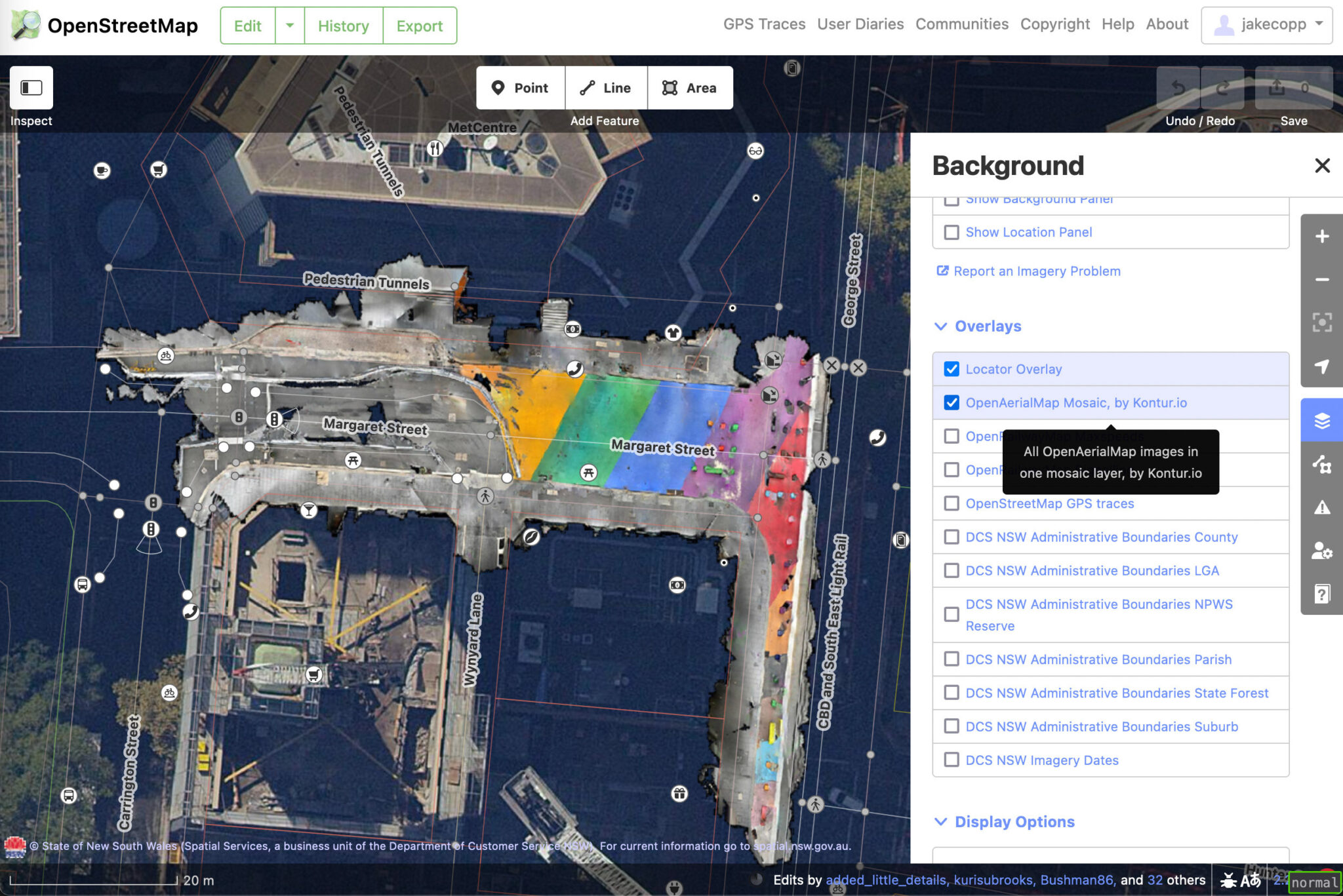
I wrote a blog post on how you can create your own aerial imagery and 3D models of streets with the built in iPhone LiDAR sensor and open source tools in the OpenDroneMap package.

I’ve found you can attach your iPhone to your bike and generate LiDAR point clouds of the kerb and cycleway infrastructure if you go slow!

https://jakecoppinger.com/2023/03/generating-aerial-imagery-with-your-iphones-lidar-sensor/

Let me know what you think! I appreciate any feedback or improvements on the process.

OpenAerialMap imagery in iD editor

Location: Sydney CBD, Sydney, Council of the City of Sydney, New South Wales, Australia

In Flanders, all traffic signs are open data. This information is hugely useful. Well, it could be. Most of the traffic signs date from several years back and have not been updated since. The Flemish Verkeersborden.vlaanderen project intends to change that. Municipality by municipality, we see updates starting to happen. Several of them have done a complete update, or at least do occasional additions.

In a perfect world, when the municipality decides to change a traffic situation (a new speed limit, a new one-way restriction,…), they start to work in this database. First there’s a planned sign. Then when it is installed, it becomes a real sign. The real sign is offered to the OSM mapping community (and Waze, TomTom, Here, …) and they add the info to the affected street - almost in real time.

We’re not quite there just yet, but the edits in the database that do happen are still useful. Obviously because it makes for a better map. Less obviously because it saves everyone a lot of time. We often get a mail from municipalities: “hey, we have changed reality, can you now change your map”. We want to be able to say: “oh we know, we already updated it!””

So we’re building on a tool in good Road Completion tradition to make sure that if the government provides the data, we can guarantee that we’ll be up to date. This in turn might be a little incentive for more municipalities to keep their bit of the database online. Just like in Road Completion, we “accidentally review” the government data as well. When we map traffic signs, we spot errors. Often user error, sometimes logical errors. These can then help municipalities to improve their data quality or even local reality. OSM data users will be able to see how well we keep track of new traffic signs - they won’t have to trust us on our word that the data is good.

See full entry

The Operations Working Group is looking at what it take to deprecate HTTP Basic Auth and OAuth 1.0a in favour of OAuth 2.0 on the main API in order to improve security and reduce code maintenance.

Some of the libraries that the software powering the API relies on for OAuth 1.0a are unmaintained, there is currently a need to maintain two parallel OAuth interfaces, and HTTP Basic Auth requires bad password management practices. OAuth 2.0 libraries should be available for every major language.

We do not yet have a timeline for this, but do not expect to shut off either this year. Before action is taken, we will send out more notifications. Deprecation may be incremental, e.g., we may shut off creation of new applications as an earlier step.

What can you do to help?

If you are developing new software that interacts with the OSM API, use OAuth 2.0 from the start. Non-editing software can require authentication support, e.g. software that checks if you have an OSM login.

If you maintain existing software, then look into OAuth 2.0 libraries that can replace your OAuth 1.0a ones. We do not recommend implementing support for either protocol version “by hand”, as libraries are readily available and history has shown that implementing your own support is prone to errors.

If you do not develop software that interacts with the OSM API, this change will not directly impact you. You may need to update software you use at some point.