 OpenStreetMap

ฉันขอให้เพื่อนนะนำ ให้ฉันด้วย
Users' Diaries
Recent diary entries
Posted by Gonéo on 20 December 2021 in French (Français).
J’ai entamé un travail de mise à jour dans OpenStreetMap des arceaux à vélo de la métropole de Lyon. Il reste beaucoup à faire.
À cette heure je compte 4.091 objets dans le jeu de la métropole versus 3.351 dans le jeu OpenStreetMap. Après analyse le greffon Conflation de JOSM annonce ces chiffres :
- 2.846 correspondances, avec des écarts allant jusqu’à 40 mètres (la limite que j’ai fixée pour le rapprochement)
- 1.245 objets présents uniquement dans le jeu de la métropole
- 505 objets présents uniquement dans le jeu OpenStreetMap
Quand les positions correspondent et que c’est pas déjà renseigné, j’ajoute systématiquement la référence (le champ “nom” du jeu de la métropole) en tant que ref:FR:GrandLyon. Ceci permettra un rapprochement plus fiable par la suite.
Positionnement : Pour les objets que j’ai traités, l’erreur de positionnement se situe parfois dans les données OpenStreetMap, parfois dans les données Métropole, voire parfois dans les 2. Quand les arceaux étaient visibles j’ai recalé les positions dans OSM. J’ai laissé une note=positionnement corrigé par rapport à l'open-data en espérant que ça remonte peut-être un jour à la métropole. Et pour éviter qu’à chaque comparaison on se demande qui a raison. Malheureusement je ne l’ai pas fait au début et il en manque. Je referai une passe.
Suppressions : Il y a des arceaux qui disparaissent suite à des réaménagements de voirie. Ils sont supprimés du jeu Métropole mais ils sont encore présents dans les données OpenStreetMap. Quand j’ai un doute je laisse un fixme=resurvey, que je double avec une note demandant de confirmer si les arceaux existent encore. Ça peut faire doublon mais le fixme est plus facile à utiliser pour les requêtes, tandis que la note est plus visible pour les contributeurs qui sont sur le terrain.
Nova dalnice jaromer Hradec Kralove je jiz otevrena
日本国内の市町村内にある町名・字名(以下、地名とします)の登録がほとんどの市町村において完了しました。
国内の地名の登録は2012年頃から位置参照情報(以下、ISJ)のインポートという形で始まったようです。 osm.wiki/Import/Catalogue/Japan_ISJ_Import
その後長く動きはなかったようですが、nyampireさんのISJ 2019のインポートが2021年に動き始めました。 osm.wiki/JA:MLIT_ISJ/import2019_outline
私は2019年にOSMを始め、地図に地名さえ載ってないのは寂しいな、使いづらいなと思っていたので、当初から少しずつ地理院地図のトレースという形で地名の登録を始めました。 しかし、地名の手入力というのは果てしなく時間がかかるものです。
ということで、ISJ 2019のインポートが始まってからほどなくして、私もそのインポート作業をお手伝いすることにしました。 そしてようやく2021年11月に5つほどの市を除く全市町村への位置参照情報掲載の地名を登録終えました。
そのインポート作業をする中で、いくつかのエリアで新たな町名ができたことを知ります。 そして、新町名の情報をネット検索すると、出るわ出るわ、結構あちこちでしているようです。 要因としては住宅地が新たにできることで住居表示の実施をしたり、区画整理や町界町名整理などに伴う、新町名の設定などがあります。
そこで、概ね2018年以降設置された新町名について、その項目と地理院地図やISJ、OSMへの登録状況をまとめてみました。 osm.wiki/JA:Chimei_placename
これを見るとISJや地理院地図にいつ頃の分まで登録されているなとか、抜けているのもあるなということが見えてきます。 当面はこのリストを元にOSMへの地名の登録あるいは確認を行うことで、最新情報を保っていきたいなと思います。

The street complete app makes filling out data for OSM really fun. This was unexpected. I thought it was just going to be a more convienent way to enter data, but it’s also oddly satisfying.

Don’t forget to get some of your only one 🕜
Posted by Muluba on 16 December 2021 in French (Français).

La collecte de la donnée avec KOBO, facilite l’obtention de beaucoup d’information sur l’objet à collecter et cela dépend de ce qu’on veut avoir comme information. La localisation du lieu de la collecte est encore mieux quand on veut faire les analyses spatiales sur les informations.
En effet, l’insertion du langage OSM dans le paramétrage de Kobo, simplifie largement la marche à suivre pour placer les informations sur le point collecté dans OSM. Jusqu’ici on convertissait les données en XLS ou CSV, puis on faisait des tris sur les colonnes utiles, on ajoutait les tags osm et en fin on envoyait à osm.
Avec le téléchargement des données dans le langage OSM, ça facilite l’envoi à OSM après quelque contrôle qualité, parce qu’envoyer les données à OSM, nécessite toujours une vérification pour éviter la duplication avec les données existantes. Je pense que KOBO va ainsi nous aider à gagner le temps de travail.
Ma curiosité a finalement été éclairée lors de la démonstration faite par Zack et Peter lors de « State of the map africa » le 20 novembre dernier sur l’utilisation du langage OSM dans KOBO, j’aimerais bien essayer ça moi-même dans la communauté pour voir le succès de cette facilitation. Si quelqu’un l’a bien compris c’est cool pour moi qu’on échange là-dessus. Ne l’oubliez pas, je suis plus à l’aise en français qu’en anglais.
Using Kobo Toolbox for OSM mapping
Collecting data with KOBO makes it easier to obtain a lot of information about the object to be collected and it depends on what you want to have as information. The localization of the place of collection is even better when we want to make spatial analyses on the information.
Indeed, the insertion of the OSM language in the Kobo settings greatly simplifies the process of placing the information about the collected point in OSM. Until now, we converted the data into XLS or CSV, then we sorted the useful columns, added the osm tags and finally sent them to osm.
%20by%20Vince%20Emond.jpg)
Hi all,
Some of you may remember earlier this year we conducted an experiment to compare traditional mapping with ai-assisted mapping. Below is our summary of findings and the full report for those who may be interested. We hope this experiement will be the start of the conversation of how we can ethically and responsibly introduce AI augmented mapping workflows into HOT’s work in 2022.
Humanitarian OpenStreetMap Team, comparison of traditional digitizing of building features in OpenStreetMap of machine learning assisted building digitization
Key findings:
- Although most participants were new to AI-assisted mapping, the majority of participants were open and likely to integrate it into their workflows.
- For beginner mappers, AI-assisted mapping drastically increased their mapping speed, but had no significant effect on their quality
- For advanced mappers, after a small mapping slow-down, AI-assisted enabled more efficient mapping without impacting their quality
- Open models offer significant potential impact and value for humanitarian response
- More data created through AI-assisted mapping may exacerbate the ‘validation bottleneck’
In the last 10 years, the use of AI/ML in the geospatial sector has boomed. Private sector, academic and nonprofit organizations alike have been investing significant thought, time and resources into exploring and testing the potential and possibility of how AI/ML can augment and amplify current GIS workflows.
Unfortunately for the open mapping community, a ‘go fast and break things’ approach has done exactly that, often coming at significant cost to the project and the community. As a result, open mapping communities are reluctant to allow unchecked AI/ML to roam free in the world that is OSM - created and crafted by countless hours of dedicated human mapping.
Posted by amapanda ᚛ᚐᚋᚐᚅᚇᚐ᚜ 🏳️⚧️ on 16 December 2021 in English.

What I did in OpenStreetMap in November 2021
Posted by อู่มิวสิคร็อคโทนโทนิกซ์ on 15 December 2021 in Thai (ไทย).
Last updated on 26 July 2022.

เมื่อวันที่ 5/12/21 Mechanic ซ่อมบางอย่างนวมทั้ง เีเจชื่อดัง สนใจเรื่อง โดรน และขอซื้อในราคาสูง เจรจาต่อรองเพียงคนเดียว เหมือนไม่ให้ก็ต้องให้ในวันนั้น จนถึงวันนี้ รอสัณญาเงิน
ซ่อมทุกส่วนสำเร็จแล้ว ….ชาาง ซ่อมโลกทางใต้…✍️ 🙏

Today the OSMF board made the expected decision to formally roll out the behavior control regime that has been in the making for quite some time on the talk and osmf-talk mailing lists. Nothing surprising here - i have commented on the larger topic before.
As i have written in my previous commentary, creating communication channels where participants are protected from being exposed to cultural and personal communication style diversity beyond what they are able and willing to deal with is fine - and actually desirable. That for this purpose existing communication channels are repurposed is a bit rude, but that is something we can deal with.
The news is that the board in their decision also includes the intention to extend the behavior control regime to all international communication channels hosted by the OSM Foundation. While this has been the expressed desire of those pushing for community management and behavior control in OSM all along, this is the first time the OSMF board has actually indicated they intend to adopt this idea of a totalitarian behavior control system - not only creating spaces for those who are unwilling or unable to tolerate behavior diversity outside their personal and cultural standards, but projecting these standards on everyone and declaring them to be binding for everyone, everywhere within the domain controlled by the OSMF. This is not unexpected, given past articulations and actions from the board, but it is still sobering to see that becoming definitive - in the form of a formal decision - without any critical discussion or reflection on what that means.
For me it has been clear from the beginning that i will not subordinate myself to the behavior standards of someone else when contributing to what is an endeavor of egalitarian cross cultural cooperation like OpenStreetMap. Especially not if the codifications of those standards are written down in a way that is as vague as what has been adopted by the OSMF board now.
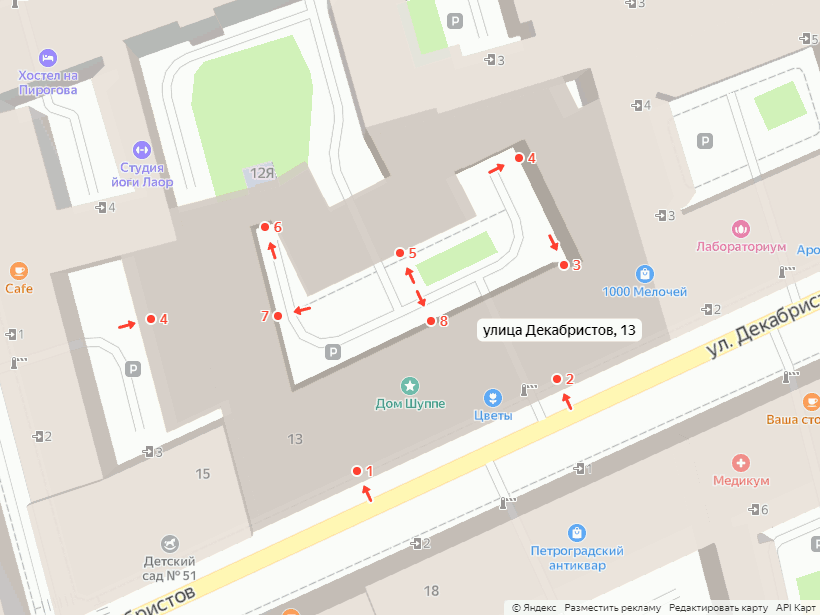
Интересно, откуда у Яндекса данные по подъездам? Некоторые тут говорят, какие у них замечательные данные. Действительно, часто их данные с реальностью совпадают, или в них можно найти лишь мелкие отличия. Но иногда их данные к реальности имеют отдалённое отношение.
Только что ввёл дом: из девяти входов у меня с Яндексом совпадают два (№1 и №7, ну можно засчитать ещё №2, если не смотреть на него относительно арки).

First of all what a great set up by the state of the map committee.
I must say, before the conference I wasn’t quite aware of all the partners OSM was in collaboration with, it seems like it all goes well beyond just mapping.
Of great interest was the content density of OSM in Africa and the lack of map content that has resulted over the years and that can be particularly attributed to the lack of technological advancements especially for Africa.
Great idea by Isla from the use of offline spaces and technology to sort of overcome the lack of internet connectivity when one seeks such services.
The importance of free and open source software is indeed an important aspect of mapping, from the presentation it’s quite clear why open source software is essential in an effort to overcome some of the already existing challenges that mappers face.
Well I’ve used some of these open source software like QGIS, and ArcMap which was unfortunately not free and open source software. Great innovation from the OSGeolive where users can change the user language making it usable to most mappers irrespective of their language.
Quite an eye opener from the use of AI generated buildings and manual tracing. To share a personal opinion, data quality is key in all these aspects to ensure quality analysis by any user who wishes to use this OSM data
From the presentation on the journey towards building a sustainable OSM community in Malawi, I was particularly concerned about my country of origin (Eswatini formally known as Swaziland) as from browsing on the OSM website, it seems like very few Eswatini mappers contribute to this initiative.
The challenges highlighted in the presentation including disaster and risk management were pointed out on their solutions including population data which can help locate people at risk in cases of such natural disasters such as volcanic eruptions. At last I saw a somehow familiar face, Geoffrey😇

I am Lineekela and I am quite new to the OSM community but I have GIS experience and background as I am a GIS graduate. I started OSM this year (2021) where I took part in the Mapathorn here in Namibia and later was part of the team that facilitated the mapathorns.
This is my first time attending the “State of the Map Africa 2021” event. I could only attend the first day but I watched the recorded sessions on YouTube so I could update myself on what I have missed out on.
From the videos I have watched, I have learned quite a lot about the open source software and their tools that can be use when it comes to spatial data. I have learned about OSGeoLive and the tools that are available like GeoNode which is an SDI for sharing and managing spatial data. QGIS whas also talked about, but I have already known about it as it is the software I use when creating maps and cleaning GPS data. Another thing I found interesting was the journey towards building a sustainable OSM community in Malawi as we here in Namibia are currently busy trying to establish a community here in Namibia aswel. We have started in April 2021 with Mapathorns where we trained community members how to digitize their respective settlements that they were familiar with. I am looking forward to the next State of the Map Africa event so I can share my experiences and learn from my fellow mappers as well.

🏡44/18 หมู่. 1 ตำบลหนองรี อำเภอ เมืองชลบุรี จังหวัด ชลบุรี 20000
Posted by yongololo on 14 December 2021 in French (Français).

Mon Experience State of the Map Africa 2021
FR- version
 La 3éme edition du state of the map Africa (SOTMA) c’est tenu du 19 au 21 Novembre 2021 durant trois jours j’ai pu assisté a plusieurs panel et discussion aussi j’ai présenté la communauté OSM RDC durant une session d’échange et aussi assisté claireHalleux sur la session pratique d’edition sur le wiki openstreetmap.
Posted by François2 on 13 December 2021 in French (Français).
Pour ceux qui ne connaissent pas indoor=, je vous invite à consulter le billet d’introduction. En bref, c’est une carte qui affiche les espaces intérieurs d’OpenStreetmap avec un sélecteur de niveaux.
Indoor= a toujours eu pour but de faciliter le travail des contributrices et contributeurs en ayant des données le plus à jour possible avec la mise à jour horaire des données d’OpenStreetMap. Malgré cette fréquence, il était frustrant d’attendre le rendu plusieurs dizaines de minutes pour se rendre compte d’une erreur.
Pour éviter cette embuche et réduire le temps de retour sur son travail, vous pouvez désormais prévisualiser vos changements sur indoor= avant de les envoyer sur OpenStreetMap.
Le plus simple pour l’utiliser est d’utiliser JOSM. Vous enregistrez vos modifications au format GeoJSON, et vous les envoyez sur indoor=.
Démonstration
On le voit, une fois le fichier sélectionné, une interface spécifique apparait, et il est facile de choisir une nouvelle version pour permettre de corriger ou d’améliorer les modifications.
Précisions, le rendu GeoJSON est une prévisualisation, il ne sera pas le reflet parfait du rendu final:
-
la gestion des caractères latins et non latin des POIs n’est pas géré
-
les surfaces contiguës area/corridor ne sont pas fusionnées
-
certains POIs ne sont pas correctement gérés
-
les performances sont moins bonnes
-
il n’est pas encore possible de cliquer sur les POIs
Essayez la prévisulation dès maintenant !
Si vous trouvez de grosses différences ou pour tout autre retour, n’hésitez pas à créé un ticket sur GitHub.
For those who have never heard of indoor=, you may want to read the introductory blog post. In short, it is a map that displays the indoor data of OpenStreetmap with a level selector.
Indoor= has always aimed to facilitate the work of contributors by having the most up-to-date data possible with the hourly update of OpenStreetMap data. Despite this frequency, it was frustrating to wait several tens of minutes for the rendering to realize an error.
To avoid this hassle and to reduce the time of feedback, you can now preview your changes on indoor= before sending them to OpenStreetMap.
The easiest way to use it is to use JOSM. You save your changes in GeoJSON format, and send them to indoor=.
Demo
As you can see, once the file is selected, a specific user interface appears, and it is easy to choose a new version to correct or improve the modifications.
Note that the GeoJSON rendering is a preview, it will not be a perfect reflection of the final rendering:
-
the management of latin and non-latin characters of POIs is not managed
-
contiguous area/corridor surfaces are not merged
-
some POIs are not correctly managed
-
the performances are less good
-
it is not possible to click on POIs yet
If you find big differences or for any other feedback, feel free to create a ticket on GitHub.
Posted by Abibis on 12 December 2021 in French (Français).

La 3e édition du sotma a pris fin ce dimanche 21 novembre 2021.
Durant 3 jours, j’ai pu suivre de nombreuses communications aussi diverses que variées.
C’est la première fois que j’assiste à ce genre d’événement OSM.
Cette conférence m’a permis de découvrir des initiatives venant des communautés. Il est très intéressant de souligner qu’il y en a que l’on peut répliquer chez soi. C’est d’ailleurs l’un des avantages avec le projet openstreetmap. Ces trois jours ont été également l’occasion de mapper et de voir le visage des personnes dont on entend parlé ou rencontre les noms. J’ai aimé le programme et son contenu. Cependant, la majorité des présentations sont en anglais. Cela a été parfois un problème pour moi, des difficultés à interagir. Je voudrais à cet effet, recommander qu’il y ait des interprètes pour traduire vers les autres langues au cours des prochaines éditions. Je remercie le comité d’organisation pour m’avoir permis d’assister à cette conférence en m’octroyant la bourse.
Posted by dcapillae on 12 December 2021 in Spanish (Español).
Last updated on 3 November 2023.

 Progreso en el etiquetado de direcciones postales de Málaga entre diciembre de 2009 y diciembre de 2021. Fuente: elaboración propia a partir de datos de colaboradores de OpenStreetMap.
Ya es posible buscar en OpenStreetMap por direcciones postales en los distritos municipales de Cruz de Humilladero, Ciudad Jardín, Teatinos-Universidad, Churriana y Carretera de Cádiz, así como en casi todo el distrito Centro, Este y Palma-Palmilla del municipio de Málaga.
Varios colaboradores han contribuido a esta mejora en el etiquetado de direcciones postales, entre otros, Antonio Clavero, Alan Grant, AlviNihon, MrPart, Diec, Leon, Carlos Cámara, Javier Sánchez y Jorge Sanz.