OpenStreetMap logo OpenStreetMap

Users' Diaries

Recent diary entries

tldr; hot_tech is running the second round of an ai-assisted mapping study
Call to action: please sign up to participate or share with your networks
time: read: 5m | sign-up: 5m
best before: Sept 17th, 2021

Hi all!

As some of you may remember, earlier this year HOT undertook an experiment to compare tradiational mapping with AI-Assisted mapping. After the first round of results have been gathered (soon to be released), hot_tech will be undertaking round two (Sept 17th, 2021) and we are looking for beginner mappers (<50 changesets) to join the study.

The experiment is designed to compare the results of traditional remote mapping workflows (editing in ID Editor) with emerging AI assisted workflows (editing with RapID). To do this, we will be conducting mapping experiments of two locations (Uganda and US), with beginner mappers (<50 changesets) using the two different remote mapping workflows (RapID and ID).

On Sept 17th, 2021, we will run one mapathon of 90 minutes, with participants being randomly assigned - prior to beginning mapping - to map building footprints with either ID or RapID. Data will be gathered on the existence of map features in two locations (US and Uganda) from which we will compare the completeness of mapped features and similarity of map features when compared with an OSM reference dataset.

For the mapathons we will be using convenience sampling from our networks by generating a public call for participants.

A couple of specific asks, please email if:
_ You would like to be involved in any capacity (organising, recruiting, sharing, supporting, please shoot me an email)
_ You would like to support the mapathons specifically, that would be great
_ You would like to participate in the mapathons please please sign up to participate HERE »

Thanks all, I hope everyone is safe and well and looking forward to exploring this with you all soon.

Kindness,

bo

Location: Naz, Esserts-Salève, Monnetier-Mornex, Saint-Julien-en-Genevois, Upper Savoy, Auvergne-Rhône-Alpes, Metropolitan France, 74560, France
Posted by SimonPoole on 5 September 2021 in English. Last updated on 17 December 2021.

As a rule of thumb, the primary name would be the most obvious name of the feature, the one that end users expect data consumers to expose in a label or other interface element.

From the OSM wiki Key:name

I’m currently tidying up a couple of loose ends in preparation for the release of version 16 of Vespucci. One of those dangling bits was supporting the new format of the name-suggestion-index (NSI).

The NSI was conceived back in 2013 by Aaron Lidman as a list of canonical name spellings for chains of stores, restaurants and other similar facilities, most notably for use in iD. Vespucci has supported use of the NSI nearly since day one, see a diary post from 2014 (this works quite differently in current Vespucci versions). Since then it has morphed to a, supposedly, authoritative source of tagging for a very wide range of objects. Some would say that the current version has expanded its reach far beyond what is actually useful (flagpoles ffs), but that is not the topic of this post.

Prior to the release of iD 2.20 the NSI had been in a long period of stasis with updates being made to the data, but these were not actually being deployed and given the larger format changes I had all but forgotten about it and the data in Vespucci was really old. However over the last couple of months some colleagues pointed out some weird behavior in Vespucci and iD when using NSI generated presets for tagging. In particular name tags are being added to things like excrement bag dispensers and automated postal package depots.

See full entry

Como já falando no texto anterior o OpenStreetMap não é tão amigável com o usuário comum mas serve muito bem para os cartógrafos, também recebi muitos comentários que o OSM não é um produto final e sim uma base de conhecimento compartilhada e até algumas comparações com linux… Mas usar o OSM não deveria ser difícil ou depender do rebrand de grandes empresas, acredito que tem como atingir o usuário comum e ganhar mercado e sendo opensource e ainda trazer mais mapeadores para a comunidade.

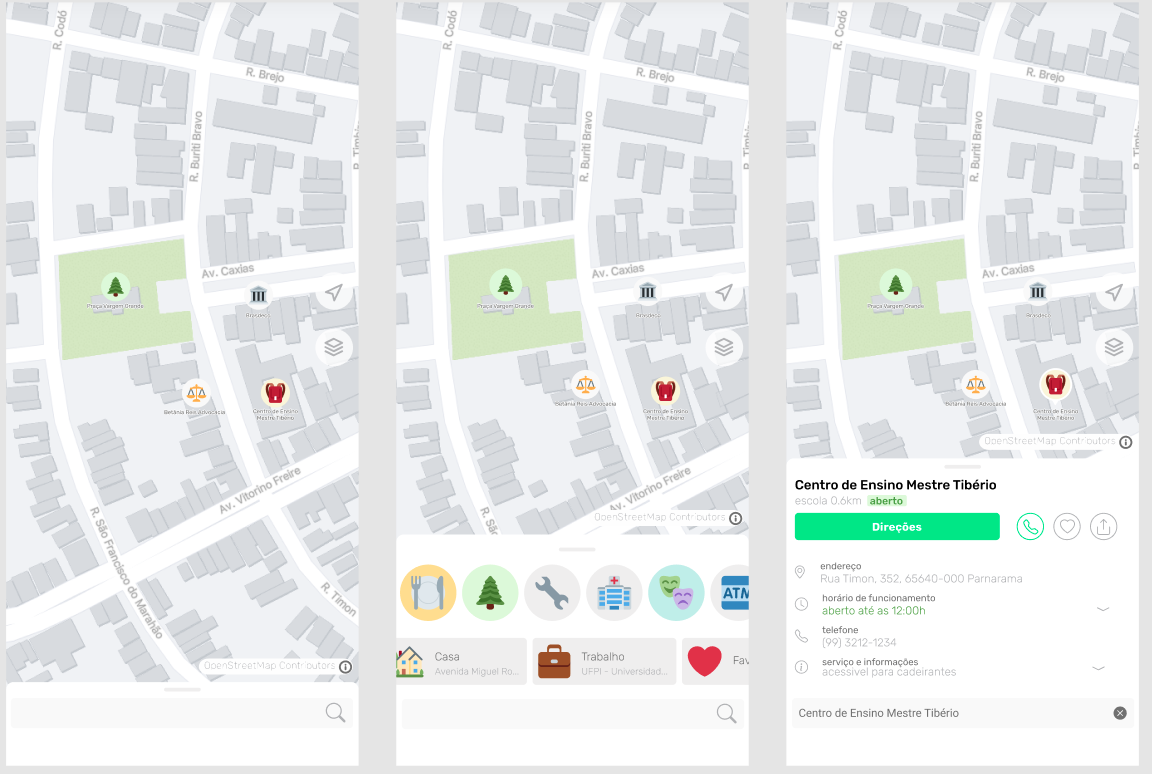
A alguns venho trabalhando no que seria um cliente ideal em que eu realmente usasse e recomendaria para meus amigos e colegas isso venho crescendo desde que eu li o artigo The Mobile Map App Part I: The Void então descidir criar um rascunho:

hermes.png

Só que para tirar essa ideia do papel eu preciso de sua ajuda, caso você tenha alguma experiencia em Flutter ou React e queria levar o OpenStreetMap a um novo patamar por favor entre em contato: [email protected]

Location: Centro, Teresina, Região Geográfica Imediata de Teresina, Região Integrada de Desenvolvimento da Grande Teresina, Região Geográfica Intermediária de Teresina, Piauí, Região Nordeste, Brasil
Posted by Gustavo22Soares on 4 September 2021 in English.

As already mentioned in the previous text OpenStreetMap is not so friendly to the common user but serves very well for cartographers, I also received many comments that OSM is not a final product but a shared knowledge base and even some comparisons with linux… But using OSM should not be difficult or depend on the rebrand from big companies, I believe that it has a way to reach the common user and win market and being opensource and still bring more mappers to the community.

For some time now I have been working on what would be an ideal client that I would really use and recommend to my friends and colleagues. This has been growing since I read the article The Mobile Map App Part I: The Void so I decided to create a draft:

hermes.png

But to get this idea off the paper I need your help, if you have some experience with Flutter or React and want to take OpenStreetMap to a new level please contact me: [email protected]

Location: Centro, Teresina, Região Geográfica Imediata de Teresina, Região Integrada de Desenvolvimento da Grande Teresina, Região Geográfica Intermediária de Teresina, Piauí, Northeast Region, Brazil
Posted by ExecutableFiles on 3 September 2021 in English.

I’ve noticed that Anchorage has several bus routes, yet only one has actually been somewhat put on the map (route 102). I’ve looked into what setting up a bus route would look like and after setting up another one halfway (route 10), I’ve figured out what needs to be done in order to complete a large project like this.

First off, Openstreetmap is not very good with creating a bus line easily, as tagging needs to be in a specific order according to the Wiki page on bus routes (the issue is currently being looked at as of now), so I think the method of mapping bus routes will be most efficient when done this way:

  1. Each bus platform/stop must be mapped and placed into a relation before any route is mapped with ways. If the ways are set up first it can be quite a pain to move the bus stops to the top afterwards. I made this mistake when setting up bus route 10 and it was not fun.
  2. After that is done, the bus routes can finally be placed down. It doesn’t matter as much if every stop in Anchorage has been mapped so long as all the bus stops on that specific line is mapped out.

This is a pretty large project that’s going to take a bit of effort, so any outside help is greatly appreciated. Also, if you’re knowledgeable in creating bus routes and you see any errors in this method or my mapping, please feel free to correct me or the issue.

Location: South Addition, Anchorage, Alaska, United States
Posted by assanges on 3 September 2021 in English. Last updated on 4 September 2021.

OpenStreetMap must not be the petri dish of political-driven nonsense

Yet here we are again, the Chinese Commies just spit on everything they thought was rightful. Yes yes, I explicitly use the term 'Commies' as gallantry since I came from 'the Taipei and environs' by their courtesies. BTW, 'Taiwan' or 'Formosa' is the place if you can't recall.

I was rather indolent to express any political views on the OpenStreetMap as it should be a site to record facts, not a place to be poisoned by political flim-flam. However, the landscape has changed too much from a niche and friendly environment to a colossal and somewhat hostile one.

OpenStreetMap is not and shalln't be the sacrifice in the political struggles

More and more Chinese mappers joined as China rises, but many rather acting irrationally and nonconstructive. These mappers can mainly be categorised into 4 major doctrines:

  1. OSM datasets exploiting: denying the existence of Xinjiang internment camps, the de facto status of Taiwan, Penghu, Kinmen and Matsu, nor the territorial dispute on the South China Sea and Pinnacle Islands;
  2. Invalid notes abusing: creating notes unrelated to data qualities and asserting Chiese political view;
  3. OSM wiki vandalising: improper editing on the page ‘Taiwan’ and clearing OSMTW community early discussions;
  4. Heavily mapping on unrealistic constructions in a foreseeing future: e.g. Beijing-Taipei Expressway, China National Highway 319 (Kaohsiung-Chengdu)

Unfortunately, all of them were never cared to listen nor discuss, while the community members try to be friendly and sagacious. Which let me rethink the need to embrace or cope with such gibberish, rather.

See full entry

Location: Liming Village, Zhongzheng District, Station Front, Taipei, Taiwan
Posted by ignaciolep on 2 September 2021 in Spanish (Español). Last updated on 13 August 2023.

Resumen: “Mapear” y “cartografiar” significan lo mismo, pero la primera es más corta y comunica el concepto de “hacer mapas” de manera más sencilla y directa. Además, “mapear” es un término aceptado por la RAE y usado en todo el mundo hispanohablante, por lo que no hay razón para evitarlo o reemplazarlo.

¿Qué verbo usas cuando quieres expresar la acción de hacer mapas? ¿Mapear o cartografiar? Esta pregunta puede parecer trivial, pero tiene su importancia en el ámbito de la traducción y la edición de mapas, especialmente en proyectos colaborativos como OpenStreetMap.

Como colaborador de traducciones “crowdsourced”, de vez en cuando me encuentro con algún traductor que reemplaza la palabra “mapear” por “cartografiar”. Esto lo hacen porque creen que “mapear” es un chilenismo o una “traducción de baja calidad” por parecerse a su versión en inglés (“to map”). Pero, ¿es realmente así?

En primer lugar, hay que aclarar que “mapear” no es un anglicismo, sino una palabra formada a partir del sustantivo “mapa” y el sufijo “-ear”, que indica acción. Esta forma de derivación es muy común en español. Por tanto, no hay nada de malo en usar “mapear” como verbo.

En segundo lugar, hay que señalar que “mapear” no es un chilenismo, sino una palabra reconocida por la Real Academia Española (RAE) y usada en todo el mundo hispanohablante. Según el Diccionario de la lengua española (DLE), “mapear” significa “hacer mapas”. Esta definición se ajusta perfectamente al ámbito de la cartografía, que según el mismo diccionario es el “arte de trazar mapas geográficos”.

Es cierto que el verbo “mapear” se incorporó al DLE en 2014, con la publicación de la 23.ª edición, y que se trató de un aporte de la Academia Chilena de la Lengua, por lo que quedó etiquetado como si fuera un término dialectal. Sin embargo, eso no significa que solo se usara en Chile ni que fuera una novedad. De hecho, hay ejemplos de uso de “mapear” en textos anteriores a 2014 y procedentes de diversos países.

See full entry

J’arrive juste de chez Google. Ouf.

J’ai beaucoup “collaboré” dans Google Maps et au décidé cet été de me degoogliser au maximum. En effet, Google a bloqué mon compte agence ads évoquant des raisons floues.

Ils ont perdu ma confiance déjà bien égratignee. En tant que mini agence web, j’évite gafam et consorts pour accompagner mes clients et amis vers des endroits plus sûrs et plus sains.

Goog. M’a fait envoyer deux mois de relevés bancaires pour qu’ils lèvent enfin l’interdiction. Ce qu’ils ont faut après deux mois, sans même envoyer un mail.

Je sais que la privacy et la protection des individus en général est ma raison de vivre (carrément).

Il en découle ce qui permet aux gens de vivre : les réseaux de distribution : data, trains, et énergie particulièrement. Surtout si c’est vert. C’est agréable de trouver des gens ouverts qui pensent un peu comme moi. Cette communauté fait beaucoup de bien à tous.

Vive le libre, vive le web, vive la vie !

Salto

Posted by Lejun on 1 September 2021 in English. Last updated on 2 September 2021.

Tag’s use

While the amenity=parking tag is used “de facto”, the amenity=parking_space micromapping oriented tag has been introduced and approved by vote on 2011-05-01. The main reason for it’s introduction is to help people, disabled or not, easily find parking spots inside parking lots without any important downside to it.

Other voted proposals introduced the parking:lane=* and parking=street_side tags and while those are quite useful (I’m still reserved concerning the first), I’d rather map parking spaces directly as those kind of parking’s capacity is generally quite low. The parking:lane proposal even adds:

Consider using parking:lane=* as a simple alternative if the streetside parking spaces are stretched over a longer section of the road and no micromapping of these areas is desired.

Ha! Which fool wouldn’t want some micromapping in its life? Micromapping is love, micromapping is but the purpose of life.

The tag is especially useful in combination with the footway=acces_aisle tag (not to be confounded with service=parking_aisle which is oriented towards vehicular routing) which is used for pedestrian routing in parking lots.

Tools

This tutorial makes use of the JOSM editor along with the BuildingsTools and Gridify plugins and the high resolution of aerial imagery in France. Some similar functions may be found on other editors that I don’t know of, feel free to try and find your own workflow in the journey for the slickest parking lot micromapping.

“Parking:orientation”

The main difficulty about mapping parking spaces comes from its typology. Up to now I have found four different kinds of geometry and I’ll go through them from the simplest to the hardest to map in my opinion. The overall pattern of those is implicit and it’s recommended to use the parking:orientation key to specify if necessary.

Straight (Parallel or perpendicular)

See full entry

Location: ZAC de Châteaufarine, Chateaufarine, Besançon, Doubs, Bourgogne – Franche-Comté, Metropolitan France, 25000, France
Posted by AngocA on 1 September 2021 in Spanish (Español). Last updated on 28 March 2022.

Este artículo hace parte de una serie de artículos que he escrito acerca de las notas. En el primero escribí sobre el contexto de las notas frente a la comunidad de OpenStreetMap, y en el segundo sobre cómo crear, ver, y cerrar las notas desde diferentes aplicaciones. Aquí están los artículos:

En este artículo explico cómo analizar las notas y si hay muchas activas en la zona de interés, poder diseñar una estrategia para cerrarlas.

Notas creadas y solucionadas por país

Comencemos con un servicio que ha creado Pascal Neis específicamente para notas. Antes de continuar es importante mencionar que Pascal ha creado una gran cantidad de herramientas para análisis de datos de OSM, lo cual facilita el trabajo o análisis de OSM desde diferentes aristas.

Con respecto a las notas, él nos ha puesto a disposición una página que permite ver las notas de cada país, discriminadas por las abiertas, las cerradas y las totales, donde además hace un cálculo de la tasa de resolución: https://resultmaps.neis-one.org/osm-notes

Esta página permite inducir cómo la comunidad de cada país está involucrada en el mapa, en la parte de resolución de notas. Además, puede dar una idea de cómo, de manera general, está la comunidad involucrada activamente en contribuir en el mapa. Se puede ver que los países con mayor cantidad de notas resueltas, y los de mejor tasa de abiertas/cerradas, son los países que tienen comunidades de colaboradores más involucradas y activas.

See full entry

Location: UPZs Localidad Teusaquillo, Localidad Teusaquillo, Bogotá, Bogotá, Distrito Capital, RAP (Especial) Central, Colombia
Posted by cquest on 31 August 2021 in French (Français). Last updated on 1 September 2021.

J’ai profité de l’été pour me (re)-lancer dans le chantier “serveurs de tuiles”.

Petits rappels

OpenStreetMap France héberge génère plusieurs fonds de carte à l’aide de ses “serveurs de tuiles”:

  • rendu “FR”, une adaptation commencé en 2012 du style OSM de l’époque, destinée à un public francophones (noms en français en priorité, icône plus parlantes en France, etc) avec des ajouts originaux (terrains de sport, etc)

  • le rendu “humanitaire” largement utilisé par HOT et disponible aussi sur openstreetmap.org

  • le rendu “CyclOSM” , le petit dernier, lui aussi disponible sur openstreetmap.fr

À cela s’ajoute aussi OpenRiverBoat, un rendu adapté à la navigation fluviale, des rendus en langues régionales, des rendus techniques.

Les trois premiers sont assez fortement utilisés et complexes. Le rendu “FR” contient par exemple 82 couches différentes parfois multiples ce qui donne au total plus de 170 couches de dessin pour arriver au rendu final avec plus de 10000 règles qui servent à décider comment représenter graphiquement tel ou tel objet.

Les outils utilisés

Le cœur est une base postgresql/postgis, qui contient les données OSM utiles à la fabrication du fond de carte et à sa mise propre mise à jour.

Les données OpenStreetMap brutes sont importées dans postgresql puis mises à jour régulièrement à l’aide d’osm2pgsql. Typiquement la base résultat occupe environ 1To.

La génération du fond de carte est faite par renderd qui utilise la librairie mapnik pour transformer les données vectorielles issues de postgresql en images en appliquant une feuille de style.

Cette feuille de style au format XML utilisée par mapnik, est générée à l’aide de kosmtik à partir un code source écrit en cartocss, une sorte de CSS adaptée à la cartographie.

See full entry

This diary explores the problems with the OSM Wiki entry for service=driveway, and why is there a need for service=driveway2. In the process, it also describes the headaches encountered while trying find a optimal solution. However, deeply entrenched opinions makes this process untenable.

Need for clear indication of classified service way type

The topic of discussion will need to begin on how OSM tags are designed in an hierarchy, which begins with initial key-value pair of highway=service, followed by classifier tags service=driveway or service=parking_aisle. Note that highway=service without any service=* does not tell the data consumer if this is simply a minor way that is un-classified (not yet assigned a classification type such as parking_aisle or alley or driveway), or if this minor way is an implicit driveway. In general, a data consumer will assume that the way is un-classified, instead of assuming that it is an implicit driveway.

The classifier issue is the first issue present in the service=driveway Wiki entry - that suggests that minor ways linking from major roads to parking_aisles should be tagged as an implicit driveway with no classifier tags.

  • This means that data consumers are unable to determine if the way segment is un-classified, or if it is indeed an implicit driveway when such minor service way connected to parking_aisles are encountered..
  • Similarly, a user whom just want to quickly add minor service roads but does not perform classification will mean that data consumers cannot identify if such ways are classified or un-classified, and therefore prevents accurate assessment if further classification is required.

Definition of driveway

See full entry

We seek your community input - please help us by sharing the Etiquette guidelines and giving input on the OSM wiki by September 8, 2021. We also have some upcoming consultation meetings to hear your views. ## Announcement

The LCCWG moderation subcommittee is holding two online public meetings about the revisions to the current Etiquette Guidelines, which are now open for public comment.

The draft guidelines are found here, with comments open to Sept 8:

Both public online meetings will be held via Big Blue Button in this room:

Two timeslots to accommodate a global audience.

Meeting #1: Thursday September 2; 1400 UTC (your time zone)

7 AM Pacific Time (US) 10 AM Eastern Time (US) 2 PM UTC 4 PM Central European Time

Meeting #2: Saturday, September 4; 06:00 UTC (your time zone)

11:00 PM Pacific Time (US; evening of Sept 3) 02:00 AM Eastern Time (US) 06:00 AM UTC 08:00 AM Central European Time 09:00 Nairobi 11:45 Kathmandu 1300 Jakarta 1400 Manila 1600 Sydney

Give input on the OSM wiki by September 8, 2021

See full details for the Etiquette and moderation process on the wiki -. The draft guidelines are found here, with comments open to Sept 8th, 2021

With thanks on behalf of the subcommittee

Location: Plainpalais, Geneva, 1205, Switzerland
Posted by messpert on 29 August 2021 in English.

I have mapped areas of Bodmin Moor especially around Minions which was originally a mining settlement. Large parts have been mined until around 1900, but it is likely that there has been mining since prehistory.

Early mining, as least medieval, was largely based on streamwork. This is described here (https://historicengland.org.uk/listing/the-list/list-entry/1020051). That describes a particularly large example near Minions. This website (https://www.aditnow.co.uk/Photo/Gonamena-Tin-Streamwork_50013/) includes some photographs.

As seen in those pictures, the ground is heavily disturbed. That case is fairly extreme. Often the area is smaller, but usually following a stream, and only a few metres deep. Frequently the ground is sandy with fine gravel, presumably from the extracted waste. Actually that is true in places at Gonamena, and it is also true of other smaller workings around Minions.

We don’t (yet) have any good tagging for these places, but I had used landuse=surface_mining which I think captures these distinctive areas quite well. Together with disused=yes. Unfortunately another mapper decide to change that tagging to landuse=quarry which is just plain wrong.

I have now changed to historic=mine (I am not keen on that) and landuse=disturbed (also not really a landuse) until someone comes up with better ways of capturing these special places. Perhaps I might change historic from mine to surface_mining.

There is a thread on [email protected] about this.

Versão em Português link

Disclaimer: All the text you read below is based on an online research aimed at the Brazilian market. survey link

It isn’t news - or shouldn’t be - that OpenStreetMap has a great value in sharing local information. It is a social impact tool for minorities and humanitarian aid policies. Despite the big efforts thousands of mappers who dedicate themselves every day to improve the maps, added to the diligent efforts by the BigTechs to promote their own services, the OSM is far from being the most ppopular map in the world. Or, at least a reference as big as its sister, Wikipedia.

A Hidden Gold Mine

Out of a group of geotech enthusiasts, the OSM is totally unknown to the general public. As we could see in the survey, about 68% of the participants had never heard about OpenStreetMap. Although most likely having had previous experiences with one of the various contact points (Tesla, SnapMap, BigMaps, Apple Maps, Facebook, Strava, Mapbox), most people still didn’t know about OpenStreetMap.

If you’re concerned about whether people see or not your work on OpenStreetMap, the answer is simple as that: Of course they do. They just don’t know where it comes from!

The main reason for this omission is that companies often try to hide our contributions in the smallest and most obscure lines of terms of service while building their own proprietary database, giving grumbs to the community. No need to name names, right?

But this isn’t an exclusive practice of large corporations. How often do apps like Maps.me, OSMAnd, OrganicMaps stop to remind their users that the data they’re using came from OpenStreetMap?

Truth is, no one wants to tell you about their Goose that laid the Golden Eggs!

Not everyone wants to map

See full entry

Location: Centro, Timon, Região Geográfica Imediata de Timon, Região Integrada de Desenvolvimento da Grande Teresina, Região Geográfica Intermediária de Caxias, Maranhão, Northeast Region, Brazil

English Version link

Disclaimer: Todo o texto que você lerá abaixo é baseado em uma pesquisa feita online voltada ao mercado Brasileiro. link para um resumo da pesquisa feita

Não é novidade - ou não deveria ser - que o OpenStreetMap tem uma grande importância no compartilhamento de informação de um local. É uma ferramenta de impacto social para minorias e políticas de ajuda humanitária. Apesar dos grandes esforços dedicados por milhares de mapeadores que se dedicam a cada dia melhorar os mapas, somado ao esforço diligente das grandes BigTechs para promover seus próprios serviços, o OSM está longe de ser o mapa mais popular do mundo. Ou, pelo menos, uma referência tão grande quanto sua irmã Wikipédia.

Uma mina de ouro escondida

Fora um grupo de afissurados em geotecnologia, o OSM é totalmente desconhecido para o publico geral. Como pudemos observar na pesquisa feita, cerca de 68% dos participantes nunca tinha ouvido falar do OpenStreetMap. Apesar de muito provavelmente já terem tido experiências prévias com um dos vários pontos de contato (Tesla, SnapMap, BigMaps, Apple Maps, Facebook, Strava, Mapbox), mesmo assim a maioria das pessoas não conheciam o OpenStreetMap.

Se você se você se preocupa se as pessoas veem seu trabalho no OpenStreetMap, a resposta é simples assim: claro que sim! Elas só não sabe de onde vem!

O principal motivo para essa omissão é que empresas frequentemente tentam esconder nossas contribuições nas linhas mais pequenas e obscuras de termos de serviço enquanto constroem sua própria base dados proprietária dando migalhas para a comunidade. Não preciso citar nomes né?

Mas isso não é uma prática exclusiva das grandes corporações, quantas vezes aplicativos como Maps.me, OSMAnd, OrganicMaps param para lembrar seus usuários que os dados que estão usando veio do OpenStreetMap?

A verdade é que ninguém quer contar sobre sua galinha dos ovos de ouro!

Nem todo mundo quer mapear

See full entry

Location: Centro, Timon, Região Geográfica Imediata de Timon, Região Integrada de Desenvolvimento da Grande Teresina, Região Geográfica Intermediária de Caxias, Maranhão, Região Nordeste, Brasil

Завершил корректировки и дополнения в части западнее реки Славянки. Теперь карта вполне точно отражает текущее состояние парка на настоящий момент. Пройдусь по восточной части долины реки Славянки и вплотную приступлю к Дворцовому району. В целом там размечено все правильно, но надо навести красоту и аккуратность и кое-что исправить и дополнить.