Posted by Reibert on 7 December 2021 in Russian (Русский).
Last updated on 31 December 2021.

Удалено.
 OpenStreetMap
Удалено.
“30 Day Map Challenge” happened over November. Remembering this from last year, I knew we were in for a bombardment of cartographic creations on the #30DayMapChallenge hashtag. Combining this with a search for “OpenStreetMap” mentions I sat back and let the mappy goodness flow into my tweetdeck for the whole month.
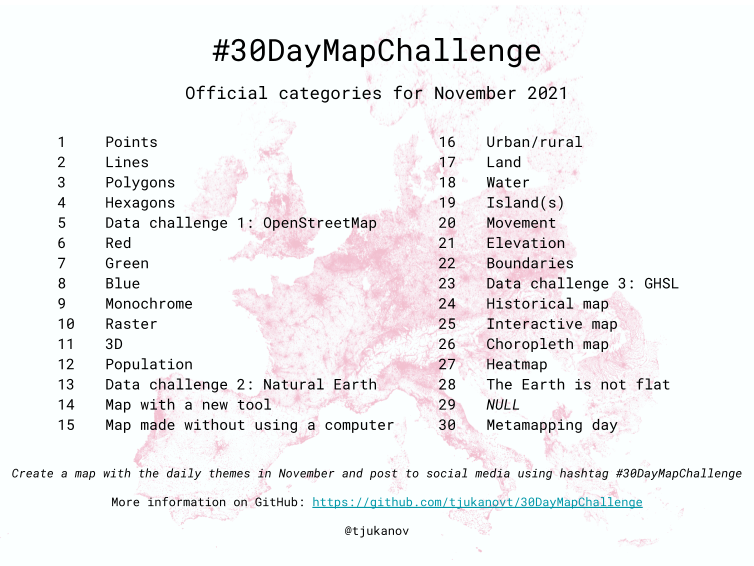
Here’s some I particularly liked:
During the State of the Map Africa 2021 conference especially on theme of leaving no one behind and underrepresented communities as well as emerging from a global pandemic, as a women I understood the importance of inclusion and equity, I got to know the role of Representing a local community in the geospatial data collection on the OSM and discovered that is no longer impossible but it easy and applicable on any achievable scare any local growing Local community can afford .
Therefore, with all the ideas speakers emphasized at the conference we fully explored the topic of Beyond mapping and Reusing Open Street Map data/FOSS4G where we were able to learn how community can make use of available Geodata for personal and institutional development.
Also taking about the free software we were able to understand further the four major advantages that come with the free software like the run, improve, share , and Study. Generally, on our side, the experience was good especially the marathon, keynotes from different speakers, panel discussions, and lightning talks were really exciting . During this conference, I came to learn about the Open Mapping Hub ESA and the roles the hub has played to expand the Mapping communities in the region through the funding of various projects like the Open Cities Project in collaboration with other international institution.
In fact what I can say is, yes we still have a lot to learn about challenges and opportunities available , as well as tools to use . but the biggest interest everyone took as a take away considering my local community members who managed to attend , is that , it is no longer impossible for women , mothers and underrepresented community youths in general .
My name is Mr. Mbunzama Narcisse an Open street Map enthusiast based in the democratic republic of Congo. I had the chance to participate in the virtual Open Street Map Africa 2021 conference.
This conference was an opportunity for me first to learn about different projects on the Open Street Map implemented across the Africa continent, I also had the chance to acquire new knowledge on Open street Mapping tools and to meet and interact with other mappers from across the continent.
The sessions, the workshops were a unique opportunity for me to better understand certain concepts and to have a great insight on open street map use in Africa, going from different fields such as the Open street Map uses in School, women active in geospatial fields, the use of JOSM to map, Open street Map in health areas and other humanitarian and environmental fields where Open street Map use hugely use.
Overall the conference went well, and it was a success. However for a virtual conference and taking into account the time of the conference, it seemed very long taking into account other realities that we sometimes have in Africa such as regular power cuts, connection problems to the Internet. Internet. It would be better for future virtual conferences to see how to reduce the time of online meetings (For example from 12:00 to 18:00 will be very easily followed than a meeting from 10:00 to 20:00) and also to directly record the sessions and upload these videos to allow participants to review it even after the conference.
Based on the State of the Map conference 2021 theme of leaving no one behind and emerging from a global pandemic, as a student I understood the important role universities play in the geospatial data collection on the OSM. Therefore, with much emphasis from speakers at the conference we fully explored the topic of Beyond mapping and Reusing Open StreetMap data/FOSS4G where we were able to learn how students and the community can make use of available Geodata for personal and institutional development. Also taking about the free software we were able to explore further the four major advantages that come with the free software like the RUN, SHARE, IMPROVE, and STUDY. Generally, on my side, the experience was great especially the marathon, keynotes from different speakers, panel discussions, and lightning talks were great. During this conference, I came to learn about the Open Mapping Hub ESA and the roles the hub has played to expand the Mapping communities in the region through the funding of various projects like the Open Cities Project in collaboration with the World Bank.
hi everyone
My name is Walter Mayeku, a postgrad urban planner and currently working as a geospatial engineer and a volunteer at the OSM Kenya working group. So initially when we were bidding to host this year’s conference all our hopes were revolving around having a physical conference you know… The interactive sessions and the entire networking platforms. Thanks to the entire SOTMA 2021 committees and the local community (OSM Kenya) for putting so much selfless efforts to see us have such a great first virtual conference. Personally I enjoyed and left enlightened because it was more that what I anticipated. If there is much I have learnt from the pitching, speeches and networking is that you can not underestimate the role of partnershipsand local government involvement in the development of bigger community based groups and projects. Listening to some of the most enlightening presentations has helped me on how to analyse existing community projects as we as a community plan to undertake bigger projects from this new phase. Thank you for making the event a success.
My name is Innocencia Sigfrid a crowd2map intern in Everywhere She Maps project where female mappers are given chance to strengthen their network and also adding underrepresented places to the map.
I had a chance to attend the online conference State of Map Africa (SotMAfrica) Which is a biannual regional conference that celebrates the culture of open mapping,open data, Geographical information system (GIS) and its impacts across Africa.
It was my first time to attend to this conference and the experience was extraordinary as I happed to gain more insights about open street map Africa and found out that Open Street Map Africa is a strong and a growing network and from this network personally I can bring a lot of positive changes in my community.
During the conference I got the chance to participate in different sessions hosted by different people, organizations, youth chapters where I learned on how they perform different projects and other activities in their community and it was during this time that I convinced my self that everything is possible when a team is well organized and have same goal to accomplish. I was inspired by all speakers but more with OMDTZ, IRDP, ENOCK who presented about beyond mapping,SHAMILLAH &CLAIR who presented about the lessons learned from building footprints import,TONNY JOHN,
My name is Angolo Salume a, a member of vision youth mapper chapter in Uganda ,first and far most i want to thank the organizers of this event it was really educative may God bless you . this was my first time to attend the state of map marathon but for the time I attended it really changed me and one of the persons who inspired me is Eric T Tamba who is a region ambassador of Tanzania , i attended his session and how he presented his projects and activities carried out in their youth chapter. I also attended the session where Christine from OSM Malawi who was talking about OSM sustainability in Malawi During the break time session i was able to interact with different people and it was amazing ,thank you for the opportunity given and would love to attend it next year again GOD BLESS everyone
During the summer, a number of wild-life sanctuaries found their way into the openstreetmap data around the area of my local knowledge. Legal provisions place a simple conditional restriction on accessing the protected areas: From November 16 up to April 30 one must not stray from tracks, well-known paths and pistes. Some days ago, I started to think about ways to add that to the data, and came up with access:conditional=only_trail_use @ (Nov 16-Apr 30). That felt pretty good human readable, Apart from a new restriction, it was very much in line with what the documentation on conditional restrictions proposes. The new value itself follows established naming conventions of documented restrictions.
Still, that seemed too little, to pitch this tagging to a consumer of openstreetmap data in close vicinity, developing an online slippy map, that sets out to highlight protected areas to the interested public, i.e. skiers and other winter sport enthusiasts. I searched for a reference implementation, that parses openstreetmap conditional restrictions, and I did not find a single one.
So I had to start from scratch: Below some lines of python, that take the (very simple) tag value from above, and find out, if the restriction applies at a certain date. In all its simplicity, there are some pitfalls worked around. For more complete coverage, it might still be wise to look for a full blown calendaring module to evaluate time constraints, and of course a full blown parser of the myriad of expressions available in conditionals.
Hi 👋, I’m Amanda McCann, I’m an current OSMF Board Member, and I’d like you to vote №1 to re-elect me to the OSMF Board. 🙂 Here’s my manifesto.
So who am I?
I’m a (craft) mapper. I’ve loved maps for a long time, and hence was drawn to OSM. I try to edit every day, and I’m doing pretty well that way. hdyc tells me I have mapped 2,700 days. For the last several years, I have mapped for 300+ days per year. I love the term “craft mapper”. I view my mapping contributors to OSM with pride, like a craftsperson of old would look at their work.
We must remember what’s important. If you don’t like maps, what are you even doing here? A board member that keeps mapping will be more aware of what most OSMers are experiencing, and will have insight into what is important, what’s easy, what’s hard, for lots of OSMers. That will make them a better OSMF Board members. OTOH I do lots of contributions which cannot be included in my OSM edit count.
I’m a hacker. I’ve been using linux for 15+ years. I’m a free software programmer. Computers & the internet are wonderful tools for the good in the world. We can use them to make our lives & our society better. You should be able to understand the computing machines around you, and to control them and make them better. In my day job I’m a regular sysadmin for the small OSM consultancy company Geofabrik, so I’ve installed lots of OpenStreetMap software & map styles. I’m pretty good at writing bash scripts, and I can write long PostgreSQL queries to work with your OSM data.
I’m a queer trans woman. I came out as trans & transitioned in mid-2021. (So you might see references to my old name, which started with “R”). Everyone in OSM has been wonderfully supportive about this. Honestly, it’s surreal how anti-climactic it has been in the OSM space. OSM is pretty cool. I founded the RainbOSM telegram group. for LGBTQ+ people & allies in OSM. I guess sometimes OSMers can adjust to a new tagging scheme quickly.
09195925282
Install Java Development Kit for ARM 64 processors. JOSM developers now recommend Azul or Bellsoft Liberica JDK’s. At the moment, I’m using the Azul build: https://www.azul.com/downloads/?package=jdk#download-openjdk
Download josm-tested.jar https://josm.openstreetmap.de/josm-tested.jar
Drag and drop josm-tested.jar into the Dock
Run JOSM!

PS: Updated recommendations for JDK
UPD April 20, 2024: The instructions are effective; however, the JOSM development team now produces a build that supports both Intel and Apple Silicon processors. Currently, I download and install JOSM using Homebrew.
Die Graphenintegrations-Plattform (GIP) enthält österreichweit eine Vielzahl an Verkehrsinfrastrukturdaten in hoher Detailliertheit. Die GIP beinhaltet Daten für alle Verkehrsformen inkl. Schiffe, U-Bahnen, Seilbahnen, Busse, KFZ, Radfahrer und Fußgänger. Die GIP ist kein fertiges Produkt, sondern wird laufend erweitert. Das betrifft sowohl Inhalt als auch Struktur.
Seit Anfang 2016 werden aktualisierte Datenauszüge der GIP als Open Goverment Data (OGD) in regelmäßigen Abständen veröffentlicht. Das Basisnetz wird in dem einfach zu verwendenden GeoPackage Format angeboten. Der detailreiche Routingexport ist nur im CSV-Format verfügbar.
Der Datenauszug „Routingexport“ ist besonders interessant, da er für das Routing in allen Verkehrsmodi die relevanten Informationen enthält. Unter anderem das routingfähige Netz, die Querschnittselements mit den Erlaubnissen und Verboten nach der StVO u.v.a.m.
Mich interessierten besonders die Daten für Radfahrer. Öfters gibt es Situationen wo die Befahrbarkeit für Radfahrer unklar ist. Beim Abwägen der Merkmale ist die behördliche Sicht natürlich auch ein Argument. Aber nicht mehr, von einer Richtigkeit gehe ich nicht aus.
SynerGIS [2] stellt eine Web-Applikation bereit, die eine kleine Auswahl der Rohdaten mit Raumbezug visualisiert. Der Datenstand wird mit Juli 2018 angegeben. Die Interpretation der Daten ist schwierig, da die Bit-Kodierungen nicht aufgelöst werden. Dennoch, eine nette App für einen ersten Blick auf die Daten.
Einige Länder-GIS [3] präsentieren auch GIP-Daten. Die GIS-Steiermark stellt z.B. bei aktivierten „Fußweg“ Lage und Typ des Nutzungsstreifens für den Langsamverkehr dar. Die Legende gibt dazu näher Auskunft. Bei der Interpretation ist Vorsicht angebracht: Typ des Nutzungsstreifen und Befahrbarkeit werden im GIP immer getrennt modelliert. Eine schmale Begleitstraße (<3 m) wird z.B. im GIP mit Typ 36 „Geh- und Radweg“ bezeichnet. Wer dort fahren darf ist damit nicht gesagt.
“Have I offended someone?”, someone asked.
If you’ve ever wondered how accurate road surface tags are in OpenStreetMap, I’ve compiled a review of the accuracy of surface tags (sealed vs unsealed) in Victoria, Australia.
There’s lots of colorful maps and tables. Spoiler alert – Thanks to amazing work by hundreds of enthusiastic mappers, OpenStreetMap’s road surface tags in Victoria are extremely accurate, and provide an invaluable resource for users who want to select routes that stick to sealed or unsealed roads and tracks.
This year I had an amazing opportunity to participate in the HOT Data Quality Intership, being chosen to participate in these twelve weeks was the best thing that happened to me this year, I felt as if all my work on OpenStreetMap was recognized at that moment. I would like to thank everyone who shared their knowledge in the trainings and also to the project coordinators Sam and Becky thank you very much!
Without a doubt it was an experience that I will take for life, I met incredible people from many different countries…
No doubt it is a unique program for OpenStreetMap mappers and helps the community to grow, giving this opportunity to inspire and support young people like me to learn more about OSM and the ecosystem around us is priceless, I imagine that like me my colleagues continued to contribute to OSM in their local communities…
Here I must emphasize the importance of programs like Data Quality Intership in being able to fund and impact local communities around the world, perhaps it would be interesting to expand the program to the mapping hubs.
The future of OSM is not in closed teams maintained by companies that often do not know the reality of what they are mapping, the future of OSM is in funding the work of young volunteers and their communities giving them the opportunity to learn and improve their skills, well structured local communities know what is missing on the map and what they want to map, they know the region better.
For the future I intend to continue to apply what I learned during these 12 weeks and help the Brazilian community, I intend to continue mapping with the projects in TaskManager, I am still planning to have a more solid base for 2022 but I intend to continue with my work mapping cities in my state.
Translated with www.DeepL.com/Translator (free version)
Esse ano tive uma oportunidade incrível de poder participar do HOT Data Quality Intership, ter sido escolhido para poder participar dessas doze semanas foi a melhor coisa que me aconteceu esse ano, eu senti como se todo meu trabalho no OpenStreetMap tivesse sido reconhecido naquele momento. Gostaria de agradecer a todos que compartilharam seus conhecimentos nos treinamentos e também para os coordenadores do projeto Sam e Becky muito obrigado!!
Sem duvida foi uma experiencia que levarei para a vida, conheci pessoas incríveis e de vários países diferentes…
Sem duvida é um programa único para mapeadores do OpenStreetMap e ajuda a comunidade a crescer, ao dar essa oportunidade de inspirar e dar suporte para que jovens como eu possam aprender mais sobre o OSM e o ecossistema em volta não tem preço, imagino que assim como eu meus colegas continuaram a contribuir para o OSM em suas comunidades locais…
Aqui devo ressaltar a importância de programas como Data Quality Intership em poder financiar e impactar as comunidades locais ao redor do mundo, talvez seria interessante expandir o programa para os hub de mapeamento. O futuro do OSM não está em equipes fechadas e mantidas por empresas que muitas vezes não conhecem a realidade do que estão mapeando, o futuro do OSM passa por financiamos o trabalho dos jovens voluntários e suas comunidades dando oportunidade de aprender e aperfeiçoar suas habilidades, comunidades locais bem estruturadas sabem o que falta no mapa e o que querem mapear, conhecem melhor a região.
Para o futuro pretendo continuar a aplicar o que eu aprendi durante essas 12 semanas e ajudar a comunidade brasileira, pretendo continuar a mapear com os projetos no TaskManager, ainda estou me planejando para ter uma base mais solida para 2022 mas pretendo continuar com meu trabalho mapeando cidades do meu estado.
My name is Michael Leo from Tanzania. As a Crowd2Map Volunteer I had the opportunity to attend the conference #StateOfMap2021, it was a unique experience where for the first time I could see many experts from various areas related to data in one place, I did not know that the mapping area was too large. I saw even Tanzanians in the conference thus made me eager to actively participate so as to see what are they doing in mapping.
Well, many sessions marked me but in particular those involving development of solutions using programming language, I hardly knew that with the knowledge I have in coding and database could do a lot of things with data, for me it was a wake-up call. It was from this awakening that I decided to explore further this area of development of solutions using data, research more about what I can do with the mapping data here in Tanzania specifically in Mwanza to help in the development. With regard to networking it was possible to create networking, for an exchange of experience in the area, where it was possible to have a view also of what I can do mapping.
Congratulations to the whole team, for the beautiful organization, was all very well organized from the sessions until the presentations made, it was very good to know that there are so many people or a united group in the area of mapping and for the development of solutions for society.
Ich hab letztens schon mein neues Tool vorgestellt, welches dabei hilft, OGD Datensätze mit Wikidata, Wikipedia Listen, Wikimedia Commons und OpenStreetMap abzugleichen.
In einem neuen Screencast hab ich beschrieben, wie man das Tool selber installiert und dann eigene Datensätze hinzufügen kann: https://www.youtube.com/watch?v=4PKUCjS2HL8
Außerdem gibt es einen neuen Datensatz: die öffentlichen Toilettenanlagen in Wien!